


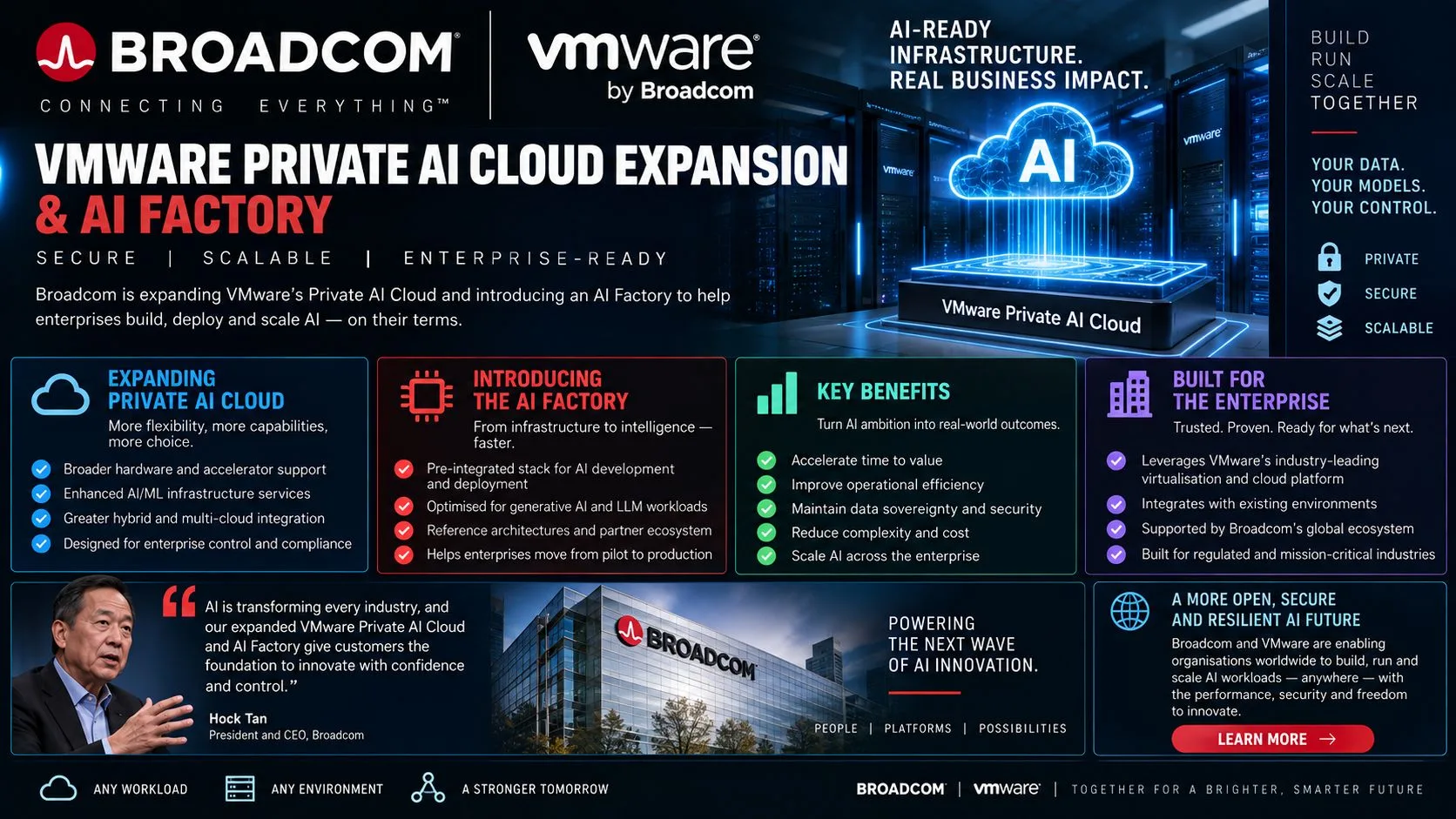
- VMware Private AI Cloud brings the AI model directly to enterprise data — eliminating the need to move sensitive data to external cloud environments.
- VMware AI Factory can compress the time from bare metal server deployment to first AI model serving from weeks down to hours.
- Enterprises can now run more than 150 open source and commercial AI models on-premises through VCF, including Nemotron 3, Gemma 4, and Qwen 3.7-Max.
- The platform addresses all three core AI cost drivers: hardware CapEx, operational complexity, and token economics — making private AI genuinely cost-competitive.
- One section covers how to evaluate whether VMware Private AI Cloud actually fits your current infrastructure — a question worth reading before your next AI budget cycle.
Broadcom just drew a clear line between enterprise AI that stays under your control and AI that doesn’t — and VMware Private AI Cloud is exactly where that line sits.
Announced at VMware Explore 2026, VMware Private AI Cloud is Broadcom’s answer to a problem that’s been quietly frustrating enterprise technology leaders for years: how do you run serious AI workloads without shipping your most sensitive data to a public cloud? Broadcom, the global semiconductor and infrastructure software company behind the VMware portfolio, built this platform to unify inference workloads, agentic AI applications, and traditional enterprise workloads on a single private cloud. For technology teams weighing their AI infrastructure options, platforms like VMware Cloud Foundation represent a meaningful shift in how enterprise AI gets deployed and governed.
Broadcom Just Changed the Game for Enterprise AI
The enterprise AI landscape has had a fundamental tension: the most powerful AI services live in public clouds, but the most sensitive enterprise data cannot go there. Broadcom’s introduction of VMware Private AI Cloud directly resolves that tension by flipping the model entirely — instead of moving data to the AI, the AI comes to the data.
VMware Private AI Cloud Brings the Model to the Data
This isn’t a subtle architectural tweak — it’s a foundational shift. Traditional public cloud AI approaches require organizations to send data outward for processing, creating exposure points that compliance teams, legal departments, and security architects consistently flag as unacceptable risks. VMware Private AI Cloud keeps everything inside the enterprise perimeter. The model runs where the data already lives, meaning data sovereignty, privacy, and regulatory compliance are addressed structurally, not bolted on as an afterthought.
What VMware AI Factory Actually Does
VMware AI Factory is the software-defined engine underneath VMware Private AI Cloud. It’s the layer that handles infrastructure automation, lifecycle management, and the operational mechanics of getting AI running in production. Think of it as the difference between having the right ingredients and actually having a working kitchen — VMware AI Factory is the kitchen.
The automation capabilities inside VMware AI Factory are specifically designed to eliminate the weeks of manual configuration that typically stand between a fresh hardware deployment and a running AI model. That compression of time isn’t incremental — it’s the difference between AI infrastructure that delivers value in hours versus one that drains engineering resources for months.
What Is VMware Private AI Cloud?
VMware Private AI Cloud is a production-ready platform for securely building, running, and governing AI at enterprise scale. It runs on VMware Cloud Foundation (VCF), Broadcom’s unified private cloud infrastructure, and it’s designed to handle inference workloads, agentic AI applications, and conventional enterprise workloads simultaneously — on one platform, not three separate ones.
One Platform for Inference, Agentic AI, and Traditional Workloads
Most enterprise environments today run AI tooling separately from their core infrastructure, which creates operational silos, duplicated costs, and fragmented governance. VMware Private AI Cloud consolidates all of this. Inference workloads — the actual serving of AI model responses — run alongside agentic applications that can reason and act autonomously, and alongside the databases, ERPs, and applications that have always lived in the private cloud. The result is a unified operational environment, not a patchwork.
Why Data Sovereignty Makes Private AI Non-Negotiable
For organizations in regulated industries — financial services, healthcare, government, legal — the question of where data goes during AI processing isn’t academic. It’s a compliance requirement. VMware Private AI Cloud addresses this by design:
- Data never leaves the enterprise’s controlled environment during AI processing
- Model inference happens on-premises, within the organization’s own security perimeter
- Governance policies apply uniformly across AI and traditional workloads on the same platform
- Organizations retain full control over which models run and what data those models can access
This architecture makes VMware Private AI Cloud particularly compelling for enterprises that have previously sat out public cloud AI adoption because the compliance math simply didn’t work.
Hardware, Model, and Accelerator Flexibility Built In
One of the more practically significant design choices in VMware Private AI Cloud is its deliberate hardware agnosticism. Enterprises aren’t locked into a single vendor’s GPU stack or a single accelerator architecture. The platform supports diverse hardware, model, and accelerator choices, which means procurement decisions can be driven by performance, cost, and availability — not platform lock-in. For instance, companies like Broadcom are continually innovating in this space.
VCF customers running VMware AI Factory have access to more than 150 open source and commercial AI models out of the box, including Nemotron 3, Gemma 4, cotomi, Qwen 3.7-Max, and GLM 5.2. That breadth of model support is significant — it means teams can select the right model for the task without being constrained by what a single cloud provider chooses to offer.
VMware AI Factory: From Bare Metal to First Model, Faster
Speed to production is where VMware AI Factory makes its most concrete case. VCF’s infrastructure automation capabilities are engineered to take a deployment from bare metal server to serving the first AI model in hours — compressing what has traditionally been a weeks-long process involving manual configuration, networking setup, driver installation, and model integration.
That timeline compression matters enormously for enterprise technology leaders who have watched AI pilot projects stall in infrastructure provisioning for months before a single inference request was ever processed. VMware AI Factory changes the operational reality of standing up AI infrastructure.
“VMware AI Factory changes that. We give customers a software-defined foundation that automates infrastructure deployment, unifies lifecycle management, and lets them choose their preferred hardware and vetted models. The result is AI infrastructure that actually makes it to production.”
— Broadcom, VMware Software Division
The zero-touch provisioning capability orchestrates end-to-end deployment of the entire stack — from hardware initialization through model readiness — without requiring manual intervention at each layer. For teams managing large-scale infrastructure, this is the kind of automation that meaningfully reduces both time-to-value and the risk of configuration errors during deployment.
How Zero-Touch Provisioning Eliminates Manual Setup
Zero-touch provisioning inside VMware AI Factory means the entire infrastructure stack — from bare metal initialization to GPU driver configuration to model serving endpoints — deploys automatically without engineers manually intervening at each step. Traditional AI infrastructure deployments require coordinating across networking teams, storage administrators, GPU configuration specialists, and model operations engineers, often across multiple weeks. VMware AI Factory collapses that coordination into a single automated workflow.
Day 2 Operations and AI Tokenomics Control
Getting to first inference is one challenge. Keeping AI infrastructure running efficiently at scale is the harder, longer-term problem. VMware AI Factory addresses Day 2 operations directly — the ongoing lifecycle management, monitoring, scaling, and optimization work that determines whether an AI deployment stays cost-effective over time.
Token economics — or tokenomics — refers to the cost-per-token dynamics that determine how expensive it is to run AI inference at scale. VMware Private AI Cloud tackles this through three specific mechanisms in VCF 9: NVMe memory tiering to reduce hardware CapEx, cluster-wide storage pooling to lower infrastructure overhead, and unified lifecycle management to reduce the operational complexity that quietly inflates AI running costs. Together, these capabilities give enterprise technology leaders meaningful levers to control AI spending rather than simply absorbing escalating token costs.
VMware Cloud Foundation as the Software-Defined Foundation
VMware Cloud Foundation is the infrastructure layer that makes all of this possible. VCF provides the software-defined compute, networking, and storage substrate that VMware AI Factory runs on top of — and critically, it’s the same foundation that enterprises are already using for their traditional private cloud workloads. That continuity means AI infrastructure doesn’t require a parallel, separate operational environment. It extends what already exists.
The Hardware Ecosystem Powering VMware AI Factory
VMware AI Factory is designed to work across a broad ecosystem of certified hardware partners, giving enterprise technology teams genuine choice in how they build out their AI-ready infrastructure. This hardware flexibility is a deliberate architectural decision — one that prevents organizations from being locked into a single vendor’s supply chain, pricing, or technology roadmap.
VCF AI ReadyNodes: Cisco, Dell, Lenovo, and Supermicro
VCF AI ReadyNodes are pre-validated, AI-ready server configurations from Broadcom’s certified hardware partners. Cisco, Dell Technologies, Lenovo, and Supermicro are among the key partners delivering ReadyNodes that are validated for VMware AI Factory deployments. These are not generic server configurations — they are purpose-tested hardware builds that have been validated to work with VCF’s automation and lifecycle management capabilities out of the box.
The practical benefit for enterprise infrastructure teams is significant. Instead of spending weeks validating hardware compatibility, configuring drivers, and testing GPU integration manually, teams can start with a ReadyNode configuration that is already proven to work within the VMware AI Factory stack. That eliminates an entire category of pre-deployment friction that has historically slowed enterprise AI infrastructure projects.
Broadcom and AMD: Instinct GPUs Meet the ROCm Ecosystem
Broadcom and AMD are actively collaborating to deliver a VMware AI Factory configuration that pairs VCF with AMD Instinct GPUs and the open AMD ROCm software ecosystem. ROCm is AMD’s open-source GPU computing platform, and its integration with VMware AI Factory gives enterprises a fully validated, end-to-end AI stack built on open software — reducing dependency on proprietary GPU software layers.
The AMD collaboration is particularly relevant for enterprises that want GPU optionality beyond a single accelerator vendor. Zero-touch provisioning within this configuration orchestrates the complete stack deployment, from GPU hardware initialization through ROCm software layers to model serving, without requiring manual configuration at the GPU software level. That degree of automation across the full hardware-software stack is a meaningful operational advantage.
Intel AI Software Suite Integration With VMware Cloud Foundation
Intel’s AI Software Suite also integrates with VMware Cloud Foundation, extending the accelerator ecosystem further and giving enterprises another validated path to running AI inference workloads on-premises. The Intel integration reflects VMware AI Factory’s broader architectural commitment — diverse accelerator support isn’t a marketing claim, it’s a design requirement that shapes how the platform is engineered.
For enterprise procurement teams, the availability of Intel, AMD, and other hardware partner options within the same VMware AI Factory framework means competitive procurement remains possible. Organizations aren’t forced into single-vendor GPU dependency to access VMware Private AI Cloud’s full capabilities.
How VMware Private AI Cloud Handles Security and Governance
Security in VMware Private AI Cloud isn’t a feature layer — it’s structural. Because inference workloads run entirely within the enterprise’s own private cloud environment, sensitive data never transits to an external system for AI processing. Governance policies that enterprises already apply to their VCF environments extend directly to AI workloads running on the same platform. Access controls, audit logging, compliance boundaries, and model governance all operate within the same unified framework that manages traditional enterprise workloads — meaning security teams aren’t learning a new system to govern AI, they’re extending existing controls to a new workload type.
What This Means for Enterprise Technology Leaders
VMware Private AI Cloud represents a genuine convergence point — the moment where private cloud infrastructure and private AI infrastructure stop being separate disciplines managed by separate teams with separate budgets. For enterprise technology leaders, this convergence has direct implications for how AI programs get funded, staffed, and scaled. The platforms, skills, and operational frameworks that enterprises have already built around VCF now extend directly into AI infrastructure, reducing the organizational activation energy required to move from AI experimentation to AI production.
Cost Predictability vs. Public Cloud AI Spending
Public cloud AI spending has a well-documented problem: it starts manageable and scales unpredictably. Token-based pricing models mean that as AI adoption grows inside an organization, costs compound in ways that are genuinely difficult to forecast. Enterprise technology leaders who approved modest AI pilots have found themselves facing infrastructure bills that bear little resemblance to what was budgeted. VMware Private AI Cloud changes the cost structure fundamentally — CapEx-based on-premises infrastructure replaces consumption-based cloud billing, making AI spending something that can actually be planned for.
VCF 9 specifically targets the three core AI cost drivers that inflate total cost of ownership: hardware CapEx through NVMe memory tiering, operational complexity through unified lifecycle management, and tokenomics through more efficient inference resource utilization. The combination gives enterprise finance and technology teams a cost model they can project forward, rather than one they discover retroactively at the end of each billing cycle. For more insights on private cloud economics, check out how Broadcom doubles down on private cloud economics.
How to Evaluate If VMware Private AI Cloud Fits Your Infrastructure
If your organization already runs VMware Cloud Foundation as its private cloud substrate, the evaluation is straightforward — VMware Private AI Cloud extends directly from your existing investment. For organizations not yet on VCF, the evaluation should center on three questions: Do you have AI workloads that involve data you cannot send to a public cloud? Do you need hardware flexibility rather than single-vendor GPU lock-in? And do you need AI and traditional workloads governed under the same security and compliance framework? If the answer to any of those is yes, VMware Private AI Cloud warrants serious architectural consideration.
The VMware Private AI Cloud Marks a New Era for Enterprise AI
- The model comes to the data — not the other way around — ending the data sovereignty compromise that public cloud AI has always required
- More than 150 open source and commercial models are available on-premises, including Nemotron 3, Gemma 4, Qwen 3.7-Max, GLM 5.2, and cotomi
- Zero-touch provisioning compresses bare metal to first model deployment from weeks to hours
- Hardware flexibility across AMD Instinct GPUs, Intel AI Software Suite, and VCF AI ReadyNodes from Cisco, Dell, Lenovo, and Supermicro eliminates accelerator lock-in
- AI workloads and traditional enterprise workloads share a single governance and security framework on VCF
- NVMe memory tiering and cluster-wide storage pooling in VCF 9 directly reduce the three core AI cost drivers: hardware CapEx, operational complexity, and tokenomics
The announcement of VMware Private AI Cloud at VMware Explore 2026 isn’t an incremental product update — it’s a redefinition of what enterprise private cloud infrastructure is expected to do. Private cloud has always been about control, security, and cost predictability. VMware Private AI Cloud extends all three of those properties into AI infrastructure, at production scale, without requiring organizations to build a parallel environment to run it. For more insights on cloud technology, check out this article on Cisco’s stock and cloud strategies.
For enterprise technology leaders, the significance is in the consolidation. The operational frameworks, security controls, hardware partnerships, and automation capabilities that VCF customers have already built now extend directly into production AI. The gap between where enterprise data lives and where AI can run on that data has closed — and it’s closed on terms that compliance teams, finance teams, and security architects can all accept. For instance, Broadcom’s recent developments in AI infrastructure highlight the importance of this consolidation.
Broadcom has positioned VMware Private AI Cloud as the inflection point where private cloud and private AI stop being separate disciplines. Based on what VMware AI Factory delivers — model access, automation depth, hardware ecosystem breadth, and tokenomics control — that positioning is accurate. Enterprise AI that is secure, scalable, and genuinely cost-effective is no longer a future state. It is what VMware Private AI Cloud is built to deliver right now.
Frequently Asked Questions
Below are answers to the most common questions technology leaders and infrastructure architects ask when evaluating Broadcom VMware Private AI Cloud and VMware AI Factory for enterprise deployment.
What is VMware Private AI Cloud and how is it different from public cloud AI?
VMware Private AI Cloud is a production-ready enterprise platform for building, running, and governing AI workloads entirely within an organization’s own private cloud environment. Unlike public cloud AI services that require sending data to an external provider for processing, VMware Private AI Cloud brings the AI model directly to where enterprise data already lives. This means sensitive data never leaves the organization’s controlled perimeter during inference, which directly addresses data sovereignty, regulatory compliance, and security requirements that make public cloud AI unworkable for many regulated industries.
What is VMware AI Factory and what problem does it solve?
VMware AI Factory is the software-defined foundation of VMware Private AI Cloud. It solves the operational problem of getting AI infrastructure from bare metal hardware to a running, production-ready AI model without weeks of manual configuration work. Through zero-touch provisioning and unified lifecycle management, VMware AI Factory automates the full infrastructure deployment stack — from hardware initialization through GPU configuration to model serving — dramatically compressing the time to first inference and reducing the engineering overhead required to manage AI infrastructure at scale on an ongoing basis.
Which hardware vendors are certified for VCF AI ReadyNodes?
VCF AI ReadyNodes are pre-validated AI-ready server configurations certified for use with VMware AI Factory. Certified hardware partners include Cisco, Dell Technologies, Lenovo, and Supermicro, among others. These ReadyNode configurations are tested and validated to work with VCF’s automation and lifecycle management capabilities out of the box, eliminating the manual hardware compatibility validation that typically adds weeks to AI infrastructure deployment projects.
Beyond the ReadyNode ecosystem, VMware AI Factory also supports GPU accelerator flexibility through validated integrations with AMD Instinct GPUs and the AMD ROCm open software ecosystem, as well as the Intel AI Software Suite. This breadth of certified hardware and accelerator options means enterprise procurement teams can make hardware decisions based on performance, cost, and availability — rather than being constrained by platform lock-in to a single accelerator vendor.
How does VMware AI Factory help manage AI tokenomics?
AI tokenomics refers to the cost dynamics of running inference at scale — specifically, the cost-per-token economics that determine how expensive it becomes to serve AI model responses as usage grows. VMware AI Factory addresses tokenomics through the capabilities built into VCF 9, including NVMe memory tiering to reduce hardware CapEx, cluster-wide storage pooling to lower infrastructure overhead, and unified lifecycle management to reduce the operational complexity that inflates running costs over time. Together, these mechanisms give enterprise technology teams active control over AI spending rather than passive exposure to escalating consumption costs.
Can VMware Private AI Cloud run agentic AI applications alongside traditional workloads?
Yes — and this is one of the platform’s most architecturally significant capabilities. VMware Private AI Cloud is designed to run inference workloads, agentic AI applications, and traditional enterprise workloads simultaneously on a single private cloud platform. Agentic AI applications — systems that can reason, plan, and act autonomously — run within the same secure, governed VCF environment as the organization’s existing databases, enterprise applications, and infrastructure workloads.
This unified architecture means agentic AI applications have direct, governed access to enterprise data without requiring data to be copied, moved, or exposed to external systems. Security policies, access controls, and compliance boundaries apply consistently across all workload types on the platform.
For organizations building toward agentic AI use cases — automated decision-making, autonomous workflow execution, multi-step reasoning applications — VMware Private AI Cloud provides the infrastructure foundation to run those workloads at production scale, with the governance controls that enterprise deployments require, without standing up a separate AI-specific infrastructure environment to do it.
If you’re ready to explore how VMware Cloud Foundation can serve as the unified platform for your enterprise’s AI and traditional workloads, Broadcom’s VMware portfolio offers a direct path from private cloud to production AI — securely, cost-effectively, and at scale.
Broadcom is making significant strides in the tech industry with its recent expansion of VMware’s private AI cloud capabilities. This strategic move aims to enhance the company’s position in the rapidly growing AI sector. By doubling down on private cloud economics and agentic AI, Broadcom is poised to offer more robust solutions to its clients. For more insights into Broadcom’s strategic initiatives, check out their VMware Explore 2026 event highlights.