


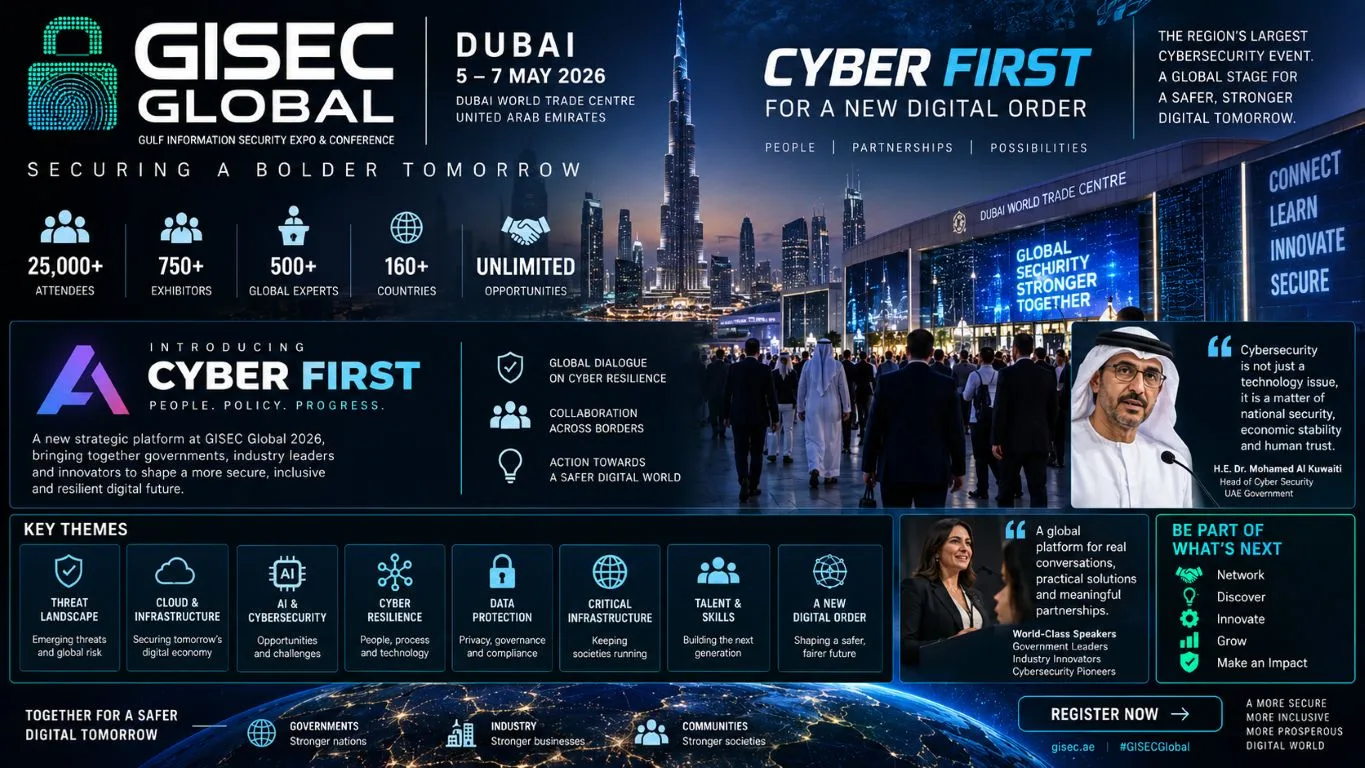
- GISEC Global 2026 runs from 16–18 September at Dubai Exhibition Centre, Expo City Dubai — the Middle East & Africa’s largest cybersecurity event is moving to a bigger stage with a bigger agenda.
- The overarching theme “Cyber First: The New Digital Order” signals a fundamental shift — cybersecurity is no longer an IT issue, it is a boardroom, government and national security priority.
- Over 25,000 cybersecurity professionals, 750+ exhibiting brands and 350+ expert speakers from 180+ countries are expected to converge in Dubai for three days of high-stakes strategy and innovation.
- AI is reshaping both attack and defense landscapes — GISEC 2026 puts artificial intelligence, quantum computing and nation-state threats at the center of its conference agenda.
- The Dubai Cyber Challenge and the School of Cyber Defense return for their second editions — keep reading to find out what new initiatives DESC is planning to unveil on the floor.
The cybersecurity world has a new headquarters for three days in September 2026, and if you lead an organisation, a nation, or a security team, you need to be paying attention.
GISEC Global 2026 is not just an industry conference — it is the point where government policy, enterprise strategy, and cutting-edge technology converge under one roof. Organised by inD, a joint venture between the Dubai World Trade Centre (DWTC) and Informa, this edition marks a significant evolution for the event, relocating to the iconic Dubai Exhibition Centre (DEC) at Expo City Dubai. For cybersecurity leaders looking to stay ahead of the curve, GISEC Global 2026 represents a rare opportunity to engage directly with the minds shaping global digital resilience.
Key Takeaways
GISEC Global 2026 Is the Cybersecurity Event You Cannot Afford to Miss
The numbers alone make the case. GISEC Global 2026 is projected to bring together more than 25,000 cybersecurity professionals, 750+ exhibiting brands, 350+ expert speakers, and participants from 180+ countries — all under one roof for just three days. That density of expertise, authority and decision-making power is unmatched anywhere in the region.
What makes this edition particularly significant is the move to Dubai Exhibition Centre, Expo City Dubai — a venue purpose-built for global-scale events and symbolic of the UAE’s ambition to lead the world’s most consequential conversations. The exhibition footprint has expanded by 20% compared to previous editions, reflecting the surging global demand for serious, solutions-oriented cybersecurity dialogue.
The Event Has Grown 20% Year-on-Year, Reflecting Surging Global Demand
Cyber threats are not shrinking — and neither is GISEC. The event’s consistent year-on-year growth mirrors the expanding attack surface facing governments and enterprises worldwide. Ransomware, AI-powered intrusions, nation-state campaigns and critical infrastructure vulnerabilities are no longer edge-case scenarios. They are the daily reality that security leaders must navigate, and GISEC has become the definitive platform to address them head-on.
Hosted and endorsed by the UAE Cyber Security Council, the Dubai Electronic Security Center (DESC), the Ministry of Interior, and Dubai Police, GISEC Global 2026 carries institutional weight that few private-sector events can match. These endorsements are not ceremonial — they signal that the outcomes of this event directly influence national policy and regional security strategy.
What “Cyber First: The New Digital Order” Actually Means
Every major event has a theme, but Cyber First is more than a slogan — it is a strategic repositioning of how the world must think about digital security. The phrase captures a fundamental truth that has taken the industry years to fully articulate: cybersecurity can no longer be treated as a downstream function of technology. It must be the starting point of every decision, every infrastructure investment, and every policy framework.
Cybersecurity Has Moved From the IT Department to the Boardroom
The days of the CISO reporting to the CTO with a quarterly update are over. Cyber risk is now firmly on the agenda of heads of state, finance ministers, and board chairs. A single ransomware attack can halt national infrastructure. A supply chain breach can cascade across entire economies. GISEC Global 2026 is built around this reality, creating programming and dialogue that speaks directly to leaders — not just technologists.
How the Cyber First Theme Reframes National and Economic Priorities
Cyber First positions digital resilience as a prerequisite for economic competitiveness, not a cost of doing business. Countries that treat cybersecurity compliance as a foundational pillar — embedding it into procurement standards, regulatory frameworks and national development strategies — are the ones building digital trust at scale. This is the lens through which every session, panel and keynote at GISEC 2026 will be framed.
For enterprise leaders, this shift has immediate practical implications. Boards are now legally and reputationally accountable for cyber resilience in many jurisdictions. Investors scrutinise cyber posture before committing capital. Regulators are mandating faster breach disclosures and stronger governance structures. GISEC 2026 gives leaders the frameworks, case studies and peer connections to meet these demands with confidence. Additionally, understanding the importance of sensitive data loss prevention is crucial for maintaining robust cybersecurity measures.
Why This Shift Matters for Every Cybersecurity Leader Right Now
If your security strategy still lives in the IT silo, GISEC Global 2026 is the forcing function you need. The conversations happening in Dubai in September 2026 will shape regulatory approaches, procurement standards and national cyber frameworks for years to come. Missing them means missing the context that will define your operating environment.
The Cyber First Leadership Summit: Where Global Power Meets Cyber Strategy
One of the most significant new additions to GISEC Global 2026 is the Cyber First Leadership Summit — a dedicated high-level forum designed specifically for ministers, heads of national cyber agencies, C-suite executives and senior government officials. This is not a panel discussion with a Q&A at the end. It is a working session where consequential decisions get shaped, especially in light of evolving cybersecurity compliance requirements.
The summit is structured around the geopolitical and strategic dimensions of cybersecurity — areas that are increasingly inseparable from traditional security discussions. Digital sovereignty, AI governance, cross-border threat intelligence sharing and the weaponisation of critical infrastructure are all on the table. These are the conversations that define how nations and organisations will navigate the next decade of digital conflict and cooperation.
Confirmed participants include some of the most influential voices in global cybersecurity. Visa’s Global CISO and the Head of the UAE Cyber Security Council are among the speakers bringing both enterprise and government perspectives to the summit stage. Their presence underscores the private-public collaboration model that GISEC has championed since its inception — and that the Cyber First theme now places at the absolute center of the event’s purpose.
Ministers, CISOs and National Cyber Authorities in One Room
The real value of the Cyber First Leadership Summit is proximity — access to the decision-makers who are actively shaping the policies and frameworks you will need to comply with, align to, or influence. Whether you are a national CISO managing a country’s cyber posture or an enterprise security leader trying to align your strategy with regulatory direction, being in that room in September 2026 is a strategic advantage that no webinar or whitepaper can replicate.
Geopolitics, AI and Digital Sovereignty on the Agenda
The Cyber First Leadership Summit agenda reflects the uncomfortable reality that cybersecurity and geopolitics are now permanently intertwined. Digital sovereignty — the right of nations to control their own data, infrastructure and digital ecosystems — has become one of the most contested battlegrounds of the 21st century. At GISEC 2026, ministers and cyber chiefs will tackle questions that go far beyond firewall configurations: Who controls critical data pipelines? How do allied nations share threat intelligence without compromising operational security? What happens when AI systems become weapons in state-level conflicts?
Confirmed Speakers Include VISA’s Global CISO and UAE Cyber Security Council Head
Having Visa’s Global CISO on the same stage as the Head of the UAE Cyber Security Council is not a coincidence — it is a deliberate signal about the kind of dialogue GISEC 2026 is engineering. Financial infrastructure is one of the most targeted sectors in the world, and the person responsible for protecting Visa’s global payment network brings a level of real-world threat intelligence and operational depth that is impossible to replicate in a classroom. Paired with the architect of the UAE’s national cyber strategy, these conversations will produce frameworks and insights that attendees can take directly back to their organisations and governments.
Why Dubai Is the Right City to Host This Conversation
Dubai is not hosting GISEC Global 2026 by default — it has earned that position. The UAE has built one of the most sophisticated national cybersecurity frameworks in the world, combining regulatory infrastructure, institutional capacity and strategic ambition in a way that few countries have matched. When global cyber leaders land in Dubai in September 2026, they are arriving in a city that does not just talk about digital resilience — it operationalises it.
UAE Cyber Security Council, DESC and Dubai Police All Endorse the Event
The institutional backing behind GISEC Global 2026 is extraordinary by any standard. The UAE Cyber Security Council, the Dubai Electronic Security Center (DESC), the Ministry of Interior and Dubai Police have all formally endorsed the event. These are not passive endorsements — they represent active participation, programming contributions and a direct line between the event’s outcomes and national policy implementation.
DESC, in particular, plays a central operational role in GISEC 2026. The Dubai Electronic Security Center is responsible for ensuring Dubai’s digital resilience across government and critical sectors, and its leadership has been explicit about using GISEC as a platform to unveil new initiatives. According to DESC’s representatives, new developments and competitive initiatives will be revealed at the event — specifically tied to their continued focus on anticipating emerging threats and strengthening Dubai’s cybersecurity ecosystem.
Dubai Police’s involvement brings a law enforcement and critical infrastructure protection dimension that adds significant depth to the event’s agenda. Cybercrime is no longer a niche division within police departments — it is a front-line operational priority. Having Dubai Police at the table means that discussions about threat response, digital forensics and criminal cyber activity will be grounded in real operational experience, not just theoretical frameworks.
The collective weight of these endorsements means that decisions made and connections forged at GISEC Global 2026 have a direct pathway into the institutions that shape UAE and regional cybersecurity policy. For attendees, that is an access point that simply does not exist anywhere else in the region.
- UAE Cyber Security Council — National policy authority overseeing the UAE’s cyber strategy and regulatory framework
- Dubai Electronic Security Center (DESC) — Operational body ensuring Dubai’s government and critical sector digital resilience
- Ministry of Interior — Brings national security and law enforcement cyber dimensions to the event’s agenda
- Dubai Police — Contributes frontline cybercrime response expertise and critical infrastructure protection perspectives
How GISEC 2026 Supports the Dubai Cyber Security Strategy and D33 Economic Agenda
Dubai’s D33 Economic Agenda sets an ambitious target of doubling the emirate’s GDP by 2033, and digital infrastructure is a foundational pillar of that plan. Cyber resilience is not a side note to economic growth in this context — it is a prerequisite. GISEC Global 2026 directly supports this agenda by creating the connections, knowledge transfer and innovation partnerships that allow Dubai to position itself as the world’s most trusted digital economy. Every exhibitor, every speaker and every policy discussion on the floor contributes to that larger strategic objective.
AI Is Both the Shield and the Weapon at GISEC 2026
No topic dominates the current cybersecurity landscape more completely than artificial intelligence — and GISEC Global 2026 treats it with the full complexity it deserves. AI is not simply a tool that defenders use to detect threats faster. It is simultaneously the most powerful capability enhancement available to attackers, enabling them to automate reconnaissance, generate convincing phishing content at scale, and identify vulnerabilities faster than any human team can patch them. GISEC 2026 puts this dual reality front and center.
87% of Organisations Say AI-Related Vulnerabilities Are the Fastest-Growing Cyber Risk
The acceleration of AI adoption across every sector has created an entirely new category of cyber risk. AI systems themselves — the models, the training data, the inference infrastructure — are now high-value targets. Adversarial attacks that manipulate AI outputs, data poisoning campaigns that corrupt training datasets, and model theft operations that extract proprietary intelligence are all active threat vectors that security teams must now defend against in addition to their existing workload.
For organisations deploying AI in operational contexts — autonomous systems, financial modelling, healthcare diagnostics — the stakes are even higher. A compromised AI model in a critical decision-making pipeline is not just a data breach; it is a systemic failure with potentially catastrophic downstream consequences. GISEC 2026’s AI-focused programming addresses this directly, giving security leaders the threat intelligence and defensive frameworks they need to deploy AI responsibly.
The offensive dimension is equally urgent. AI-powered social engineering attacks are already bypassing traditional awareness training. Deepfake audio and video are being used to impersonate executives in financial fraud schemes. Automated vulnerability scanning tools powered by large language models are dramatically reducing the time between vulnerability discovery and exploitation. These are not future threats — they are happening now, and GISEC 2026 brings together the practitioners who are actively fighting them.
Quantum Computing and Dual-Use Technologies Also on the Conference Agenda
Quantum computing represents the next existential challenge to current cryptographic infrastructure. While large-scale quantum computers capable of breaking RSA encryption are not yet operational, the timeline is compressing — and the threat of “harvest now, decrypt later” attacks means that data being encrypted today could be exposed within the decade. GISEC 2026 dedicates specific programming to post-quantum cryptography, helping organisations understand what migration to quantum-resistant algorithms actually involves in practice.
Dual-use technologies — tools and systems that have legitimate civilian applications but can be weaponised — represent another complex frontier. From commercial drone technology to open-source AI models, the line between innovation and threat vector is increasingly thin. GISEC 2026 addresses this tension directly, bringing together technologists, policymakers and security practitioners to develop frameworks for managing dual-use risk without stifling the innovation that drives economic growth.
Nation-State Threats and Critical Infrastructure Resilience Take Centre Stage
Nation-state cyber operations have fundamentally changed the risk calculus for critical infrastructure operators. Power grids, water systems, financial networks, and telecommunications infrastructure are now active targets in geopolitical conflicts — and the attacks are increasingly sophisticated, patient and difficult to attribute. GISEC 2026 dedicates significant programming to this threat category, recognising that it represents the highest-consequence scenario for governments and enterprises alike.
Critical infrastructure resilience requires a fundamentally different approach to security than traditional enterprise defence. Operational technology (OT) environments — the industrial control systems that run power plants, water treatment facilities and manufacturing lines — were designed for reliability and longevity, not security. Many of these systems are decades old, cannot be easily patched, and were never intended to be connected to internet-facing networks. Yet they increasingly are, creating massive exposure that nation-state actors are actively mapping and exploiting.
The GISEC 2026 agenda brings together the OT security specialists, government officials and critical infrastructure operators who are on the front lines of this challenge. The sessions are designed to produce actionable outcomes — not just awareness of the problem, but specific frameworks for segmentation, monitoring and incident response in OT environments that security leaders can implement immediately after the event. For more insights on recent security updates, check out the July 2026 Patch Tuesday where Microsoft addressed numerous vulnerabilities.
- OT/IT convergence security — Protecting industrial control systems as they connect to enterprise networks
- Threat intelligence sharing — Cross-sector and cross-border frameworks for real-time attack data exchange
- Incident response for critical systems — Playbooks designed specifically for infrastructure environments where downtime is not an option
- Attribution and deterrence — How governments and organisations respond to confirmed nation-state attacks
- Supply chain security — Protecting the hardware and software pipelines that critical infrastructure depends on
What Attendees Can Expect on the Exhibition Floor
The GISEC Global 2026 exhibition floor is where strategy meets product — and with a 20% larger footprint than previous editions, it is the most expansive showcase of cybersecurity innovation the Middle East and Africa has ever hosted. More than 750 exhibiting brands will be demonstrating everything from next-generation endpoint detection platforms to zero-trust architecture solutions, AI-powered threat intelligence tools and post-quantum cryptography implementations. For security leaders evaluating their technology stack, the floor provides a compressed, high-density environment to assess, compare and engage with vendors across every security domain simultaneously.
750+ Exhibiting Brands Across a 20% Larger Exhibition Footprint
The exhibition floor at GISEC Global 2026 is not a trade show in the traditional sense — it is a living map of where cybersecurity is heading. With more than 750 exhibiting brands spread across a footprint 20% larger than any previous edition, the floor gives security leaders unparalleled access to the tools, platforms and services that will define defensive capability over the next three to five years. From AI-native security operations platforms to hardware security modules built for post-quantum environments, the breadth of innovation on display reflects the full complexity of today’s threat landscape.
What makes the GISEC exhibition floor particularly valuable for decision-makers is the concentration of vendor expertise in one place. Procurement cycles that typically take months of research, RFI processes and vendor meetings can be dramatically compressed when you can walk from a next-generation SIEM demonstration directly into a conversation with a zero-trust architecture specialist and then into a live OT security platform showcase — all within the same afternoon. For CISOs and security architects evaluating their technology roadmap, this density of expertise is genuinely irreplaceable.
The Dubai Cyber Challenge and School of Cyber Defense Return for Second Editions
Two of the most distinctive elements of GISEC Global return for their second editions in 2026 — and DESC has indicated that both will feature new initiatives and developments that go beyond what was delivered in their debut years. The Dubai Cyber Challenge is a high-stakes competitive platform that tests the skills of the region’s most talented cybersecurity practitioners across real-world attack and defense scenarios. It is not a theoretical exercise — participants engage with live systems, simulated breach environments and time-pressured incident response challenges that mirror the actual conditions under which security teams operate.
The School of Cyber Defense represents the longer-term investment in human capability that the cybersecurity industry desperately needs. Talent shortage is one of the most acute structural problems facing the sector globally, and the School of Cyber Defense addresses it directly by creating an intensive, practitioner-led learning environment within the event itself. Participants leave not just with connections and conference notes, but with tangible skills upgrades and a clearer pathway into the cybersecurity workforce. DESC’s commitment to expanding both initiatives in 2026 signals that these programmes are producing measurable results — and that the ambition behind them is only growing.
GISEC Global 2026 Is a Defining Moment for the Cybersecurity Community
GISEC Global 2026 arrives at a moment when the stakes of getting cybersecurity wrong have never been higher — and when the community of leaders capable of getting it right has never been more urgently needed. The move to Dubai Exhibition Centre, Expo City Dubai, the introduction of the Cyber First Leadership Summit, the expanded exhibition floor, and the return of the Dubai Cyber Challenge and School of Cyber Defense all point in the same direction: this is an event that has matured into a genuinely critical infrastructure of the global cybersecurity ecosystem itself.
If you lead a security team, a government agency, or an organisation that depends on digital infrastructure — which in 2026 means virtually every organisation on earth — the conversations happening in Dubai from 16 to 18 September 2026 will shape the environment you operate in for years to come. The question is not whether those conversations matter. It is whether you will be in the room when they happen.
Frequently Asked Questions
When and Where Is GISEC Global 2026 Taking Place?
GISEC Global 2026 takes place from 16 to 18 September 2026 at the Dubai Exhibition Centre (DEC), Expo City Dubai. This marks a significant venue upgrade from previous editions, with the iconic Expo City location providing a larger and more purpose-built environment for the event’s expanded scale. Dubai Exhibition Centre is one of the most technologically advanced event facilities in the world, making it an appropriate setting for a conference of this calibre.
Who Should Attend GISEC Global 2026?
GISEC Global 2026 is designed for anyone whose work intersects with cybersecurity at a strategic, operational or technical level. The event explicitly caters to a wide spectrum of professionals — from national cyber chiefs and government ministers to enterprise CISOs, security architects, threat intelligence analysts, compliance officers and technology vendors.
If you are responsible for protecting digital infrastructure, setting cyber policy, building security products, or making investment decisions that affect organisational resilience, GISEC 2026 has programming, connections and insights specifically relevant to your role. The Cyber First Leadership Summit targets senior government and C-suite leaders, while the exhibition floor and technical conference tracks serve practitioners at every level of the security function.
What Is the Cyber First Leadership Summit?
The Cyber First Leadership Summit is a dedicated high-level forum within GISEC Global 2026, specifically designed for ministers, heads of national cyber authorities, C-suite executives and senior government officials. It is structured around the strategic and geopolitical dimensions of cybersecurity — topics including digital sovereignty, AI governance in national security contexts, cross-border threat intelligence frameworks and the protection of critical infrastructure from nation-state attacks.
The Summit is not a passive conference format. It is designed to facilitate working dialogue between the decision-makers who are actively shaping the policies, frameworks and strategies that will govern digital security over the next decade. Confirmed participants include high-profile figures such as Visa’s Global CISO and the Head of the UAE Cyber Security Council, ensuring that both enterprise and government perspectives are represented at the highest level.
- Target audience: Ministers, national cyber chiefs, CISOs, board-level executives and senior government officials
- Core topics: Digital sovereignty, AI in national security, geopolitical cyber risk, critical infrastructure resilience
- Format: Strategic dialogue sessions designed to produce actionable frameworks, not just awareness
- Confirmed speakers: Visa Global CISO, Head of UAE Cyber Security Council, and additional senior figures across government and enterprise
- Strategic value: Direct access to the decision-makers shaping the regulatory and policy environment you operate within
For security leaders who need to align their organisational strategy with the direction of national and international cyber policy, participation in the Cyber First Leadership Summit is one of the highest-leverage investments of time available in the 2026 calendar.
How Has GISEC Global Grown Since Its First Edition?
GISEC Global has experienced consistent year-on-year growth that mirrors the expanding global demand for serious, high-level cybersecurity dialogue. The 2026 edition represents the most significant single-year expansion in the event’s history — a 20% larger exhibition footprint, a new venue capable of hosting the event’s growing scale, the introduction of the Cyber First Leadership Summit as a standalone strategic forum, and the return and expansion of the Dubai Cyber Challenge and School of Cyber Defense programmes. The growth from a regional trade event to a genuinely global platform with participants from 180+ countries and institutional endorsement from the UAE’s most senior cyber authorities reflects both the quality of the event and the urgency of the issues it addresses.
How Do I Register for GISEC Global 2026?
Visitor registration for GISEC Global 2026 is available through the official GISEC website, where free visitor passes can be obtained. Organisations interested in exhibiting or sponsoring the event can submit enquiries through the exhibition booking portal on the same platform. Given the projected attendance of more than 25,000 cybersecurity professionals and the expanded scale of the 2026 edition, early registration is strongly recommended to secure access to preferred sessions, the Cyber First Leadership Summit and exhibition floor features.
For organisations evaluating whether to send a team or secure an exhibition stand, the return on investment case is straightforward: three days in Dubai in September 2026 will deliver more relevant connections, intelligence and strategic insight than most organisations accumulate across an entire year of industry engagement. The concentration of government officials, enterprise security leaders, technology innovators and policy architects in one place — with the institutional backing of the UAE Cyber Security Council, DESC, the Ministry of Interior and Dubai Police — creates conditions for the kind of high-stakes dialogue that genuinely moves the needle on global cyber resilience.
As the digital landscape continues to evolve, organizations are increasingly focusing on robust security measures to protect sensitive data. One essential aspect of this is data loss prevention solutions, which help prevent unauthorized access and data breaches. By implementing these solutions, companies can safeguard their critical information and maintain compliance with industry regulations.