


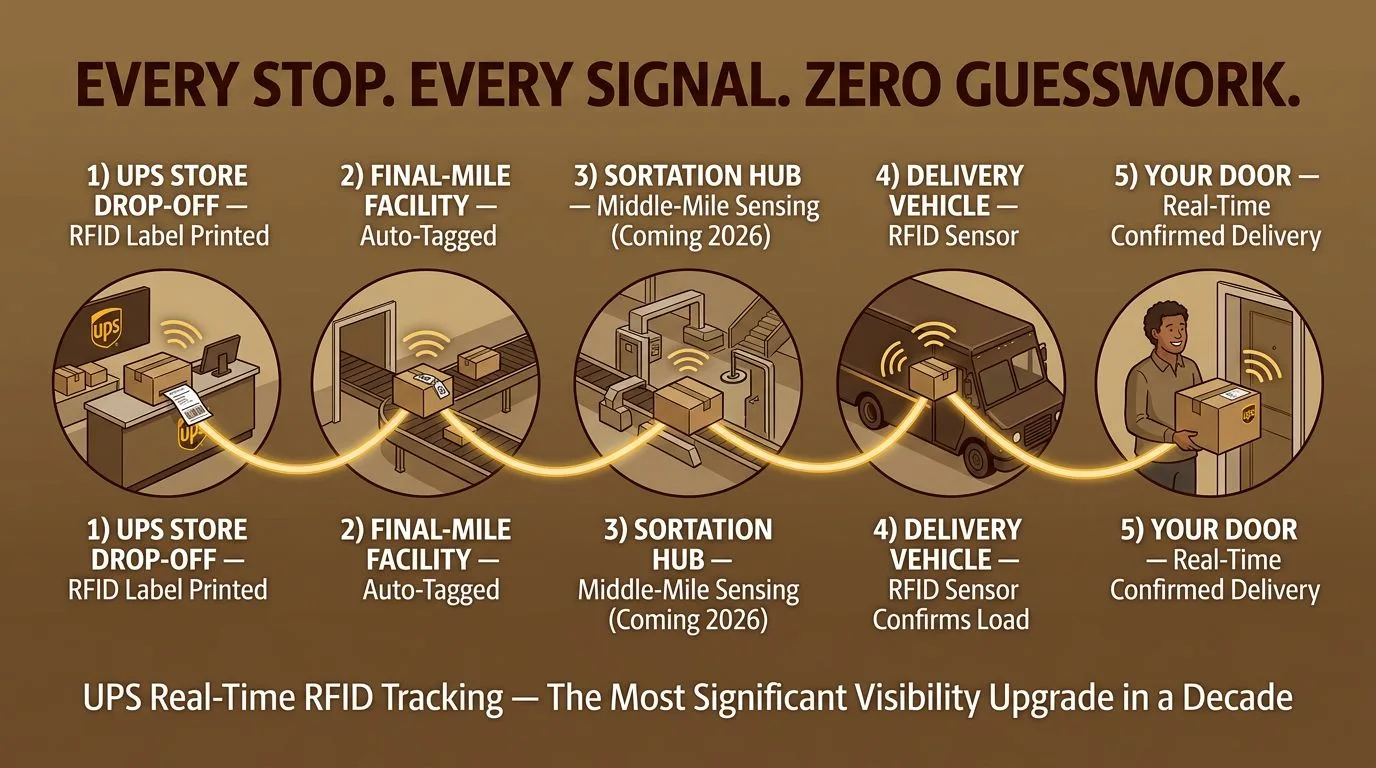
- UPS is replacing 20 million manual barcode scans per day with RFID sensing technology — the largest rollout of its kind by any major logistics carrier.
- The upgrade is backed by a $100 million investment to embed RFID readers and smart labels across UPS’s entire U.S. logistics network.
- RFID tags embedded in package labels automatically trigger wrong-truck alerts, catching misrouting errors before they cause delivery failures.
- This shift delivers real-time shipment visibility from pickup to delivery — giving businesses cleaner data and fewer surprises in their supply chain.
- Keep reading to find out what logistics teams should do right now to take full advantage of this network-wide change.
UPS Just Changed How 20 Million Daily Scans Work
UPS just made the biggest change to package tracking in over a decade — and if your business ships anything through their network, you need to understand what changed and why it matters.
On April 14, 2026, UPS announced it would roll out Radio Frequency Identification (RFID) sensing technology across its entire U.S. logistics network. The company confirmed it has already invested more than $100 million into the infrastructure required to make this happen. According to UPS, this eliminates approximately 20 million manual barcode scans every single day — replacing a slow, labor-intensive process with automated, near-instant package detection. UPS also confirmed it is the first major logistics provider to deploy RFID at this scale across a national network.
Matt Guffey, UPS Executive Vice President and Chief Commercial and Strategy Officer, described it directly:
“This is the most significant visibility upgrade in the history of our network — enabling precise tracking, faster insights, a smarter network and smarter packages.”
That’s not marketing language. That’s a fundamental infrastructure shift that touches every package, every truck, and every loading bay in their system. For businesses managing supply chains, this is the kind of operational change that quietly improves your delivery reliability without you having to do anything differently — but understanding it helps you use it smarter.
What Is RFID and Why It Replaces Barcodes
RFID stands for Radio Frequency Identification. It uses radio waves to read and capture data stored on a tag attached to a package — without any line-of-sight or manual scanning required. Think of it as the difference between a cashier scanning each grocery item one by one versus a smart cart that reads everything in the basket simultaneously as you walk out.
How Barcode Scanning Actually Worked Before
UPS’s previous system relied on manual barcode scans at each checkpoint. A worker would physically aim a handheld scanner at the label on each package to log its location in the system. This process happened millions of times per day across sorting facilities, loading docks, and delivery vehicles. While functional, it introduced friction — missed scans, human error, and gaps in tracking data that could leave businesses without accurate shipment status updates.
How RFID Reads Packages Without Manual Scans
With RFID, the process becomes passive and automatic. RFID tags are now embedded directly into UPS package labels. As packages move through facilities or are loaded onto vehicles, fixed RFID readers installed throughout the network detect and log each tag automatically. No one needs to stop, aim, or scan. The system reads multiple packages simultaneously, in real time, as they pass through sensor zones.
Why RFID Is More Accurate Than Barcodes
Barcodes require a clear line of sight and a deliberate manual action. If a package is turned the wrong way, stacked under others, or simply missed in a high-volume facility, that scan never happens. RFID eliminates that dependency entirely. Radio signals pass through cardboard, plastic wrap, and even moderate obstructions — meaning a package doesn’t need to be perfectly positioned to be detected and logged. The result is a more complete, more reliable data trail for every shipment moving through the UPS network.
The $100 Million Investment Behind the Upgrade
A $100 million infrastructure investment is not a pilot program. This is UPS committing at the network level to a permanent, system-wide technology replacement — and that scale matters for businesses relying on their service.
What the Investment Covers Across the UPS Network
The investment funds the full buildout required to make RFID work at national scale. This includes:
- RFID reader hardware installed at sorting hubs, loading bays, and transfer points throughout the U.S. network
- Smart RFID-embedded package labels that replace traditional printed barcodes
- Backend data infrastructure to process, route, and act on the real-time information captured by RFID sensors
- Integration with UPS’s existing tracking and logistics management platforms
UPS has also indicated that spending will continue beyond the initial $100 million, signaling that this rollout is ongoing rather than complete. The infrastructure being built now is designed to scale as package volumes grow and as the technology is extended further across their operations.
Where RFID Technology Is Being Installed
The RFID rollout targets the entire U.S. logistics network — which means sensors are being embedded at the facilities and vehicle entry points where the highest package volumes flow. Loading bays, conveyor systems, and the entry points of UPS delivery vehicles are all becoming RFID-enabled zones. When a driver loads packages onto a truck, the RFID sensors at the vehicle’s entry point log every package going in — and flag instantly if something doesn’t belong.
How the New UPS Tracking System Works End-to-End
The mechanics of UPS’s RFID system are straightforward, but the impact on package visibility is dramatic. Every stage of a shipment’s journey — from the moment a driver picks it up to the second it arrives at a business’s loading dock — is now captured automatically, without a single manual scan.
What makes this system powerful is not just the technology itself, but how it connects each touchpoint in the delivery chain into one continuous, real-time data stream. Gaps that previously existed between scans are now filled in automatically, giving shippers and recipients a far more accurate picture of exactly where their package is at any given moment.
RFID Tags Embedded Directly Into Package Labels
The RFID tag is embedded directly into the shipping label applied to every UPS package. This means no additional hardware, stickers, or separate tags need to be applied by the sender. The label itself becomes the tracking device. Each tag contains a unique identifier tied to the shipment record, which is read automatically every time the package passes through an RFID-enabled zone in the network.
This label-embedded approach is critical for scaling the technology across billions of annual shipments. It keeps the process identical to what shippers already do — print a label, apply it, hand it to UPS — while the intelligence happens invisibly inside the label itself. Businesses shipping through UPS don’t need to change a single step in their packaging process to benefit from the upgrade.
How Wrong-Truck Alerts Are Automatically Triggered
One of the most operationally significant features of the new system is automatic misrouting detection. When packages are loaded onto a UPS delivery vehicle, RFID sensors at the vehicle’s entry point read every tag passing through. If a package is assigned to a different route or destination facility, the system flags it immediately — before the truck leaves the facility. This technology is similar to cutting-edge tech being trialed in other sectors.
This is a fundamental shift from the old model, where a misrouted package might not be identified until it arrived at the wrong destination. Under the RFID system, the alert fires at the point of loading, giving facility staff the chance to pull the package and place it on the correct vehicle before any delay occurs. For businesses shipping time-sensitive inventory or high-value goods, this single feature alone represents a meaningful reduction in delivery failure risk.
Real-Time Visibility From Pickup to Delivery
The RFID system confirms UPS has possession of a package at the moment of pickup — not after it arrives at a sorting facility. This closes a visibility gap that previously left shippers uncertain whether a package had actually entered the network after a driver collected it. From that first confirmation, the package is tracked continuously as it moves through each RFID-enabled checkpoint in the network.
For businesses managing customer expectations, this level of granularity changes the conversation. Instead of approximate status updates tied to manual scans, the data flowing through UPS’s system becomes more precise and more frequent. Downstream, this means better estimated delivery windows, faster exception identification, and less time spent investigating where a shipment actually is.
How Loading Bays and Vehicles Use RFID Sensors
Fixed RFID readers are installed at loading bay entry points throughout UPS’s hub and spoke network. As packages move along conveyor systems or are carried through bay doors, the readers capture tag data without slowing the flow of packages. The same sensor architecture extends to delivery vehicles, where readers positioned at the cargo entry point log every package loaded onto the truck.
This creates a digital manifest for each vehicle that is built automatically in real time — not compiled manually after the fact. If the manifest doesn’t match what’s physically on the truck, the system knows. This level of automated verification is what allows UPS to replace 20 million manual scans per day without sacrificing — and in fact improving — the accuracy of their tracking data.
What This Means for Logistics Professionals
For anyone managing shipping operations, procurement, or supply chain functions at a business, UPS’s RFID rollout is not just a carrier infrastructure story — it’s a direct improvement to the data quality you’ll receive on every shipment you send through their network. Better data means better decisions, fewer escalations, and more reliable planning.
- Fewer tracking gaps: Automated RFID reads replace missed manual scans, giving you a more complete shipment history for every package
- Earlier exception alerts: Misrouting is caught at the loading stage, not after a late delivery is already affecting your customer
- More accurate ETAs: Continuous real-time data allows UPS systems to generate tighter, more reliable delivery window estimates
- Reduced investigation time: When a shipment issue does occur, the detailed RFID event log makes it faster to pinpoint exactly where and when the problem happened
- Stronger carrier accountability: Automatic pickup confirmation means you have a verified timestamp the moment UPS takes possession of your shipment
These improvements don’t require any action on the shipper’s side. They flow directly from UPS’s infrastructure upgrade into the tracking data your team already monitors. However, logistics professionals who understand what the system can do are better positioned to use that data strategically — rather than reactively.
Businesses that ship high volumes or manage complex fulfillment operations will feel the impact most immediately. The compounding effect of fewer misroutes, faster exception identification, and more accurate delivery data adds up to measurable improvements in on-time delivery rates and customer satisfaction scores over time. For more insights on how technology is shaping industries, explore AI-driven trends in cybersecurity.
Faster, Cleaner Data Across Your Supply Chain
The data quality improvement driven by RFID is not incremental — it’s structural. Manual scanning systems produce data that is only as good as the consistency of the workers performing those scans. RFID removes that variable entirely. Every read is automatic, timestamped, and tied directly to the package’s unique identifier without the possibility of a scan being skipped, misread, or logged against the wrong shipment.
For supply chain teams integrating UPS tracking data into warehouse management systems, ERP platforms, or customer-facing delivery portals, this means the incoming data stream becomes significantly more reliable. Fewer null events, fewer status anomalies, and fewer cases where a package shows no movement simply because a scan was missed.
What changes for your data pipeline with RFID-based tracking:
Data Point Barcode System RFID System Pickup Confirmation Logged at first facility scan Confirmed at moment of driver pickup In-Transit Updates Only at manual scan checkpoints At every RFID-enabled touchpoint automatically Misroute Detection Identified at wrong destination Flagged at point of loading before departure Data Completeness Subject to human error and missed scans Automated, consistent, no manual intervention Exception Response Time After delivery failure occurs Before the truck leaves the facility
For logistics teams that measure carrier performance internally, this data upgrade also strengthens the accuracy of those metrics. On-time performance tracking, exception rates, and carrier scorecards all become more meaningful when the underlying tracking data is complete and reliable rather than riddled with scan gaps. This is similar to how cutting-edge technology can enhance training and operational efficiency in other sectors.
Fewer Misrouted Shipments and Operational Errors
The core problem RFID solves: In a manual scanning environment, a package loaded onto the wrong truck may not be flagged until it arrives at the wrong facility — often hours later and sometimes not until a delivery attempt fails. The RFID system catches this at the loading dock, in real time, before the truck moves. This technology advancement is akin to AI innovations in cybersecurity, where real-time detection is crucial.
Misrouted shipments are one of the most disruptive and costly failure modes in parcel logistics. When a package ends up on the wrong vehicle or routes through the wrong hub, the downstream effects cascade quickly — missed delivery windows, customer escalations, replacement shipments, and the operational cost of recovering the misrouted package. The RFID system’s automatic wrong-truck alert capability directly attacks this failure mode at its source.
For businesses shipping to tight fulfillment deadlines — retail restocking, manufacturing components, time-sensitive B2B deliveries — even a single misrouted package can trigger a chain of downstream disruptions. The ability of UPS’s new system to catch and correct routing errors before a truck leaves the facility represents a meaningful reduction in that risk, particularly at high-volume shipping periods like peak season when manual error rates historically rise.
UPS Is the First Major Carrier to Do This at Scale
UPS isn’t just upgrading its own operations — it’s setting a new standard for the entire logistics industry. No other major parcel carrier has deployed RFID sensing technology across a national network at this scale. That distinction matters because it signals where the industry is heading, and UPS is building the infrastructure lead right now.
The competitive gap this creates is significant. While other carriers still rely on manual barcode scanning systems at key checkpoints, UPS is operating with automated, continuous package detection at every stage of the delivery chain. For businesses evaluating carrier performance and reliability, this is a real differentiator — not just a marketing claim. The data quality, exception response time, and tracking accuracy that RFID enables simply cannot be replicated by a manual scanning system, regardless of how well it is operated.
UPS’s position as the first mover at this scale also means they are accumulating operational learning that competitors will take years to replicate. The network effects of running billions of packages through an RFID-enabled system generate data insights, routing optimizations, and exception pattern recognition that compound over time. For logistics teams choosing or evaluating their primary carrier relationships, that compounding advantage is worth factoring into the decision.
What Logistics Teams Should Do Right Now
The UPS RFID upgrade is live and expanding — which means the time to align your internal processes with what the system can now deliver is now, not later. Start by reviewing how your team currently monitors UPS shipment data. If you are only checking tracking at major milestones, you are leaving real-time visibility on the table. Work with your logistics platform or TMS provider to ensure you are ingesting the full tracking event stream from UPS, not just summarized status updates. For high-volume shippers, revisit your carrier performance scorecards to account for the improved data completeness the RFID system provides — your historical benchmarks may no longer reflect what the network is actually capable of delivering. And if you manage customer-facing delivery communications, this is the right moment to tighten your estimated delivery messaging, because the underlying data feeding those estimates just got significantly more accurate.
Frequently Asked Questions
Businesses and logistics teams are asking sharp questions about what the UPS RFID rollout actually means in practice. The answers below cut through the technical noise and focus on what matters operationally.
If your team manages shipping at any volume, understanding how this system works — and how it differs from what came before — will help you use the improved tracking data more effectively and set the right expectations internally and with your customers.
What is RFID technology in UPS shipment tracking?
RFID, or Radio Frequency Identification, is a technology that uses radio waves to automatically read and capture data from a tag embedded in a package label — without any manual scanning required. In UPS’s new system, every package label contains an RFID tag with a unique identifier. As packages move through RFID-enabled zones in UPS facilities and vehicles, fixed readers automatically detect and log each package in real time, building a continuous, automated tracking record for every shipment in the network.
How does RFID improve package tracking over barcodes?
Barcode scanning requires a worker to physically aim a scanner at each package label, one at a time, with a clear line of sight. If a package is turned the wrong way, buried under others, or simply missed in a high-volume facility, that scan never happens — and the tracking record has a gap. RFID eliminates every one of those failure points.
RFID readers detect tags automatically as packages pass through sensor zones, regardless of orientation or position. Multiple packages can be read simultaneously. No worker needs to stop and scan. The result is a tracking record that is more complete, more consistent, and captured in real time rather than only at manual checkpoint intervals.
The practical impact for businesses is measurable. Fewer tracking gaps mean fewer customer service inquiries about shipment status. Faster exception detection means misrouted packages are caught before they cause delivery failures. And automatic pickup confirmation means you have verified proof the moment UPS takes possession of your shipment — not hours later when it first arrives at a sorting facility. For instance, cutting-edge technology is being trialed to enhance operational efficiency in various sectors.
- No line-of-sight required: RFID reads through cardboard, wrap, and stacked packages without repositioning
- Simultaneous reads: Multiple packages logged at once as they pass through sensor zones
- Automatic pickup confirmation: Shipment enters the tracking record at the moment of driver pickup
- Wrong-truck alerts: Misrouting flagged at the loading dock before the vehicle departs
- No missed scans: Automated reads replace the human consistency variable entirely
How much has UPS invested in its RFID tracking upgrade?
UPS has invested more than $100 million to date in building out the RFID infrastructure across its U.S. logistics network. The company has also indicated that spending will continue beyond this initial figure, confirming that the rollout is ongoing and the infrastructure investment is not yet complete. This level of capital commitment reflects a permanent, network-wide technology replacement — not a regional pilot or limited trial.
Will UPS customers see real-time tracking updates with the new system?
Yes. The RFID system generates tracking events automatically at every RFID-enabled touchpoint throughout the network — from pickup confirmation through sorting facilities, loading bays, and onto delivery vehicles. Because these reads happen continuously and automatically rather than only at manual scan checkpoints, the tracking data available to customers and businesses becomes more granular and more frequent than what the previous barcode system produced.
For businesses using UPS tracking data within their own platforms — whether through a transportation management system, an ERP integration, or a customer-facing delivery portal — this means a richer, more complete event stream to work with. Estimated delivery windows benefit from more precise in-transit data, and exception alerts surface faster because the system identifies problems at the point they occur rather than after the fact. In related news, cutting-edge technology is being trialed to enhance operational efficiency.
Is UPS the first major shipping carrier to use RFID at this scale?
Yes. UPS has confirmed it is the first major logistics provider to roll out RFID sensing technology across an entire national network at this scale. While RFID technology itself is not new — it has been used in retail inventory management, access control, and specialized logistics applications for years — no other major parcel carrier has deployed it network-wide across billions of annual shipments in the way UPS is now doing.
This first-mover position gives UPS a meaningful operational and data advantage over competitors who still rely on manual barcode scanning. The gap in tracking accuracy, exception response speed, and data completeness between an RFID-enabled network and a barcode-dependent one is not marginal — it is structural. Competitors would need to match both the capital investment and the network buildout timeline UPS has already committed to in order to close that gap.
For businesses managing carrier relationships and evaluating shipping partnerships, UPS’s network-wide RFID deployment is the kind of infrastructure differentiator that has long-term implications for delivery reliability and supply chain data quality. It is not a feature that can be quickly replicated, and the operational learning UPS accumulates by running billions of packages through this system will compound over time.
If optimizing your logistics operations and getting the most out of carrier technology upgrades like this one is a priority for your business, Ship&co provides intelligent shipping management tools designed to help businesses turn better carrier data into faster, smarter fulfillment decisions.
In recent years, the field of artificial intelligence has seen rapid advancements, bringing both opportunities and challenges. As governments and organizations worldwide explore the potential of AI, there is a growing need for vigilance regarding its risks. The International Monetary Fund has advised governments to remain cautious and vigilant about AI risks, emphasizing the importance of developing robust frameworks to manage these emerging technologies effectively.