


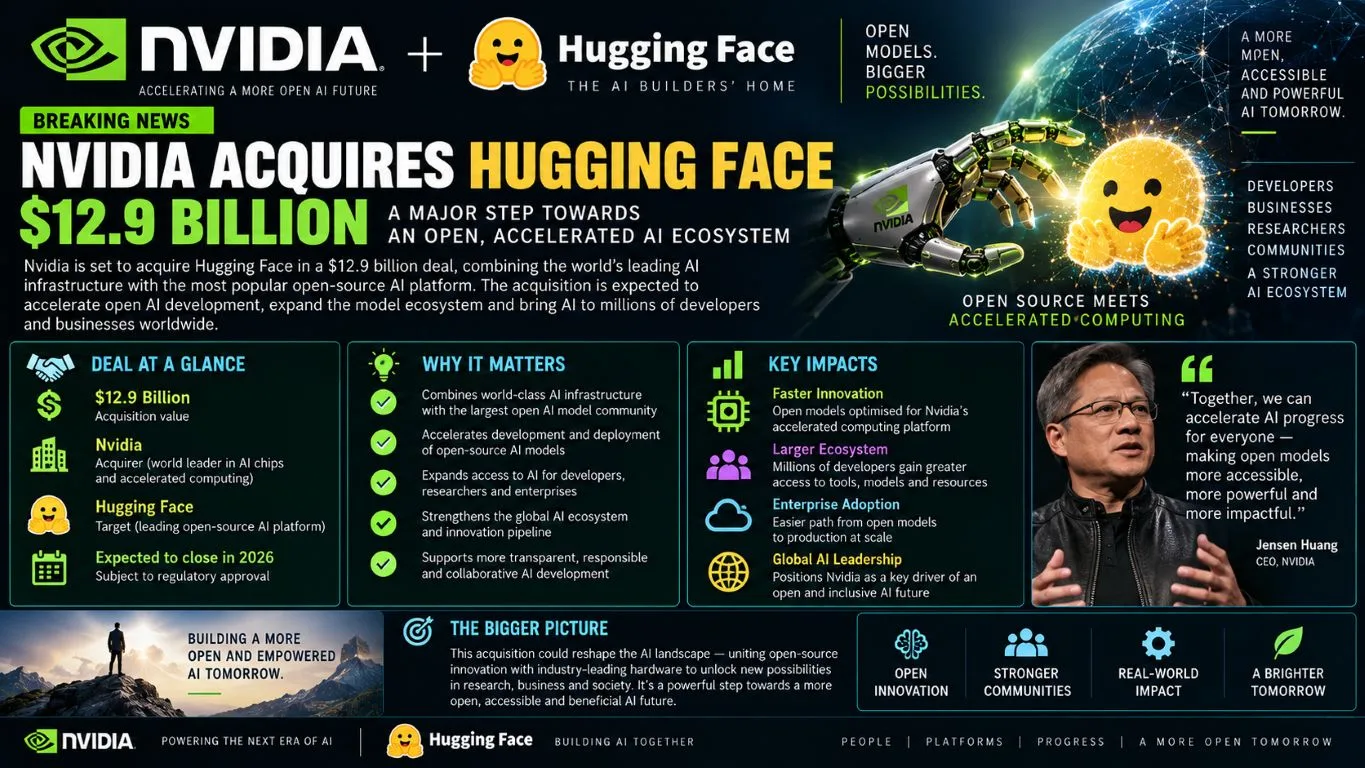
- Nvidia announced the acquisition of Hugging Face for $12.9 billion on September 3, 2026, marking one of the largest AI infrastructure deals in tech history.
- The deal combines Nvidia’s chip and data center dominance with Hugging Face’s repository of millions of freely downloadable and modifiable AI models.
- Jensen Huang framed the acquisition as a direct bet on open-source AI, positioning Nvidia against the closed-model approaches of competitors like OpenAI.
- Investors should pay close attention — this acquisition has a direct strategic logic that could deepen developer lock-in to Nvidia hardware at a critical moment in the AI race.
- There’s a key detail buried in how Nvidia is funding this deal that reveals just how much financial firepower the company has built up, and it changes how you should think about future NVDA moves.
Nvidia just dropped $12.9 billion on Hugging Face, and if you think this is just another tech acquisition, you’re missing the bigger picture entirely.
Announced on September 3, 2026, the deal gives Nvidia ownership of what many in the AI world consider the most important neutral platform in machine learning. Hugging Face hosts millions of open-source AI models, datasets, and developer tools that researchers and engineers around the world rely on daily. For investors watching NVDA, this isn’t a side bet — it’s a calculated move to control the infrastructure layer of AI development from chips all the way up to the models that run on them. Keeping tabs on high-impact moves like this one is exactly what separates informed investors from reactive ones, and resources that track AI market developments are increasingly essential for that kind of edge.
Jensen Huang, Nvidia’s CEO, put it plainly in a blog post: “We will make AI more open, more capable and more accessible to people and institutions around the world.” That’s not just a press release soundbite. It’s a strategic declaration about which side of the open vs. closed AI debate Nvidia is planting its flag on.
Nvidia Just Made Its Biggest AI Move Yet
Nvidia has been on a spending spree, but this one is different in scale and intent. At $12.9 billion, the Hugging Face acquisition is a statement that Nvidia wants to be far more than a chipmaker — it wants to be the central platform of the entire AI ecosystem.
What the $12.9 Billion Price Tag Actually Buys
The number itself is striking, but what Nvidia actually gets for $12.9 billion is even more significant. The acquisition brings Nvidia direct ownership of Hugging Face’s vast repository of open-source AI models — models that can be freely downloaded, fine-tuned, and deployed. This includes access to the datasets, developer communities, and tooling that have made Hugging Face the default starting point for AI experimentation worldwide. In short, Nvidia is buying the place where AI development begins for a huge portion of the global developer community.
This is a vertical integration play. Nvidia already owns the hardware developers need to train and run AI models. Now it owns the library those same developers pull from when they start building. That’s a powerful combination that creates a deeply reinforcing ecosystem around Nvidia’s core GPU business.
Why Jensen Huang Called This a Bet on Open-Source AI
Calling this a “bet” on open-source AI isn’t accidental language. The AI industry is currently split between two schools of thought: closed systems, where models are proprietary and access is gated through APIs, and open systems, where models are shared publicly and can be modified freely. By acquiring Hugging Face, Nvidia is firmly backing the open-source camp. This matters for investors because it sets up a direct competitive contrast with OpenAI’s closed-model strategy, and it positions Nvidia as a democratizing force at a time when regulatory and public scrutiny of AI monopolies is intensifying.
What Is Hugging Face and Why Does It Matter?
To understand why Nvidia paid $12.9 billion, you first need to understand what Hugging Face actually is and the unusual path it took to become the backbone of open-source AI development.
Founded originally as a consumer chatbot app, Hugging Face pivoted hard into AI infrastructure and never looked back. Today it functions as the de facto home for open AI research — the place where academics, startups, and enterprise teams go to find pre-trained models, share their own work, and collaborate on datasets. Its influence on how AI is built and distributed is enormous, making it a uniquely strategic acquisition target.
From a Failed Chatbot App to the GitHub of AI
Hugging Face started life as a teen-focused chatbot app before its founders recognized that the underlying AI infrastructure they were building had far more value than the consumer product it was powering. That pivot turned it into what many now call the “GitHub of AI” — a centralized platform where the global machine learning community shares models and code. Just as GitHub became indispensable to software developers, Hugging Face became indispensable to AI developers, which is precisely what made it worth billions to Nvidia.
Millions of Free AI Models in One Place
The sheer scale of Hugging Face’s model library is hard to overstate. The platform hosts millions of AI models spanning natural language processing, computer vision, audio, and more — all freely available for download and modification. This means any developer, from a solo researcher to a Fortune 500 data science team, can access state-of-the-art AI without building from scratch. That accessibility is both Hugging Face’s greatest strength and the main reason Nvidia wanted to own it.
Why Developers Have Relied on Hugging Face for Years
Developers gravitate to Hugging Face because it solves a real problem: building capable AI models from zero is expensive, time-consuming, and requires massive compute resources. Hugging Face removes that barrier by providing pre-trained models that teams can fine-tune for their specific use cases. The platform also fosters a collaborative community where model improvements are shared openly. That community loyalty is a significant intangible asset that Nvidia now owns — and one that’s notoriously difficult to replicate.
The Financial Power Behind This Deal
A $12.9 billion acquisition sounds enormous, but the more you look at Nvidia’s current financial position, the more it becomes clear that this deal was well within reach — and that Nvidia has the capacity to keep making moves like this.
Nvidia’s $197 Billion War Chest That Made This Possible
Nvidia’s financial trajectory over the past two years has been extraordinary. The company has accumulated significant cash reserves and generated profits at a pace that few technology companies in history have matched. That kind of financial firepower gives Nvidia the ability to execute a deal of this magnitude without stretching its balance sheet in ways that should concern investors. If anything, the Hugging Face deal represents a disciplined deployment of capital into a strategically adjacent asset rather than a speculative leap into unfamiliar territory.
Nearly $60 Billion in Profits Last Quarter Alone
Nvidia’s profitability has reached a level that makes even the most aggressive acquisition strategies look conservative. The company’s data center business alone has become a cash generation engine unlike anything seen in the semiconductor industry, fueled by insatiable global demand for AI training and inference hardware. That profit base gives Nvidia a strategic flexibility that competitors simply cannot match — and the Hugging Face deal is a direct expression of what that flexibility makes possible.
Open-Source vs. Closed AI: Nvidia Picks a Side
The debate between open-source and closed AI development isn’t just philosophical — it has real commercial and regulatory consequences. Closed systems like those operated by OpenAI generate revenue through API access and keep their most powerful models locked behind subscription tiers. Open-source systems, by contrast, distribute model weights freely, allowing anyone to download, modify, and deploy AI without ongoing licensing fees. These two approaches represent fundamentally different visions of who controls AI, who profits from it, and who gets access to it.
By acquiring Hugging Face, Nvidia has done something that goes beyond a typical business transaction. It has publicly declared that the open-source path is where it sees the future of AI development heading — and it has put $12.9 billion behind that conviction. That’s a meaningful signal for investors trying to read where developer sentiment and enterprise AI adoption are trending over the next five to ten years.
What Open-Source AI Actually Means for Regular People
Open-source AI means that the underlying models powering applications — from medical diagnostics tools to customer service chatbots — can be freely accessed, audited, and customized by anyone with the technical ability to do so. There are no black boxes, no vendor lock-in through proprietary APIs, and no single company controlling what the model can or cannot do. For enterprises, this translates directly into lower costs and greater flexibility. For regulators, it offers a level of transparency that closed systems fundamentally cannot provide.
This accessibility angle is important for investors to understand. The more developers and enterprises adopt open-source AI workflows, the more they rely on the compute infrastructure needed to run those models locally or in private cloud environments. That infrastructure is overwhelmingly powered by Nvidia GPUs — which means Nvidia wins on both sides of this transaction, as model host and as hardware provider.
How This Deal Challenges OpenAI’s Closed Model Approach
OpenAI has built its commercial success on a walled garden model: access to GPT-4 and its successors runs through paid API tiers, and the underlying model weights remain proprietary. That approach has generated significant revenue but also attracted criticism from the research community and raised antitrust flags among regulators in the US and Europe. Nvidia’s acquisition of Hugging Face creates a well-funded, institutionally backed alternative to that model — one that champions openness as both a technical philosophy and a market strategy.
The competitive pressure this creates on OpenAI is real. If Nvidia actively promotes and funds open-source model development through Hugging Face, it could accelerate the availability of high-quality open alternatives to GPT-class models. Enterprises that currently pay OpenAI for API access may find that open-source alternatives running on Nvidia hardware offer a more cost-effective and controllable solution. That shift in enterprise spending is something investors in both companies should be watching closely.
What Nvidia Gains by Controlling the World’s Largest AI Model Library
Owning Hugging Face gives Nvidia several compounding strategic advantages that go well beyond the immediate financial value of the platform. Consider what this control actually enables, similar to how companies leverage big data processing platforms to enhance their capabilities.
- Hardware Optimization: Nvidia can ensure that models hosted on Hugging Face are optimized to run most efficiently on its own GPU architecture, particularly its H100 and forthcoming Blackwell chips.
- Data Advantage: Hugging Face’s datasets and model usage patterns give Nvidia unprecedented insight into how AI is being built and deployed across industries worldwide.
- Developer Loyalty: By owning the platform developers already trust, Nvidia inherits a deeply loyal user base without needing to build community trust from scratch.
- Enterprise Pipeline: Hugging Face’s growing enterprise tier gives Nvidia a direct commercial channel into large organizations that are scaling AI deployments.
- Talent Acquisition: Hugging Face’s research team represents some of the most respected machine learning engineers and scientists in the world.
Together, these advantages don’t just add value — they create a feedback loop where Nvidia’s hardware business and its new model platform reinforce each other continuously, making both more valuable over time.
What This Means for NVDA Stock Investors
Strip away the technical details and the key question for NVDA investors is straightforward: does this acquisition make Nvidia’s earnings power larger, more durable, or both? Based on the strategic logic of the deal, the answer appears to be both — but the timeline and the risks are worth examining carefully before drawing firm conclusions.
Nvidia’s Pattern of Strategic AI Acquisitions
This isn’t the first time Nvidia has used acquisitions to cement its position at a critical junction in the AI stack. The company has a deliberate history of identifying infrastructure chokepoints — moments where controlling a key resource or platform creates durable competitive advantage — and moving aggressively to own them. The Hugging Face deal fits squarely within that pattern, targeting the model distribution layer at precisely the moment when AI adoption is accelerating across enterprise and government sectors globally. Investors who have watched Nvidia’s acquisition strategy over the past decade will recognize the playbook.
How Owning Hugging Face Locks Developers Into Nvidia Hardware
The lock-in mechanism here is subtle but powerful. When developers build workflows around models hosted on Hugging Face, and those models are progressively optimized for Nvidia GPU architectures, switching to alternative hardware becomes increasingly friction-filled. It’s not a hard technical lock — developers can still run these models on other hardware — but the performance advantages and seamless integration that come with staying in the Nvidia ecosystem create a strong economic incentive to do exactly that.
The Developer Lock-In Flywheel:
Developer uses Hugging Face model → Model optimized for Nvidia GPU → Developer deploys on Nvidia hardware → Developer builds next project on same stack → Developer returns to Hugging Face for next model → Cycle repeats and deepens with each project
This flywheel dynamic is what makes the Hugging Face acquisition so strategically dense. Each time a developer completes a project on this integrated stack, the switching cost to AMD, Intel, or any other GPU competitor increases incrementally. At scale, across millions of developers worldwide, that incremental friction adds up to a formidable competitive moat.
For Nvidia, this is also a defensive move. As AMD’s MI300X chips and custom silicon from cloud hyperscalers like Google TPUs become more capable, Nvidia needed a non-hardware lever to maintain developer allegiance. Owning the model library is that lever — it ensures that even as the hardware competition intensifies, the software and community ecosystem pulls developers back toward Nvidia’s stack.
Enterprise buyers are particularly susceptible to this dynamic. When a Fortune 500 company’s AI team has spent months building pipelines around Hugging Face-hosted models running on Nvidia H100 clusters, the organizational cost of switching platforms is enormous — not just technically, but in terms of retraining, retooling, and re-validating every component of that pipeline. Nvidia has just made itself significantly harder to replace in those environments.
Is This Deal Priced In or Is There Still Upside?
This is the question every NVDA investor is asking right now, and the honest answer is that it depends heavily on your investment time horizon. In the near term, markets had some forewarning of this deal through reporting from The Information before the official announcement, which means some of the positive sentiment was already beginning to reflect in price action heading into September 2026.
However, the full strategic value of owning Hugging Face will take years to materialize in Nvidia’s financials. The direct revenue contribution from Hugging Face’s enterprise tier is meaningful but not transformative at the scale Nvidia currently operates. The real upside is in the compounding effect on Nvidia’s core GPU and data center business — and that story plays out over a multi-year horizon, not a single earnings cycle.
Investors with a long-term view on AI infrastructure should consider several factors when evaluating whether NVDA still has room to run after this acquisition:
- Whether Nvidia successfully integrates Hugging Face without disrupting the open-source community that makes the platform valuable
- How quickly enterprise adoption of open-source AI models accelerates globally
- Whether regulatory bodies in the US or EU scrutinize the acquisition for antitrust concerns given Hugging Face’s central role in AI development
- How competitors respond — particularly whether Google, Microsoft, or Amazon attempt to build or acquire a credible Hugging Face alternative
Key Risk Factors for NVDA Post-Acquisition:
Risk Factor Potential Impact Probability Community backlash against corporate ownership Developer migration to alternative platforms Medium Antitrust regulatory review Deal conditions or forced divestitures Medium Competitor builds open-source alternative Reduced platform exclusivity Low-Medium Integration execution failure Talent loss, platform degradation Low AI adoption slowdown Reduced hardware demand, lower revenue Low
How This Reshapes the AI Industry Overnight
The Hugging Face acquisition doesn’t just change Nvidia’s position in the market — it reshapes the competitive landscape for every significant player in AI. Companies that previously viewed Hugging Face as a neutral, shared resource now have to reckon with the fact that it is owned by one of their most powerful suppliers. That changes procurement decisions, partnership strategies, and build-vs-buy calculations across the industry simultaneously.
Cloud hyperscalers like AWS, Google Cloud, and Microsoft Azure have all built significant integrations with Hugging Face as a model source for their AI services. Those relationships are now more complex. Each of these companies must decide whether to deepen their dependency on an Nvidia-owned platform, invest in building alternatives, or pursue acquisitions of their own to ensure they maintain access to open-source AI model infrastructure that isn’t controlled by a competitor. That strategic scramble has already begun, and the ripple effects will define the competitive structure of the AI industry for years to come.
Nvidia’s New Role as Silicon Valley’s Central Banker
The phrase “Silicon Valley’s central banker” is increasingly being used to describe Nvidia’s role in the AI economy, and the Hugging Face acquisition makes that description more accurate than ever. Just as a central bank controls the foundational infrastructure through which capital flows, Nvidia is positioning itself to control the foundational infrastructure through which AI development flows — from the chips that train models, to the data centers that host them, to the platform where those models are discovered, shared, and deployed.
This isn’t an accident. Jensen Huang has been methodical about moving Nvidia up the value chain from pure hardware into software, platforms, and now model distribution. Every acquisition and strategic partnership Nvidia has made over the past five years has added another layer to this infrastructure stack. The Hugging Face deal is the most visible expression of that strategy to date, but investors should expect it won’t be the last. When a company generates the kind of cash that Nvidia does, capital deployment becomes a competitive weapon in its own right.
Which AI Companies Should Be Worried Right Now
The companies with the most to lose from this deal are those that relied on Hugging Face’s neutrality as a shared resource. Startups building AI-powered applications on top of Hugging Face models now have to consider whether their foundational model provider is also, indirectly, a competitor or a hardware vendor with vested interests in how those models run. AI cloud service providers, model fine-tuning platforms, and companies in the MLOps space face a new strategic uncertainty that simply didn’t exist before September 3, 2026. For investors with exposure to those sectors, this acquisition is a catalyst worth reassessing your positions around.
Nvidia’s Hugging Face Deal Is a Signal, Not Just a Purchase
At its core, the $12.9 billion Hugging Face acquisition is Nvidia sending a message to the entire AI industry: the open-source ecosystem is not a secondary consideration, it is a primary battleground, and Nvidia intends to own the high ground. For investors, the signal is equally clear — Nvidia is not content to be a picks-and-shovels play in the AI gold rush. It wants to be the company that owns the mine, the equipment, the distribution network, and increasingly, the map that every miner uses to find where to dig. That level of vertical integration, if executed well, creates a durable earnings story that extends far beyond the current AI hardware cycle.
Frequently Asked Questions
The Nvidia and Hugging Face deal has generated a wave of questions from investors and developers alike. Here are the most important ones answered directly.
Why Did Nvidia Buy Hugging Face for $12.9 Billion?
Nvidia acquired Hugging Face to gain ownership of the world’s largest open-source AI model repository, combining it with its existing chip and data center dominance to create an end-to-end AI infrastructure play. The deal gives Nvidia direct access to millions of freely available AI models, the developer communities that build and maintain them, and a growing enterprise business serving organizations that want to deploy AI at scale without relying on proprietary APIs.
Beyond the immediate assets, the acquisition is a strategic land grab at a pivotal moment in AI development. By owning the platform where a massive portion of global AI development begins, Nvidia creates a powerful gravitational pull that draws developers deeper into its hardware ecosystem. The more developers build on Hugging Face-hosted models optimized for Nvidia GPUs, the stronger the incentive to keep buying and deploying Nvidia hardware — and that flywheel effect is ultimately what justifies the $12.9 billion price tag from a pure investment thesis standpoint.
What Does the Hugging Face Acquisition Mean for Developers?
For developers, the immediate practical reality is that the platform they rely on daily is now owned by Nvidia. In the short term, Hugging Face’s open-source model library and collaborative tools are expected to remain accessible, as any move to restrict that access would destroy the community value that made the platform worth acquiring in the first place. The longer-term question is whether Nvidia gradually tilts the platform’s optimization, tooling, and featured models toward its own GPU ecosystem — a subtle but commercially significant form of influence that developers and enterprises should monitor closely.
How Does This Acquisition Affect NVDA Stock?
The acquisition adds a new strategic dimension to the NVDA investment thesis that goes beyond the current GPU demand cycle. In the near term, the $12.9 billion price tag is entirely manageable given Nvidia’s profit generation capacity, and the deal does not represent a financially stressful stretch for the company’s balance sheet. The more important long-term question is whether Nvidia can successfully leverage Hugging Face to deepen developer and enterprise lock-in — because if that flywheel works as intended, it creates a more durable and defensible earnings stream than hardware sales alone.
Investors should watch for several NVDA-specific metrics in the quarters following deal close: growth in Hugging Face’s enterprise tier revenue, changes in developer platform engagement, and any signals from cloud hyperscalers about how they plan to respond to Nvidia’s new ownership of the open-source model distribution layer. Each of those data points will help clarify whether the strategic logic of this acquisition is translating into measurable financial outcomes.
Who Founded Hugging Face and When?
Hugging Face was founded in 2016 by Clément Delangue, Julien Chaumond, and Thomas Wolf. The company launched initially as a consumer-facing chatbot application targeting teenagers before pivoting to AI infrastructure and open-source model development — a pivot that transformed it from a niche consumer app into the central nervous system of the global open-source AI community and, ultimately, a $12.9 billion acquisition target for the world’s most valuable chip company.
Does Nvidia Now Control Open-Source AI?
Technically, no — open-source AI by definition cannot be controlled by any single entity, because the model weights and code are publicly available for anyone to download, fork, and deploy independently. What Nvidia now controls is the most important distribution platform for open-source AI, which is a meaningfully different but still significant form of influence.
The distinction matters for investors and policymakers alike. Nvidia cannot prevent anyone from using open-source AI models, but it can shape which models get promoted, which get optimized for Nvidia hardware first, and how the developer experience on the platform evolves over time. That curatorial and optimization power is subtler than outright control, but it is commercially potent — and it is precisely the kind of structural advantage that tends to compound in value as an ecosystem matures.
Regulators in the US and EU are likely to scrutinize this dimension of the deal carefully. The concern won’t be that Nvidia is locking models behind a paywall — it’s that the company that sells the hardware developers need also now owns the platform where those developers discover and access their models. That vertical integration raises legitimate questions about fair competition that antitrust authorities have shown increasing willingness to investigate in the AI sector.