


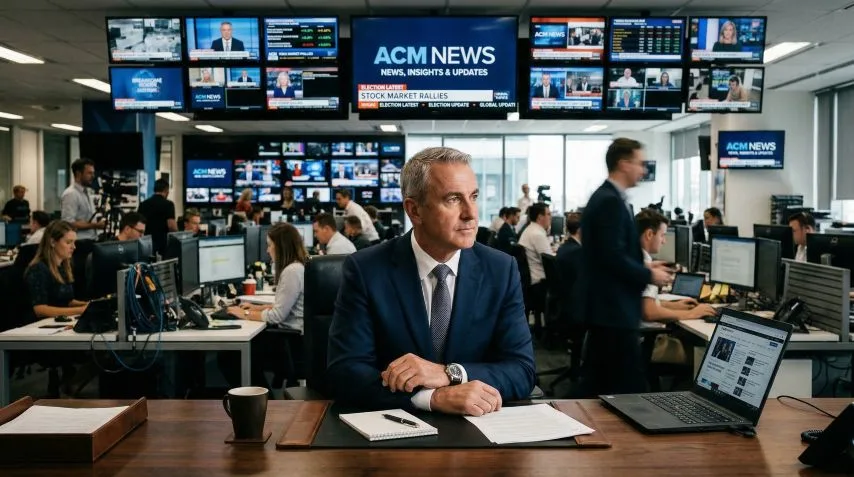
- Anthony Catalano, one of Australia’s most prominent regional media figures, has been charged with assault, false imprisonment, and making threats to kill following an incident in March 2026.
- Catalano has voluntarily stepped down from all positions across his media empire while he enters rehabilitation for substance abuse and mental health issues.
- The alleged incident involved a clothes iron and resulted in a woman being hospitalised with a broken tailbone — details that emerged during his appearance at Melbourne Magistrates’ Court.
- His temporary departure raises serious questions about leadership continuity across Australia’s regional newspaper landscape, which he has heavily shaped.
- The legal process is still in its early stages — and how this case unfolds could have lasting implications for both Catalano and the broader Australian media industry.
Anthony Catalano: Media Mogul Charged, Stepping Down
One of Australia’s most influential regional media figures is now facing some of the most serious personal and legal challenges of his career.
Anthony Catalano has long been a dominant force in Australian media, particularly in the regional newspaper space. His business dealings, acquisitions, and editorial influence have made him a well-known name not just in media circles, but across the broader Australian business landscape. For many in the industry, Catalano represents a rare breed — an operator who understood that regional journalism still held commercial and cultural value at a time when many others were walking away from it.
That reputation is now under significant pressure. In March 2026, Catalano was charged with assaulting a woman, false imprisonment, and making threats to kill. Shortly after the charges were laid, he announced he would temporarily step down from all positions within his media operations and enter rehabilitation to address substance abuse and mental health problems. The announcement was both striking and, for those who follow the media industry closely, a signal that the situation was serious.
Who Is Anthony Catalano in Australian Media
Catalano built his media presence through a strategic focus on regional and community newspapers at a time when the sector was contracting. While major metropolitan mastheads struggled with declining print revenues and digital disruption, Catalano moved in the opposite direction — acquiring and consolidating regional titles and positioning them as essential local information services. His approach was entrepreneurial and, at times, controversial, but it was undeniably effective in building a significant media footprint outside Australia’s major cities.
His influence extends beyond just ownership. Catalano has been vocal on issues affecting the media industry, including press freedom, local journalism funding, and the role of regional news in democratic communities. That public profile made the March 2026 charges all the more striking for industry observers.
The March 2026 Assault Charges Explained
Catalano appeared before the Melbourne Magistrates’ Court in March 2026, where police presented allegations that he swung a clothes iron at a woman’s head and dragged her through an apartment. The woman was subsequently hospitalised with a broken tailbone. Police formally charged him with assault, false imprisonment, and making threats to kill — a combination of charges that, if proven, carry serious legal consequences.
His Decision to Enter Rehabilitation
Following the charges, Catalano publicly stated he would seek help for both substance abuse and mental health problems. His decision to enter rehabilitation and step away from all professional roles simultaneously suggests an acknowledgment that the issues at play extend beyond the immediate legal matter. It is a significant personal statement from someone who has operated at the highest levels of Australian media for years — and it sets the stage for a period of profound uncertainty for his business interests.
Catalano’s Media Empire at a Crossroads
When a media owner of Catalano’s scale steps away suddenly, the ripple effects are felt immediately. Regional newspapers don’t run on autopilot — they require active editorial direction, commercial decision-making, and leadership that understands the specific pressures of local journalism markets. His absence, even framed as temporary, creates real operational uncertainty.
The timing matters too. Australian regional media is navigating one of its most challenging periods in decades. Advertising revenue has continued to shift toward digital platforms, print circulation remains under structural pressure, and the funding models that once sustained community newsrooms are being rebuilt from scratch. Losing an active, hands-on owner from the equation at this moment is not a minor disruption.
His Role as Regional Newspaper Mogul
Catalano’s strategy in regional media was built on a clear thesis: that local news still had an audience, and that audience still had commercial value. While larger media groups were divesting regional titles or shutting them down entirely, he was acquiring them — betting that a focused, cost-conscious operator could make regional journalism work where others had given up.
That bet gave him influence over the news diet of communities across multiple Australian states. The titles under his umbrella weren’t just business assets — they were, for many readers, the primary source of local council reporting, community events coverage, and regional business news. That’s a significant responsibility, and it’s one that doesn’t pause because the owner is unavailable. Recently, regional business news has also highlighted the impact of major layoffs in tech companies like Atlassian.
What “Temporarily Stepping Down From All Positions” Means for His Business
The phrase “temporarily stepping down from all positions” carries enormous practical weight. It means editorial leadership, board responsibilities, commercial partnerships, and strategic decisions all need to be managed by someone else — and quickly. For a media operation built significantly around one individual’s vision and relationships, that transition is rarely seamless.
The key questions now facing his business include who holds decision-making authority, whether existing editorial leadership has the mandate to act independently, and how commercial partners and advertisers are responding to the uncertainty. These are not abstract concerns — they directly affect the day-to-day functioning of newsrooms that serve real communities.
Substance Abuse and Mental Health: Catalano’s Public Statement
Catalano’s public acknowledgment that he is seeking help for substance abuse and mental health problems is significant on multiple levels. In an industry where vulnerability is rarely displayed openly, his statement stands out. It doesn’t resolve the legal questions, and it doesn’t address the specifics of what is alleged to have occurred — but it does frame his decision to step back as part of a broader reckoning rather than simply a legal strategy. Whether that transparency shapes public and industry perception of him going forward remains to be seen.
What This Means for Australian Regional Media
The Catalano situation arrives at a moment when Australian regional media can least afford instability at the ownership level. The sector has spent years advocating for greater government support, fairer revenue-sharing arrangements with global digital platforms, and sustainable funding models for local journalism. A high-profile controversy involving one of its most recognisable figures does not help that cause.
- Regional newsrooms depend heavily on owner-operators for direction and investment decisions
- Advertiser confidence can erode quickly when senior leadership is in flux
- Editorial independence becomes harder to protect during ownership transitions
- Staff morale in smaller newsrooms is directly affected by uncertainty at the top
- Community trust in local mastheads can take years to rebuild once damaged
These aren’t hypothetical risks. They are the documented consequences that play out when leadership instability hits media organisations that already operate on tight margins and lean teams. For the journalists and editors working inside Catalano’s titles right now, the uncertainty is very real.
At the same time, it’s worth noting that the titles themselves — the mastheads, the journalists, the community relationships — exist independently of any single owner’s personal circumstances. Strong editorial teams have continued to produce quality local journalism through ownership changes before, and that capacity exists here too.
Leadership Gaps in Regional News Operations
Regional news operations are particularly vulnerable to leadership gaps because they typically lack the deep management bench that larger metropolitan organisations can draw on. When a key decision-maker steps away, there isn’t always a deputy ready to absorb the full scope of responsibilities. This is one of the structural realities of regional media that rarely gets discussed publicly — until a situation like this one forces the conversation.
How Media Companies Handle Executive Misconduct
The standard playbook for media companies dealing with executive misconduct involves a combination of immediate distancing, appointment of interim leadership, and careful communication with both staff and commercial partners. The speed and transparency of that response typically determines how much long-term damage occurs. In Catalano’s case, the voluntary nature of his step-down — and his public statement about rehabilitation — removes some of the messiest elements of that process, but the operational challenges remain.
Industry Reactions and What to Watch Next
Reactions from within the Australian media industry have been measured, reflecting both the seriousness of the charges and the recognition that Catalano has not yet faced trial. Industry figures are watching closely, but few are willing to make definitive statements while the legal process is at such an early stage.
What to monitor going forward includes the progression of the case through the Melbourne Magistrates’ Court, any formal announcements about interim leadership structures within his media operations, and whether commercial partners begin to publicly distance themselves from his titles. Each of these developments will signal how the broader industry is processing what has happened.
The Legal Road Ahead for Catalano
The charges Catalano faces — assault, false imprisonment, and making threats to kill — are serious criminal matters that will now move through the Victorian court system. His appearance at Melbourne Magistrates’ Court in March 2026 was the beginning of that process, not the end of it.
Magistrates’ Court proceedings in Victoria typically involve an initial filing hearing, followed by a committal mention process where the prosecution outlines its evidence and the defence responds. Depending on the severity of the charges and the evidence presented, the matter may be committed to the County Court or Supreme Court for trial. This process can take many months, sometimes longer.
The alleged details that emerged in court — that Catalano swung a clothes iron at a woman’s head and dragged her through an apartment, resulting in a broken tailbone — represent the prosecution’s version of events. Catalano has not yet formally entered a plea, and it is important to note that charges are allegations until proven in a court of law.
His decision to enter rehabilitation simultaneously with the legal process is not unusual. Courts in Victoria do consider evidence of proactive engagement with treatment programs, particularly where substance abuse is presented as a contributing factor. However, rehabilitation does not resolve criminal charges — those must be addressed through the legal process on their own terms.
- Charge 1: Assault — alleged to involve swinging a clothes iron at a woman’s head
- Charge 2: False imprisonment — alleged to involve physically restraining the victim
- Charge 3: Making threats to kill — a serious criminal charge under Victorian law
- Victim outcome: The woman was hospitalised with a broken tailbone following the alleged incident
- Court: Melbourne Magistrates’ Court, with potential for committal to a higher court
Next Steps in the Magistrates’ Court Process
The case will continue to move through the Melbourne Magistrates’ Court system, where the prosecution will formally present its evidence and the defence will have the opportunity to respond. An early step in this process is the filing hearing, where the charges are formally recorded and a timetable for the case is established. From there, the matter typically proceeds to a committal mention, and potentially a full committal hearing where a magistrate determines whether there is sufficient evidence to send the case to a higher court.
Given the nature of the charges — particularly the threats to kill allegation — it is likely this matter will ultimately be heard in a higher jurisdiction than the Magistrates’ Court. Victorian law treats threats to kill as a serious indictable offence, and combined with the assault and false imprisonment charges, the prosecution has the basis to push for a committal to the County Court. Each court date will be a closely watched moment for the media industry, and for anyone following this story closely, especially in light of recent global law enforcement operations.
Potential Outcomes and Timeline
Court timelines in Victoria are rarely quick. From the initial filing hearing to a potential trial date, matters of this complexity can take anywhere from twelve months to several years to fully resolve. During that time, Catalano will remain in a state of legal uncertainty — which directly affects his ability to return to active leadership of his media operations, regardless of his rehabilitation progress.
Potential outcomes range from charges being withdrawn or downgraded through the committal process, to a full trial resulting in conviction or acquittal. If convicted, Victorian sentencing guidelines for these categories of offences include community corrections orders, suspended sentences, or custodial sentences depending on the severity of findings. None of those outcomes can be predicted at this stage, and it would be premature to speculate — but the range of possibilities is wide, and each carries different implications for Catalano’s professional future.
This Case Is Far From Over
What is unfolding with Anthony Catalano is more than a headline. It is a case study in how quickly a media figure’s professional standing can be disrupted by personal circumstances — and how the institutions they’ve built must find ways to function without them.
The charges are serious and unresolved. The rehabilitation commitment is real and publicly stated. The media operations he built continue to serve communities that depend on local journalism every day. All of these things are true simultaneously, and the tension between them is what makes this situation so significant for the Australian media landscape.
For media industry observers, the Catalano case raises important structural questions that go well beyond one individual. How much should a regional media operation depend on a single owner-operator? What governance structures should exist to ensure continuity when leadership is suddenly unavailable? These are questions the industry has largely avoided asking in any systematic way — and this situation is forcing them into the open.
It is also a reminder that the people who shape our media landscape are human — capable of building extraordinary things and, equally, of serious personal failures. How the industry, the courts, and the public process both of those realities at once will say a great deal about where Australian media culture stands right now.
- The legal process is at its earliest stage — no verdict or conviction has been recorded
- Catalano has stepped down voluntarily and entered rehabilitation, acknowledging substance abuse and mental health challenges
- Regional newsrooms under his ownership continue to operate and serve their communities during this period
- The court process could take one to several years before reaching a final resolution
- Industry governance questions about over-reliance on single owner-operators are now firmly on the table
Frequently Asked Questions
These are the most common questions people are asking about the Anthony Catalano case, his media operations, and what happens next.
What charges has Anthony Catalano been charged with?
Anthony Catalano has been charged with three serious criminal offences: assault, false imprisonment, and making threats to kill. The charges followed an incident in which police allege he swung a clothes iron at a woman’s head and dragged her through an apartment, resulting in her being hospitalised with a broken tailbone. The charges were filed in March 2026, and the matter is being heard in the Melbourne Magistrates’ Court. It is important to note that these are allegations — Catalano has not been convicted of any offence.
Why is Anthony Catalano entering rehabilitation?
Following the charges being laid, Catalano publicly stated that he would seek help for substance abuse and mental health problems. His decision to enter rehabilitation appears to be both a personal acknowledgment of underlying issues and a parallel response to the legal situation he now faces.
- Catalano cited both substance abuse and mental health as areas requiring professional support
- He announced rehabilitation simultaneously with his decision to step down from all positions
- Rehabilitation does not resolve criminal charges but may be considered by courts during sentencing proceedings
- The public statement was voluntary, which is relatively unusual for a media figure at his level
His willingness to make this acknowledgment publicly suggests a level of personal reckoning that goes beyond standard legal strategy. Whether that openness ultimately shapes his legal outcomes, professional reputation, or both remains to be seen as the process unfolds.
It is also worth noting that seeking rehabilitation while facing serious charges is not uncommon in the Victorian legal system. Courts do take genuine engagement with treatment programs into account, particularly where substance dependency is identified as a contributing factor to the alleged conduct. However, this consideration is entirely separate from the question of whether the charges themselves will be proven.
What media companies is Anthony Catalano associated with?
Anthony Catalano has been a significant figure in Australian regional media, with a focus on acquiring and operating regional and community newspapers at a time when many larger media groups were divesting those titles. His media footprint spans multiple Australian states, with particular strength in regional markets that have historically been underserved by major metropolitan publishers. He has been associated with regional newspaper operations that serve as the primary local news source for many communities outside Australia’s capital cities. Specific operational details of his current holdings are subject to change during the period of his stepping down.
Has Anthony Catalano been convicted of any crimes?
No. As of the time of writing, Anthony Catalano has not been convicted of any crime in relation to the March 2026 charges or otherwise. He has been charged — which means police have formally alleged the offences — but the matter has not yet proceeded through the full court process, and no finding of guilt has been made by any court.
This distinction matters enormously. In the Australian legal system, a person is presumed innocent until proven guilty in a court of law. The charges against Catalano are serious, and the alleged facts as presented by police are concerning — but they represent one side of a legal process that is still at its very beginning. Any assessment of Catalano’s culpability must wait for the court process to run its course.
Who will run Catalano’s media operations while he steps down?
This is one of the most practically significant questions arising from Catalano’s temporary departure, and at the time of writing, no formal public announcement has been made identifying a specific interim leader or leadership structure for his media operations.
In media organisations of this type — built significantly around an entrepreneurial owner-operator — the absence of a clearly named successor or interim executive creates genuine operational uncertainty. Decisions about editorial direction, commercial partnerships, staffing, and strategic investments all need to be made by someone with the authority to make them. Without a named interim leader, those decisions may default to existing senior editors or general managers within individual titles.
The lack of a clear public succession announcement is itself a signal worth noting. Larger, more institutionalised media organisations typically have documented succession protocols for exactly these situations. Regional media operations built around a single founder often do not — and this case highlights why that matters.