


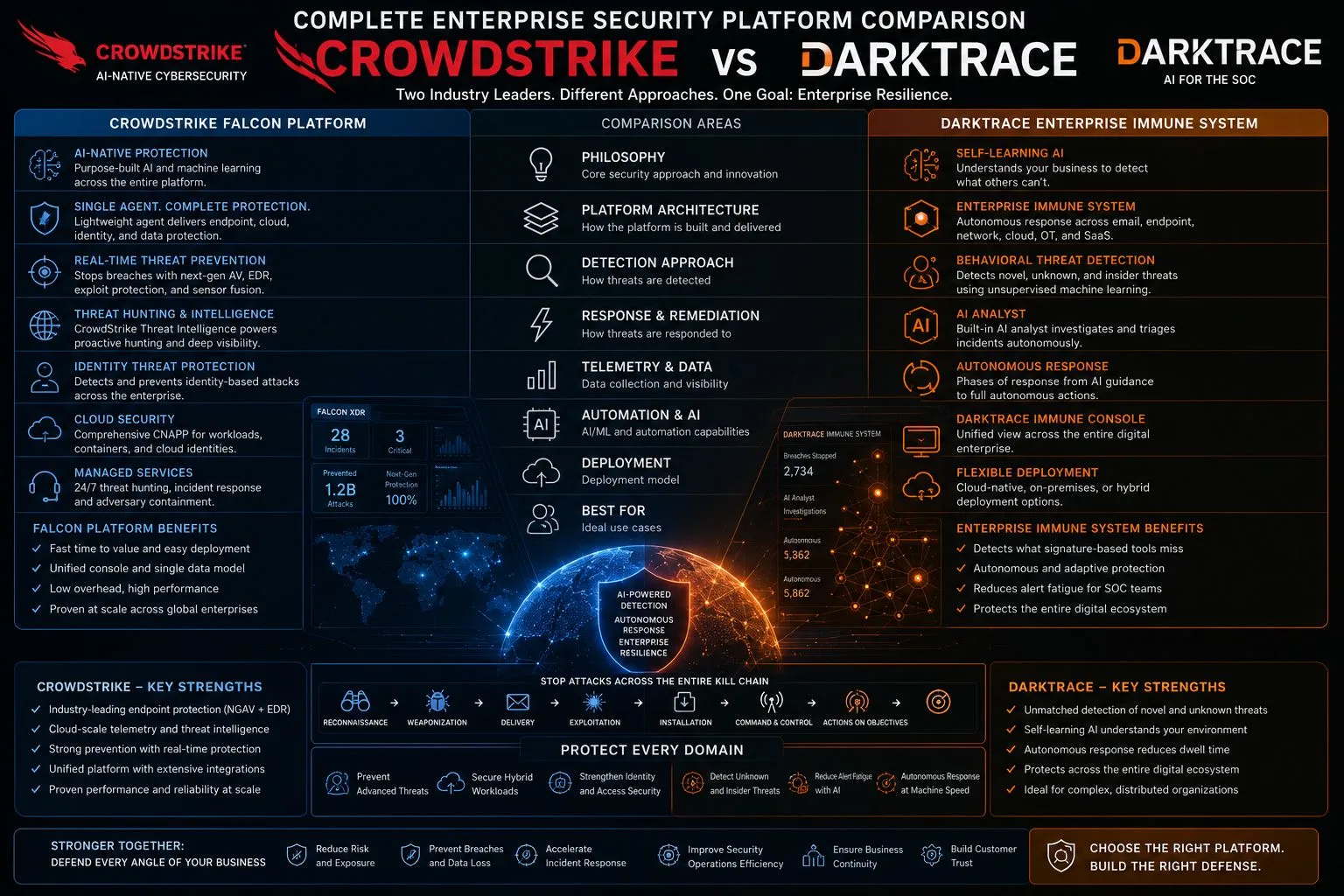
- CrowdStrike Falcon and Darktrace represent two fundamentally different approaches to enterprise security — one built on adversary intelligence, the other on behavioral AI that learns what “normal” looks like inside your network.
- CrowdStrike excels in endpoint protection and known threat attribution, leveraging its Threat Graph to process trillions of security events and match attacks to specific threat actor groups.
- Darktrace’s Self-Learning AI detects anomalies that signature-based tools miss, making it particularly powerful against zero-day attacks and insider threats that leave no known fingerprint.
- Neither platform is universally superior — the right choice depends on your organization’s size, existing stack, security team maturity, and whether your biggest risk is known adversaries or unknown unknowns.
- Many large enterprises run both platforms simultaneously, using CrowdStrike for endpoint coverage and threat intelligence while relying on Darktrace for network-level anomaly detection and autonomous response.
CrowdStrike vs. Darktrace: Two Different Philosophies, One Critical Decision
Choosing the wrong enterprise security platform doesn’t just cost money — it leaves gaps that sophisticated attackers are counting on you to have.
When it comes to enterprise cybersecurity, CrowdStrike and Darktrace are two of the most well-known names in the industry. However, these two platforms were designed with entirely different threat models in mind. CrowdStrike, which was founded in the United States in 2011, focuses on preventing breaches by using deep adversary intelligence and endpoint-focused detection. On the other hand, Darktrace, which was founded in the United Kingdom in 2013, is built on the premise that traditional tools often fail to detect threats within a network. According to Darktrace, only AI that can learn normal behavior can detect the threats that humans and signatures overlook.
Let’s be clear: neither of these platforms is inherently better or worse than the other. They’re both enterprise-level, they’re both used by organizations all over the world, and they both have unique strengths that the other doesn’t. This comparison is about cutting through the marketing jargon so your security team can make a decision based on the technical facts.
Understanding the Functionality of CrowdStrike Falcon
CrowdStrike Falcon is a cloud-native platform that is delivered entirely as SaaS. This means that there is no on-premises hardware or management infrastructure that needs to be maintained. The core of Falcon is the deployment of a single lightweight agent — the Falcon Sensor — across endpoints. All telemetry from those endpoints flows into CrowdStrike’s cloud-based Threat Graph for analysis and correlation. The platform is built on the principle that the best way to stop a breach is to understand the adversary behind the attack, not just the malware they’re using.
The Driving Force Behind CrowdStrike’s Intelligence: Threat Graph
The heart and soul of Falcon’s operations is the CrowdStrike Threat Graph. This graph database was designed for a specific purpose: to process and correlate trillions of telemetry events every week. It maps the relationships between indicators of compromise, known threat actor groups, malware families, and specific attack techniques based on the MITRE ATT&CK framework. When Falcon detects suspicious activity on an endpoint, Threat Graph cross-references that activity against a continuously updated database of adversary behavior. This database doesn’t just contain file hashes or signatures, but the actual tactics and procedures used by named threat groups like Fancy Bear (APT28) or Cozy Bear (APT29).
One of the most unique features of CrowdStrike is its ability to identify adversaries. Instead of simply alerting your SOC team that “malware was detected,” Falcon can provide information on the likely responsible threat actor group, their known objectives, and their typical next steps. This context can significantly speed up incident response.
Heavyweight Protection, Lightweight Agent: Falcon Sensor
The Falcon Sensor is designed to operate with minimal impact on the performance of the endpoints it protects. This is a critical consideration for enterprise-scale operations where thousands of devices need to remain fully operational. The sensor uses a combination of machine learning, behavioral analysis, and indicator-of-attack (IOA) detection to identify threats both on-disk and in-memory. In contrast to traditional antivirus tools that rely heavily on signature databases and require constant updates, Falcon’s IOA-based detection focuses on identifying the actions of an attacker rather than the tools they are using to carry out their attack.
Falcon OverWatch: Human-Led Threat Hunting as a Force Multiplier
In addition to the automated platform, CrowdStrike provides Falcon OverWatch — a managed threat hunting service where CrowdStrike’s own analysts proactively search for threats within customer environments around the clock. OverWatch functions as an extension of your internal security team, bringing to light threats that automated detection may have identified but not acted upon.
Overview of CrowdStrike Falcon Platform Core Modules
Module Function Main Feature Falcon Prevent Next-Generation Antivirus (NGAV) Prevention of malware using machine learning, both on and off the network Falcon Insight Endpoint Detection & Response (EDR) Real-time visibility and ability to search historical activity Falcon OverWatch Managed Threat Hunting 24/7 threat hunting led by humans across the customer base Falcon Intelligence Threat Intelligence Profiles of adversaries, IOCs, and data attribution Falcon Discover IT Hygiene Inventory of assets and detection of unauthorized accounts Falcon Horizon Cloud Security Posture Management (CSPM) Detection of misconfigurations across cloud environments
The modular design of the Falcon platform is both an advantage and a source of complexity. Companies can begin with basic endpoint protection and add modules as their security maturity increases, but the complete platform is a substantial investment that requires skilled staff to operate effectively.
Understanding the Functioning of Darktrace
Darktrace has a unique approach to threat detection. Instead of using known threat signatures or databases of adversaries, Darktrace’s Enterprise Immune System technology creates a dynamic model of normal behavior for every user, device, and network segment within your organization. It then identifies any deviations from this baseline as potential threats. The comparison to a human immune system is deliberate: just as the body learns to recognize its own cells and attacks foreign ones, Darktrace learns what is normal for your network and reacts to anything that is not.
Creating a “Pattern of Life” for Each Device with Self-Learning AI
Darktrace begins a passive learning phase when it is deployed, during which it observes all network traffic without taking any action. The platform’s unsupervised machine learning algorithms create what Darktrace refers to as a “pattern of life” for every entity on the network during this period, which usually lasts a few weeks. This includes:
- Users: Typical login times, accessed resources, data transfer volumes, and application usage patterns
- Devices: Normal communication peers, typical bandwidth usage, expected connection protocols
- Network segments: Baseline traffic flows between departments, data centers, and cloud services
- SaaS and cloud applications: Expected API call volumes, user access patterns, and data movement behaviors
What makes this approach powerful is that it doesn’t require any pre-existing knowledge of what “bad” looks like. A credential-stuffing attack by a sophisticated threat actor who has deliberately mimicked normal user behavior will still deviate subtly from that specific user’s established pattern of life — and Darktrace is built to catch exactly those subtle deviations.
Autonomous Response (Antigena): Acting Before Humans Can React
Darktrace’s Antigena feature, now incorporated into the Darktrace RESPOND product, takes the platform beyond detection to autonomous action. When a threat is detected with a high degree of confidence, Antigena can take surgical containment actions in real time, such as blocking specific connections, enforcing a device’s normal behavior, or slowing down unusual data transfers, all without waiting for human approval. The key design principle is proportionality: Antigena is calibrated to take the minimum action necessary to contain a threat, preserving business operations while neutralizing the attack vector.
Design and Implementation: Fully Cloud vs. Hybrid-Ready
Design is frequently the determining factor in enterprise security platform choices at the infrastructure level — and CrowdStrike and Darktrace have significantly different strategies in this area.
The CrowdStrike Falcon is fully cloud-based. Every part of the platform, from data collection to threat analysis to policy management, operates through CrowdStrike’s cloud infrastructure. The only thing installed in your environment is the Falcon Sensor agent on endpoints. This makes deployment quick and management overhead low, but it also means organizations in highly regulated industries or air-gapped environments may need to consider compliance issues around data leaving the premises.
- CrowdStrike deployment model: SaaS-only, endpoint agent required, no on-premises infrastructure
- Darktrace deployment model: Available as physical appliance, virtual appliance, or cloud-native SaaS depending on environment
- Network tap requirement: Darktrace requires access to network traffic (via SPAN port, network tap, or cloud connector) — no endpoint agent needed for network-level visibility
- Coverage scope: CrowdStrike covers managed endpoints; Darktrace can cover unmanaged devices, OT/IoT, and cloud workloads that have no agent installed
- Air-gapped environments: Darktrace’s on-premises appliance option supports fully air-gapped deployments; CrowdStrike requires cloud connectivity by design
The absence of an endpoint agent requirement in Darktrace is significant for organizations with large OT environments, medical device networks, or legacy systems that cannot support software agents. Darktrace can monitor those assets purely through network traffic analysis, giving it a coverage advantage in complex industrial or healthcare environments that CrowdStrike simply cannot match without agent deployment.
Detecting Threats: Known Threats and Unknown Anomalies
The most significant difference between these two platforms isn’t the cost or the implementation — it’s the basic question of what type of threats each one is designed to detect.
Adversary Attribution and Signature-Based Strengths of CrowdStrike
CrowdStrike’s detection engine is built on a deep catalog of adversary knowledge accumulated over more than a decade of incident response work, nation-state threat tracking, and global telemetry. When Falcon detects an indicator of attack, it cross-references that activity against named threat actor profiles — CrowdStrike tracks over 200 adversary groups using a consistent naming convention (Bears for Russia, Pandas for China, Kittens for Iran, and so on). This means your SOC team isn’t just seeing an alert — they’re seeing context that tells them the likely motivation, typical targets, and probable next steps of the group behind the activity.
Where CrowdStrike really shines is in its ability to detect known attack patterns that are carried out by known adversaries. Its behavioral IOA detection is especially good at detecting common attack techniques such as credential dumping, lateral movement via Pass-the-Hash, and living-off-the-land attacks that take advantage of legitimate Windows tools like PowerShell or WMI. Because these techniques have been seen and documented in thousands of real-world breaches, Falcon’s detection logic for these types of attacks is exceptionally well-tuned.
Darktrace’s Advantage Against New and Zero-Day Threats
Darktrace’s detection advantage shines where CrowdStrike’s catalog-based approach falls short: threats that have never been encountered before. A zero-day exploit launched by a new threat actor with no previous history leaves no adversary fingerprint to match against — but it will still cause abnormal behavior on the network. A device that suddenly starts scanning internal subnets at 2am, a user account that accesses 10,000 files in 20 minutes, or an IoT sensor that begins making outbound connections to an unknown external IP — none of these require a known signature to detect. Darktrace’s Self-Learning AI catches them by knowing what those entities are supposed to be doing and flagging what they’re not supposed to be doing.
False Positive Rates: A Comparison of CrowdStrike and Darktrace
False positives can be detrimental to the efficiency of a SOC, as an overload of low-quality detections can cause real threats to go unnoticed. CrowdStrike’s IOA-based detection is typically regarded as high-fidelity, producing alerts that are well-contextualized and actionable, which helps to reduce noise. On the other hand, Darktrace’s anomaly-based approach can result in a higher volume of alerts during the initial deployment period before the AI has fully learned the environment’s normal behavior patterns. Organizations that deploy Darktrace without allowing for sufficient learning time, or that operate in environments with highly variable user behavior, often report a tuning burden during the first 30 to 60 days of deployment. Once the model stabilizes, the quality of the alerts improves significantly, but it’s an important operational consideration that security teams should plan for.
Enterprise vs. SMB Fit: Which Platform is Right for Your Company
Platform fit isn’t just about features — it’s about whether your team has the expertise, budget, and infrastructure to deploy and operate the tool effectively at your organization’s specific scale.
Why CrowdStrike is More Suited to Large Enterprise Environments
CrowdStrike Falcon was designed with scalability in mind. Its SaaS architecture allows it to protect tens of thousands of endpoints without significantly increasing management complexity. Its modular licensing structure enables large organizations to create a comprehensive security stack — NGAV, EDR, threat intelligence, CSPM, identity protection, and managed hunting — all within a single platform and console. For enterprises with global footprints, distributed workforces, and complex hybrid cloud environments, having such unified visibility across a single pane of glass is extremely valuable operationally.
The main issue is the cost and complexity. CrowdStrike’s entire platform comes at a premium price, and to get the most out of modules like Falcon Intelligence, Falcon Discover, or Falcon Horizon, you need security personnel with the expertise to use the information the platform provides. Organizations without a mature SOC or dedicated threat intelligence function may find that they are paying for capabilities that they don’t have the team to fully utilize.
Where Darktrace Excels
Darktrace’s agentless network monitoring is especially useful in environments where endpoint agents can’t be universally deployed — such as manufacturing floors with OT systems, hospitals with connected medical devices, financial institutions with legacy infrastructure, or any organization with a significant number of unmanaged or BYOD devices. It also offers great value to organizations that want autonomous response capabilities but don’t have the 24/7 SOC staffing to act on alerts in real time. Darktrace RESPOND essentially serves as an always-on first responder, taking proportional containment actions the moment anomalous behavior crosses the confidence threshold — with or without a human analyst available to approve the action.
Common Complaints to Consider Before Purchasing
All enterprise security platforms have their flaws, and the worst thing a security team can do is make a purchasing decision without knowing their chosen tool’s shortcomings.
Complexity and Cost of CrowdStrike’s Premium Offering
Enterprise security professionals often criticize CrowdStrike Falcon for its pricing model. Each module requires a separate license, and building a complete security stack across Falcon Prevent, Falcon Insight, Falcon Intelligence, Falcon OverWatch, and cloud security modules represents a significant yearly commitment. This cost often surprises organizations when they start expanding beyond basic endpoint protection. Moreover, the platform’s depth can be a double-edged sword. The same wealth of data and context that makes Falcon powerful for experienced security teams can become overwhelming for organizations with smaller or less specialized security staff. Threat hunting workflows, custom IOA rule creation, and advanced intelligence reporting all require hands-on expertise that not every organization has in-house.
Concerns About Darktrace’s Tuning Requirements and AI Transparency
Darktrace’s two most common criticisms focus on the burden of early-deployment tuning and the “black box” nature of its AI decision-making. During the initial learning period, the platform can produce a significant amount of low-confidence alerts as the model builds its baseline, especially in environments with highly variable or seasonal user behavior patterns. Security teams must spend time reviewing and suppressing false positives during this window, or they run the risk of normalizing the habit of ignoring alerts. The more serious concern, often raised by enterprise security architects, is AI transparency: Darktrace’s models make autonomous response decisions without always providing a clear, human-readable explanation of why a specific behavior was flagged as anomalous. For security teams that need to document and justify every containment action, especially in regulated industries, that lack of explainability can be a real compliance challenge.
Costly and Complex: The Downside of CrowdStrike
Enterprise security users often criticize CrowdStrike Falcon for its pricing model. Each module requires a separate license, and if you want a comprehensive security stack that includes Falcon Prevent, Falcon Insight, Falcon Intelligence, Falcon OverWatch, and cloud security modules, you’ll need to make a significant yearly investment. This often comes as a surprise to organizations that initially use CrowdStrike for basic endpoint protection but later decide to expand. For mid-market organizations, the per-endpoint licensing cost can quickly exceed budget expectations, especially if you want to access the most powerful detection and response capabilities, which require premium tiers. Additionally, the impact of cyberattacks on cloud systems can further complicate security strategies.
Concerns About Darktrace’s Tuning Requirements and AI Transparency
Two of the most common criticisms of Darktrace are the tuning required in the early deployment stages and the “black box” nature of its AI decision-making process. During the initial learning phase, the platform can produce a large number of low-confidence alerts as it builds its baseline, especially in environments with highly variable or seasonal user behavior patterns. The more serious concern, often brought up by enterprise security architects, is AI transparency. Darktrace’s models make autonomous response decisions without always providing a clear, human-readable explanation of why a certain behavior was flagged as anomalous. This lack of explainability can pose a real compliance challenge for security teams that need to document and justify every containment action, especially in regulated industries.
Security Teams: Is CrowdStrike or Darktrace Better?
There’s no clear-cut winner here, and any comparison that states one platform is superior is oversimplifying a truly complex decision. The correct answer depends on your organization’s threat model, where your coverage gaps are, and what your security team can effectively operate.
If your main priority is endpoint protection on a large scale, you are facing threats from known nation-state or cybercriminal adversaries, and you have a security team with the expertise to take advantage of in-depth threat intelligence, then CrowdStrike Falcon is the better choice for you. On the other hand, if you need coverage across unmanaged devices or OT environments, are worried about insider threats or zero-day attacks that do not leave a known fingerprint, or require autonomous response capabilities that do not require 24/7 human staffing to be effective, then Darktrace is the better option.
CrowdStrike Falcon vs. Darktrace — Head-to-Head Decision Matrix
Criteria CrowdStrike Falcon Darktrace Primary Detection Method Adversary intelligence & behavioral IOAs Unsupervised AI & anomaly detection Best Threat Coverage Known adversaries, ransomware, nation-state TTPs Zero-day, insider threats, novel attack patterns Endpoint Agent Required Yes — Falcon Sensor on all managed endpoints No — network-level visibility without agent OT/IoT/Unmanaged Device Coverage Limited without agent deployment Strong — agentless network monitoring Autonomous Response Available via Falcon Fusion (SOAR workflows) Native via Darktrace RESPOND (Antigena) Deployment Model Cloud-native SaaS only Cloud, virtual appliance, or physical appliance Air-Gapped Environment Support No — requires cloud connectivity Yes — on-premises appliance option available Threat Attribution Named adversary group attribution (200+ groups) No attribution — behavioral anomaly focus Initial Tuning Burden Low — well-calibrated out of the box Moderate — 30–60 day learning period required Best Organizational Fit Large enterprises with mature SOC teams Complex environments, lean security teams
For the largest enterprise environments with the budget to support both, running CrowdStrike and Darktrace in parallel is a genuinely powerful combination — CrowdStrike covering the endpoint layer with deep adversary intelligence, and Darktrace monitoring the network and cloud layers for behavioral anomalies that no signature database can catch. Many Fortune 500 security teams have landed on exactly this architecture, treating the two platforms as complementary rather than competitive.
Common Questions
Choosing an enterprise security platform often leads to many detailed questions. These details are crucial when you are considering tools that will be at the heart of your organization’s threat defense architecture. Here are the answers to the most frequently asked questions security teams have when they are comparing CrowdStrike and Darktrace.
Is it Possible to Use CrowdStrike and Darktrace Together in the Same Security Stack?
Yes, it is — and in many large enterprise environments, this is exactly how they’re deployed. The two platforms do not overlap in any significant way that creates redundancy. CrowdStrike Falcon operates at the endpoint layer, providing deep visibility into what’s happening on managed devices, while Darktrace operates at the network and cloud layer, monitoring traffic flows and behavioral patterns across the entire environment including devices that have no Falcon Sensor installed.
When you run both platforms together, security teams can cover the entire kill chain. This ranges from the initial endpoint compromise that CrowdStrike can detect and attribute, to the lateral movement and data exfiltration behaviors that Darktrace can detect through network anomaly detection. The integration is practical because each platform can feed its own SIEM or SOAR workflow. Both platforms also support API-based data export for teams that are building a unified detection and response capability. Here are some key integration points to consider:
- SIEM correlation: Both CrowdStrike and Darktrace can export alerts and telemetry to major SIEM tools such as Splunk, Microsoft Sentinel, and IBM QRadar, providing a unified correlation across endpoint and network data.
- SOAR automation: Both CrowdStrike Falcon Fusion and Darktrace RESPOND can be orchestrated through SOAR platforms like Palo Alto XSOAR to create automated response playbooks that cover both tools.
- Threat intelligence sharing: CrowdStrike’s IOC data can be used as external threat intelligence in Darktrace to enrich its anomaly detection with known-bad indicator context.
- Incident correlation: When both platforms alert at the same time, cross-referencing Falcon’s endpoint telemetry with Darktrace’s network behavior data provides a much richer incident reconstruction for forensic investigation.
The main obstacle to running both is the cost. Each platform has enterprise-level pricing, and the combined investment requires a security budget that shows a real organizational commitment to defense-in-depth. For organizations that can justify it, the layered coverage is hard to match with any single-vendor solution.
Which platform is better at detecting insider threats?
Darktrace has an inherent advantage in detecting insider threats, and it’s directly due to its fundamental architecture. The platform develops a unique behavioural baseline for each user account on the network, so it’s well placed to detect when a legitimate user – one with valid credentials and normal access rights – starts behaving in ways that deviate from their established pattern. A finance team member who suddenly accesses engineering repositories at 11pm, downloads 50GB of files, and connects to an external cloud storage service for the first time will trigger Darktrace’s anomaly detection even though each individual action they took was technically authorised. This capability is particularly crucial given the rising threats from spyware and other cyber threats that can exploit authorized credentials.
While CrowdStrike can identify insider threats, it does so in a less straightforward manner. Falcon Identity Threat Protection offers User and Entity Behavior Analytics (UEBA) capabilities, which allow for the monitoring of user account behavior. This is especially useful in detecting credential-based attacks and privilege escalation. However, this is primarily a threat-based detection model that identifies known attack patterns associated with compromised credentials, rather than a pure behavioral baseline approach. For an insider threat actor who is slowly, deliberately, and subtly moving within their normal access boundaries, except for subtle volume or timing anomalies, Darktrace’s continuous behavioral modeling is simply better equipped to identify what’s going on. For more insights into enterprise AI solutions, you can explore this comparison of enterprise AI solutions.
If your company is a financial services firm, defense contractor, or an organization with a large number of privileged users, and you are concerned about insider threats, you might want to consider using Darktrace as your main insider threat detection layer. You could then use CrowdStrike as your endpoint layer to confirm and enrich any findings once an investigation has been initiated.
Does Darktrace Need a Big Security Team to Run Effectively?
Darktrace’s autonomous response capability via Darktrace RESPOND is a major selling point for lean security teams. It can detect and contain threats without needing a human analyst to approve every action. Even a small security team — or a single-person function — can deploy Darktrace and have meaningful autonomous protection running 24/7. This is because the platform doesn’t wait for human intervention to act. However, getting the most out of Darktrace’s investigation, reporting, and tuning capabilities does benefit from dedicated analyst time. This is especially true during the initial 30 to 60 day learning period and when major changes occur in the network environment that require the model to be recalibrated.
How Does CrowdStrike Falcon Protect Against Ransomware?
CrowdStrike Falcon is known to be one of the best endpoint protection platforms for ransomware, thanks to its unique architecture. Falcon’s behavioral IOA detection identifies the execution patterns of ransomware, specifically file enumeration, shadow copy deletion, and mass encryption, and stops the process before encryption is complete. This detection is based on behavioral patterns rather than ransomware signatures, so Falcon can detect new ransomware variants that have never been seen by an antivirus database, as long as the execution behavior is similar to known ransomware techniques.
CrowdStrike has openly reported halting ransomware operations from groups such as Carbon Spider (the group behind DarkSide ransomware) and Wizard Spider (Ryuk/Conti). Its threat intelligence on ransomware-as-a-service (RaaS) ecosystems is among the most detailed available. Falcon OverWatch also has a specific role in ransomware defense. Human threat hunters monitor for pre-ransomware indicators such as reconnaissance activity, credential harvesting, or the deployment of remote access tools. This can disrupt an attack campaign days before the ransomware payload is ever deployed, which is increasingly how sophisticated ransomware groups operate.
Can Darktrace’s Autonomous Response Be Safely Enabled in a Live Production Environment?
Whether or not Darktrace RESPOND can be safely enabled in a live production environment depends on the configuration model you select during deployment. Darktrace provides three operational modes: fully autonomous (where RESPOND acts immediately without human approval), human confirmation (where actions are suggested and queued for analyst approval before execution), and a passive monitoring mode where RESPOND generates recommended actions but takes no autonomous steps. Most enterprise deployments begin in human confirmation mode during the first 30 to 60 days while the behavioral baseline is being established, then selectively enable autonomous response for specific, well-understood threat categories — like blocking connections to known malicious IPs or enforcing normal device behavior during off-hours.
Darktrace RESPOND is designed with a proportionality principle, which is a key safety feature. Instead of taking drastic measures such as disconnecting a whole device from the network, RESPOND is programmed to take the least action required. This could involve blocking a suspicious connection, reducing the speed of a strange data transfer, or enforcing a device’s regular communication pattern, all while not disturbing legitimate business operations. This precise method greatly lowers the chance of Darktrace unintentionally interrupting a critical business process due to a false positive detection.
However, any automatic security measure in a live environment carries an inherent risk. In sectors where uptime is critical, such as hospitals, utilities, manufacturing, and financial trading systems, organizations should work closely with Darktrace’s professional services team to define precise confidence thresholds and action scopes before enabling a fully autonomous response. Darktrace RESPOND has been deployed autonomously in some of the world’s most complex and availability-sensitive environments with the right configuration and a fully stabilized behavioral model. But it requires a thoughtful setup, not just flipping a switch on day one. Cyvera offers specialized cybersecurity consulting for organizations looking to strengthen their overall security posture with expert-backed tools and guidance. They can help teams evaluate, deploy, and optimize enterprise security platforms like CrowdStrike and Darktrace for their specific environments.