


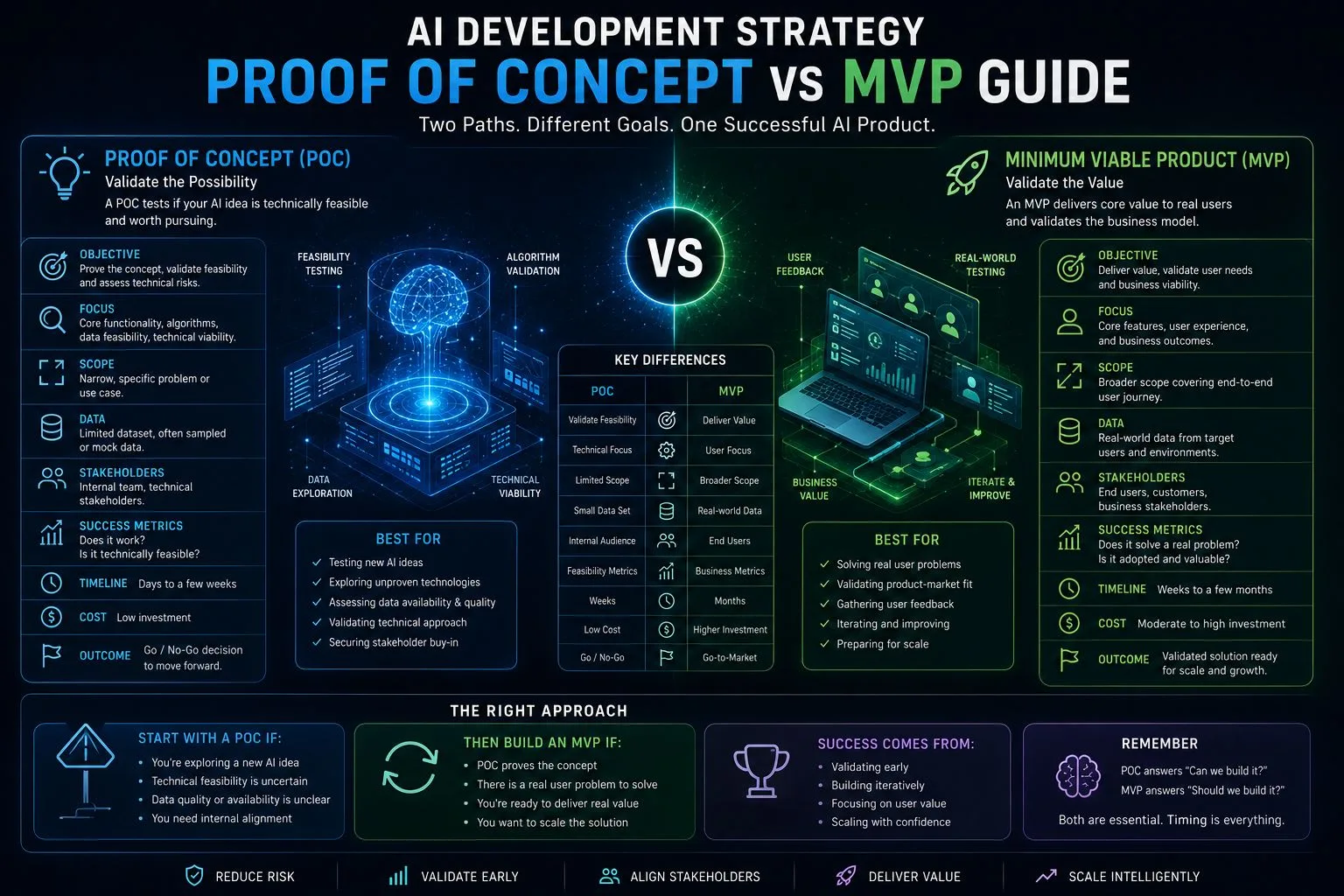
Overview
- Proof of Concept, Prototype, and MVP each serve a unique purpose. Using the wrong one at the wrong time can lead to budgetary issues and launch delays.
- One of the most common and expensive errors teams make when working with machine learning or large language models is to skip the PoC phase in AI development.
- The usual order is PoC → Prototype → MVP, but not every AI project requires all three stages. Knowing when to skip a stage is just as crucial as knowing when to use each one.
- The MVP is the first version of your product that real users interact with, while a prototype is still a tool for internal validation.
- Understanding the current stage of your project could save you months of rework and tens of thousands in wasted development costs.
Incorrect sequencing in AI development doesn’t just slow things down, it can derail the entire project before it ever reaches users.
Most AI teams jump straight into building without validating whether the technology actually works in their specific context, or whether users even want what they are building. The result is wasted sprints, confused stakeholders, and products that never make it past internal demos. Whether you are building a recommendation engine, a natural language processing tool, or a computer vision system, the path from idea to market follows a clear structure: Proof of Concept, Prototype, and MVP. Each stage answers a different question, involves different people, and produces a different output.
For those teams that are going through this process, having a well-defined AI development strategy is not a luxury, but a necessity. It can mean the difference between actually delivering something or just wasting your time. Resources from experienced AI development consultancies can offer frameworks that remove the guesswork from each stage.
PoC, Prototype, and MVP Are Distinct Tools
These three terms are often used interchangeably in product meetings, leading to confusion and miscommunication. A PoC is not simply a crude version of your product. A prototype is not a beta. And an MVP is not just a product with fewer features. Each one is a unique tool that is used to answer a specific type of question at a specific point in your project timeline.
Understanding Each Stage
Imagine each of the three stages as responding to three separate inquiries. A PoC inquires: is it possible for this technology to function in this setting? A Prototype inquires: will the intended users find this solution logical? An MVP inquires: will actual users adopt this in a real-world setting? The moment these questions become intertwined, you begin to create the wrong product for the wrong market at the wrong time.
Stage Core Question Primary Audience Output Proof of Concept Can this technically work? Internal engineers / stakeholders Feasibility report or demo Prototype Does this design make sense? Internal team / select testers Interactive model or mockup MVP Will users adopt this? Real end users in market Functional product with core features
Each stage feeds directly into the next. You use what you learn in the PoC to inform what you build in the prototype. You use what you learn in the prototype to decide what goes into the MVP. The entire point is to make your biggest decisions with the smallest possible investment of time and money.
Why Rushing Through Steps Is More Expensive Than It Seems
Jumping right into an MVP might seem like a good idea. In AI development, it’s usually not. AI systems have a level of technical uncertainty that traditional software doesn’t have. A language model that does well on benchmark data might completely fail when it comes across your specific dataset, domain, or user behavior. Finding out about that failure at the MVP stage — after you’ve built a whole product around it — is a lot more costly than finding it in a two-week PoC sprint.
The calculations are simple: a PoC could take an engineer two to four weeks to complete. If an MVP is built on a faulty technical assumption, it could take a full team six to twelve months of effort before anyone realizes that the core technology simply isn’t good enough to ship.
What does a Proof of Concept mean in AI Development?
A Proof of Concept is the first and most technically oriented phase of AI product development. It’s a brief, time-limited experiment that aims to answer a single question: can the technology do what we need it to do, in our specific environment, using our specific data? It’s not a product. It’s not a customer demonstration. It’s an internal technical validation exercise.
What is a PoC for?
A PoC isn’t about showing off. It’s about answering a technical question with evidence before you pour resources into it. In the world of AI, this usually means testing if a model architecture works well with your data, if your data pipeline is good enough, and if the infrastructure you have in mind can handle the system at the scale you need.
Let’s illustrate this with a scenario: A medical organization is considering the development of an AI system that can detect unusual lab results for further clinical analysis. Before they create a product, they conduct a PoC using half a year’s worth of past lab data to see if their selected classification model can reach the minimum 94% sensitivity threshold needed for clinical applications. If the model only reaches 91% on that data set, the PoC has prevented them from creating a product that would not pass regulatory scrutiny.
A PoC can take as little as a few days or as long as a few weeks. The main limitation is maintaining focus — you are only testing the most crucial technical assumption. If you find yourself creating user interfaces or designing onboarding processes during a PoC, you’ve already lost your way.
The result of a successful PoC isn’t a product, it’s a decision. You either find that the technology is feasible and you move forward to the prototyping stage, or you find it’s not feasible and you change your approach before you start spending big money on development.
What a PoC Looks Like in Practice
When it comes to AI development, a PoC usually involves a data scientist or machine learning engineer performing controlled experiments on a representative sample of real data. There is no front-end interface. There is no user journey. There might be a Jupyter notebook, a model evaluation report, and a brief technical summary presented to decision-makers. The sophistication is in the methodology and the rigor of the testing conditions, not in the presentation layer.
When Should You Use a PoC?
You should use a PoC when the most significant risk in your project is technological. This is nearly always the case when you’re dealing with machine learning models, large language models, computer vision, or any AI system where performance thresholds are important. If you’re unsure if your data is clean enough, if your model will generalize, or if your system’s latency is acceptable for real-time use, these are all PoC questions, not MVP questions.
What is a Prototype?
After your PoC verifies that the technology is technically possible, the prototype stage starts. A prototype is a preliminary, interactive version of your product that allows actual people — typically internal stakeholders, subject matter experts, or select test users — to experience the flow, interface, and functionality before anything is completely constructed. It serves as the link between technical validation and market validation.
In AI development, prototypes have several unique roles that are often underestimated:
- They expose usability problems with AI outputs before those problems are baked into production code
- They test whether users trust and understand the AI’s recommendations or outputs
- They reveal edge cases in user behavior that no engineer would have anticipated
- They give stakeholders something tangible to react to, which generates far more useful feedback than abstract descriptions
- They help define exactly which features belong in the MVP and which can wait
The prototype does not need to be powered by your actual AI model. Many effective AI prototypes use simulated outputs — sometimes called “Wizard of Oz” testing — where a human manually produces the responses the AI would eventually generate. This lets you validate the user experience completely independently of the underlying technology.
What Makes a Prototype Different From a PoC
The difference lies in who it’s for and why it’s made. A PoC is created for engineers and those who make technical decisions to assess if something can be done. A prototype is made for users and stakeholders to evaluate if something is beneficial and user-friendly. A PoC is found in a terminal or a notebook. A prototype is found in a browser, a Figma file, or a demo environment that can be clicked on.
What Should A Prototype Deliver?
A successful prototype should deliver three main things: confirmed user flows, a prioritized feature list for the MVP, and documented assumptions about how users will interact with the AI system. If your prototype doesn’t throw up any surprises, you likely didn’t test it with the right people or scenarios. The value of a prototype is directly proportional to how much it challenges your original assumptions about user behavior.
What Does Minimum Viable Product (MVP) Mean?
An MVP is the first version of your AI product that real users will use in a live environment. We’re not talking about internal testers or stakeholders here. We’re talking about actual end users using the product to solve a real problem in real conditions. The term was made popular by Eric Ries in The Lean Startup, and the core principle hasn’t changed: release the smallest version of your product that offers real value, then use real-world feedback to guide all future decisions.
When it comes to AI development, it’s hard to say what the “minimum viable” is. AI systems need to reach a certain level of performance before they can provide any value. For example, a recommendation engine that’s only correct 40% of the time isn’t just minimally viable — it actually damages user trust. This is why the PoC stage is so important for AI. You need to understand your performance floor before you can decide what minimum viable means for your product.
Where the MVP Concept Came From
Eric Ries came up with the MVP concept as part of his Lean Startup methodology, which he developed based on his observations of startups creating complex products that nobody in the market wanted. His original concept was straightforward: rather than spending a year building something in a vacuum, release the smallest possible version that still delivers the core value, then let actual user behavior — not internal opinions — guide every decision that follows.
When it comes to developing AI, this concept becomes even more important. AI products are fraught with uncertainty: the technology may function flawlessly, but users may not trust it, understand it, or incorporate it into their current workflows. The MVP stage is where you discover which of these issues are genuine and which ones you conjured up in a meeting room.
What Sets an MVP Apart From a Prototype
The most significant difference is the impact. If a person uses your prototype and runs into an issue, nothing tangible is at risk — you jot down observations and make improvements. If a person uses your MVP and runs into an issue, you lose a customer, harm confidence, or create a support request. An MVP is a legitimate product operating in a legitimate environment with legitimate consequences. It must be operational, secure, and capable of providing true value on its own. A prototype only needs to be sufficient to produce valuable feedback.
Essential Features vs. Optional Features
Deciding the scope of an MVP is often a hot topic in any product team, and in AI development, it’s even more so because there’s always one more model to improve, one more edge case to deal with, one more integration to implement. The discipline required is brutal prioritization: only include the features that are absolutely necessary for a user to experience the main value of the product. Everything else goes on a backlog. A natural language contract analysis tool doesn’t need to support multiple languages, have a version history, or team collaboration features in its MVP — it needs to accurately identify risk clauses in a contract and present them clearly. That’s all.
Comparing PoC, Prototype, and MVP
When you compare all three stages against the same criteria, the differences become clear. Teams that understand this comparison stop arguing about which stage they’re in and start making faster, better decisions.
- Purpose: PoC validates technical feasibility; Prototype validates usability and design; MVP validates market demand with real users
- Audience: PoC targets engineers and technical leads; Prototype targets internal stakeholders and select testers; MVP targets real end users
- Fidelity: PoC is low fidelity with no user interface required; Prototype is medium fidelity with interactive elements; MVP is high fidelity and fully functional
- Duration: PoC typically runs days to two weeks; Prototype runs two to six weeks; MVP development runs six weeks to several months depending on complexity
- Success Metric: PoC succeeds when a technical question is answered; Prototype succeeds when user flows are validated; MVP succeeds when users return and engage repeatedly
- Risk Addressed: PoC addresses technical risk; Prototype addresses design and usability risk; MVP addresses market and adoption risk
What this comparison reveals is that each stage is designed to eliminate a specific category of risk before you invest in the next level of effort. This is not a bureaucratic process — it is a capital efficiency strategy. The goal is always to make your most expensive decisions with the most available evidence.
Teams that try to cut corners and skip stages aren’t actually saving time. They’re just pushing risk further down the line, where it becomes increasingly costly to deal with. Catch a usability issue during prototyping, and it might take a few days of design tweaks to fix. But if that same issue isn’t caught until after an MVP launch, you’re looking at user churn, negative reviews, and months of scrambling to fix the product.
How Long Each Stage Takes
The time it takes to develop a Proof of Concept (PoC) in AI can vary greatly, as it largely depends on how readily available the data is and how prepared the infrastructure is. A team that already has clean, labeled data and a cloud infrastructure in place could have a PoC ready in as little as three to five days. However, a team that first needs to find, clean, and label training data could take three to four weeks just to get started. The time it takes to develop a prototype is usually more predictable, with most AI prototypes taking anywhere from two to six weeks to build and test, depending on how complex the user flows being validated are. The time it takes to develop a Minimum Viable Product (MVP) can vary the most, ranging from six weeks for a tool with a narrow scope to six months or more for a complex system with multiple models and integration requirements.
Who is Responsible for Testing at Each Stage
Most teams don’t ask this question outright, but it’s an important one. At the PoC stage, the testers are engineers and data scientists who are assessing model performance against established metrics — accuracy, F1 score, latency, or whatever threshold the use case requires. At the prototype stage, the testers are a combination of internal stakeholders and carefully chosen external users who represent your target market but who are aware they are evaluating an early model. At the MVP stage, the testers are actual users with no special context — they are interacting with what they believe is a finished product, and their behavior is the only feedback signal that matters.
How to Tailor Your Pitch to Investors at Each Stage
When you are looking for funding or trying to get a budget approved, the stage you are at should directly shape how you frame the conversation. A PoC tells investors: “We have proven that this technology works for our specific use case, and here is the evidence.” A prototype tells them: “We have validated that users understand and want to engage with this solution.” An MVP tells them: “We have real users generating real data, and here is what the retention and engagement metrics look like.”
Every phase signifies a unique decrease in risk, and investors directly price that risk reduction. Turning up at a funding conversation with a PoC result rather than just a pitch deck could mean the difference between a term sheet and a polite rejection. Turning up with MVP traction data is a completely different conversation than either of those. Understand what phase you’re in, and lead with the evidence that phase provides.
How to Progress From PoC to Prototype to MVP
Progressing between stages is not a simple process, nor is it just about ticking off boxes on a list. Each stage concludes with a conscious choice — a go/no-go decision based on the evidence at hand. Advancing without this clear decision point is how teams fall into the trap of endlessly building without ever delivering a product.
Step 1: Validate Technical Feasibility With a Proof of Concept
Begin by identifying the highest-risk technical assumption in your AI project. This is not the most interesting one or the one your engineers are most excited to solve. This is the one that, if it turns out to be incorrect, means the entire product concept fails. Design your proof of concept to test that assumption exclusively. Set a clear performance threshold before you start — if your natural language processing model needs to achieve 85% intent classification accuracy to be useful, define that number upfront and treat anything below it as a failed proof of concept. This pre-commitment prevents the common pattern of retrospectively lowering standards to justify moving forward.
Step 2: Construct and Evaluate a Prototype
After your PoC verifies technical viability, avoid the temptation to instantly start constructing the actual product. The prototype phase is necessary because technical viability and user appeal are entirely separate issues. Construct the most basic interactive version of your product that allows representative users to experience the core value proposition. Evaluate it with at least five to eight users in your target segment, paying particular attention to instances of confusion, skepticism of AI outputs, or unforeseen workflow friction. Record every assumption that is questioned. The prototype is complete when you have a validated user flow and a clear, evidence-supported feature priority list for your MVP.
Step 3: Release a Working MVP to Real Users
The MVP release isn’t a soft internal launch — it’s a purposeful market entry with defined success metrics established before launch. For an AI product, those metrics should include both engagement metrics (do users come back?) and performance metrics (is the AI delivering accurate, useful results at scale?). Build the minimum feature set that delivers the core value identified in your prototype stage, and ship it to a controlled initial user group. Use quantitative data — session length, return rate, task completion rate — as your main feedback signal, supplemented by direct user interviews.
It’s all too common for teams to view the MVP as a final product, rather than a tool for learning. Every interaction your users have with the MVP is generating data that should directly inform your next development sprint. Teams that treat the MVP launch as the end of the validation process and the beginning of pure feature-building miss the entire point of the methodology. The MVP is where the real learning begins.
Is It Always Necessary to Go Through All Three Stages?
- If the technology is already well-understood and has been proven, you may not need the PoC
- If your users are internal and the interface is simple, you may not need a prototype
- If you are building on top of an existing AI platform or API, the technical risk is lower and the need for a PoC is significantly reduced
- If you have direct, continuous access to your target users during development, you can gather feedback on the prototype informally without a dedicated stage
- If the product is an iteration of something that already exists in your organization, prior validation may carry over
The truth is, not every AI project needs all three stages. The framework is there to eliminate specific categories of risk, and if a particular risk category simply does not apply to your project, the corresponding stage may not add value. The question to ask at each decision point is: what is the biggest unresolved risk right now, and which stage is specifically designed to resolve it?
Teams often make the mistake of saying “we don’t need all three stages” as an excuse to move quickly, rather than as a genuine assessment of risk. It’s smart product development to skip a stage if the risk it addresses is genuinely low. But if you skip a stage just because you’re eager to start building, you might end up with a product that’s technically impressive but that no one uses, or a product that’s beautifully designed but that’s built on a model that doesn’t work reliably in production.
The most accepted way to save time in AI development is to forego the PoC when you are creating on a proven, thoroughly documented AI service — like OpenAI’s GPT-4, Google’s Vertex AI, or AWS Rekognition. These platforms have shared performance benchmarks, extensive real-world usage data, and predictable behavior across common use cases. If your application is a perfect fit within a documented, thoroughly tested use case for one of these services, the technical feasibility question is largely already answered and you can move directly to prototyping.
No matter what technology you’re using, one thing you can’t ignore is the need to validate user behavior. The prototype stage isn’t just about testing the technology – it’s about seeing if real people can understand, trust and incorporate your AI system into their daily routines. This is a question that can’t be answered in advance by a vendor’s benchmark data, and it’s the one that most often catches even experienced AI product teams off guard.
Selecting the Appropriate Phase for Your AI Initiative
The phase you initiate should be dictated solely by where the greatest amount of unaddressed risk is present in your project at this moment. It should not be influenced by your schedule, stakeholder pressure, or the phase your competitors seem to be in. A thorough, truthful risk assessment at the start will show you precisely where to start.
When to Consider a Proof of Concept
Consider a proof of concept (PoC) when you are using a new model architecture, an untested data source, a specialized domain where general models typically do not perform well, or any use case where a specific performance threshold is a must. This includes medical diagnoses, financial risk scoring, or safety-critical industrial systems. A PoC is also necessary if your team has no experience with the specific AI technology your project needs or if there is any real internal disagreement about whether the technical approach will work. The existence of that uncertainty alone is enough reason for a PoC sprint before any design or product work starts.
Indications That You’re Prepared to Construct an MVP
You’re prepared to go straight to an MVP when the technical strategy has been validated — either through your own PoC findings or through directly comparable production deployments — and when your prototype testing has yielded a validated, stable user flow with documented feature priorities. Specifically, you should have a defined performance baseline your AI system is already meeting, at least one round of prototype feedback from representative users, a clear and agreed-upon definition of “minimum viable” for your specific use case, and a set of pre-defined success metrics you will measure after launch. If all four of those conditions are met, continuing to prototype or iterate internally is just delay dressed up as diligence.
Begin at the Appropriate Stage and Develop with Assurance
Every AI product that has been successful in the past ten years has followed some sort of this validation sequence, even if the teams involved did not explicitly call it that. The practice of answering technical questions before design questions, and design questions before market questions, is what distinguishes products that are shipped and scaled from projects that are stuck in endless development cycles. Identify where your highest unresolved risk is right now, match it to the stage that is designed to resolve it, and start there with a clear success criterion and a defined exit point. That single decision, made correctly at the beginning, is the basis of every effective AI development strategy.
Common Questions
These are the most common questions that AI development teams ask when they are deciding between a PoC, Prototype, and MVP for the first time.
What distinguishes a PoC from an MVP?
A Proof of Concept asks: is it possible to use this technology in this context? It’s an internal, technical trial that generates proof of practicality, not a product. An MVP asks: will actual users accept this? It’s a working product that’s released to real end users in a live setting, with the goal of collecting real user behavior data.
The key difference lies in the audience and the results. Engineers assess a PoC against performance metrics. The market, on the other hand, assesses an MVP through usage behavior. Mixing up the two could result in either releasing unproven technology to actual users or treating an internal demo as market validation. Both of these scenarios can lead to dangerously misleading conclusions.
Is it possible to bypass the prototype stage and move directly to an MVP?
Yes, under certain conditions. If you have very close, ongoing contact with your target users throughout development — which is typical in enterprise B2B AI tools where the end users are coworkers or current customers — informal usability feedback can take the place of a formal prototype stage. Likewise, if your MVP is a narrow, single-function tool with a self-explanatory interface, the design risk that prototyping mitigates may be minimal enough to bypass.
But, when it comes to AI development, bypassing the prototype stage can be risky in a way that it isn’t with traditional software. This is because users often find it hard to gauge how much they should trust the outputs of AI, and this issue only comes to light when real users start to interact with the interface. If your AI system makes recommendations, predictions or automated decisions that users have to act on, it’s almost always worth investing in a prototype test. This is because if you discover a trust issue after you’ve launched your MVP, it’s going to be a lot harder and more costly to put right than if you’d caught it in a Figma prototype.
How much time does it take to create an MVP?
For the majority of AI products, MVP development takes between six weeks and six months. A single-model tool with a simple interface and an existing data pipeline can reach MVP in six to eight weeks if it has a narrow scope. A multi-model system with complex integrations, regulatory requirements, or significant data preparation needs can take four to six months or longer. The most effective way to shorten MVP timelines without increasing risk is to ruthlessly narrow the feature scope — every feature added to the MVP definition extends the timeline and increases the surface area for things to go wrong before you have real user data to guide your decisions.
Is a proof of concept the same as a pilot?
No, they are not the same, and the difference is crucial in AI development. A proof of concept (PoC) is a technical experiment carried out internally before product development starts. It doesn’t involve actual users, a live environment, or production infrastructure. A pilot, on the other hand, is a controlled, limited deployment of a functioning product to a small group of actual users in a real environment. It is more similar to a limited MVP launch than a PoC.
After you’ve completed both the PoC and prototype stages, you’re ready to move on to the pilot stage, where your functional product gets a little bit of real-world exposure. It’s problematic when organizations refer to their early technical experiments as “pilots” because it implies that the product is ready for users and is more complete than a PoC. By being precise about what stage you’re in, you can keep everyone’s expectations — from the technical team to the product team to leadership — in alignment.
How does an MVP differ from a prototype?
The primary difference is the completeness and impact of the product. A prototype is an interactive model that can look and feel like the real thing, but it doesn’t have to work reliably, handle edge cases, or scale to real usage. It’s designed to gather feedback in a controlled environment. An MVP, on the other hand, is a real, functional product that has to work reliably because real users are counting on it to provide real value.
When it comes to AI development, a prototype may use simulated or manually generated AI outputs to test user experience without the underlying model. An MVP needs to be powered by the actual AI system that performs at or above the minimum threshold you defined in your PoC. The transition from prototype to MVP is not just an increase in fidelity – it’s a fundamental shift from internal experimentation to external accountability.
Teams that treat their MVP like a prototype — releasing it without adequate performance validation, or with the expectation that users will tolerate significant errors because “it’s an early version” — consistently underperform in user acquisition and retention. Users do not grade AI products on a curve. If the AI does not deliver reliable value from the first session, most users will not return for a second one. That reality is why the full PoC → Prototype → MVP sequence exists, and why following it correctly is the most dependable path to an AI product that actually succeeds in the market. For teams looking to navigate this process with experienced guidance, working with a specialized AI development partner can compress timelines and significantly reduce the risk of costly missteps at each stage.