


Key Takeaways:
- Bankers are predicting positive changes in 2026, including changes or clarifications to existing stablecoin legislation, reductions in enforcement actions, and eased capital requirements.
- Recession woes are the top concern for bankers heading into 2026, followed by cybersecurity threats and fraud in traditional payments channels.
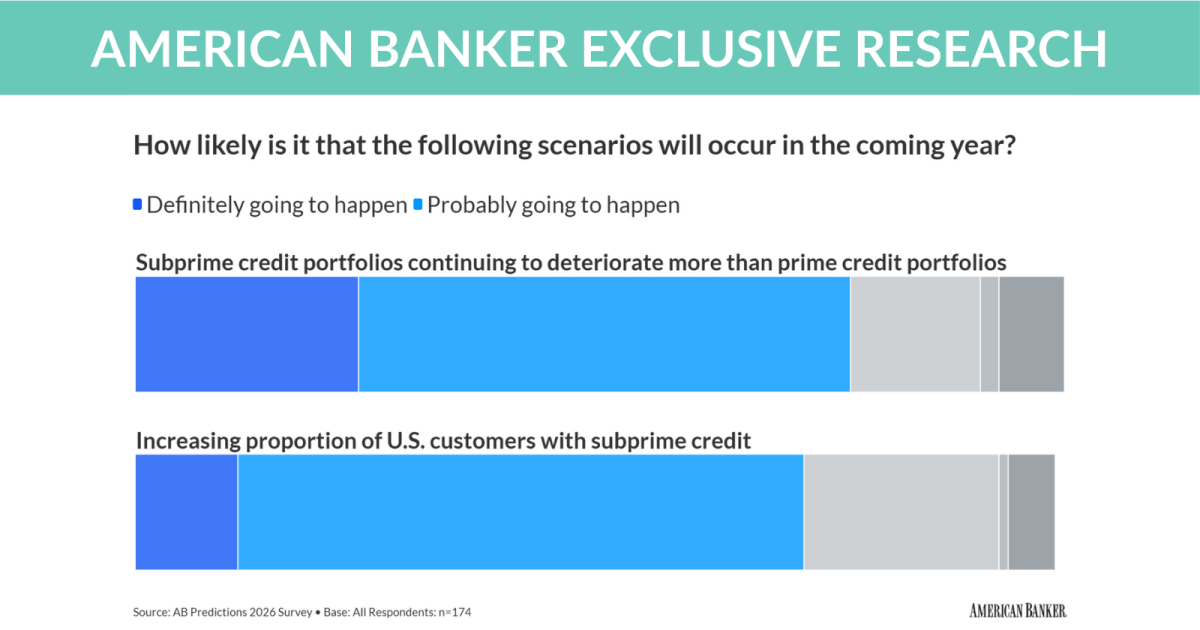
- The subprime credit landscape is poised to change for the worse in 2026, with 77% of respondents saying it is somewhat likely that subprime credit portfolios will continue to deteriorate at a faster rate than prime credit portfolios.
- Bankers are also concerned about technology challenges, competition from other banks or credit unions, and account takeover fraud or scams.
- The banking industry is expected to face significant risks in 2026, including economic turmoil, cybersecurity threats, and fraud.
Introduction to the 2026 Predictions Report
The banking industry is bracing itself for a wave of changes in 2026, with bankers predicting both positive and negative developments. The American Banker’s 2026 Predictions report, which surveyed 174 banking professionals, provides insight into the industry’s expectations for the coming year. The report highlights key areas of change, including legislative shifts, economic conditions, and technological advancements. With interest rate cuts, artificial intelligence policies, and cryptocurrency legislation all on the horizon, bankers are preparing for a potentially tumultuous year.
Key Areas of Change in the Banking Industry
Bankers are eyeing a wave of legislative shifts for 2026, with 66% of respondents predicting changes or clarifications to existing stablecoin legislation. This is seen as a positive development for financial institutions, with 51% of respondents stating that it would have a positive impact. Additionally, 63% of bankers predict that regulators will reduce enforcement actions, and 52% expect eased capital requirements for banks. These changes are seen as positive for the industry, with respondents predicting that they will lead to increased investment and growth. However, not all predictions are positive, with 25% of bankers predicting that the banning of Section 8 housing vouchers is a moderate possibility in 2026, and 35% predicting that this shift will be detrimental to the industry.
Downcast Expectations for 2026
Despite some positive predictions, bankers are generally pessimistic about the start of 2026. Worries about economic turmoil, cybersecurity threats, and fraud are all weighing on the industry. The issue with the most negative impact on banking institutions, as identified by 45% of bankers, is a recession or economic downturn. This is followed by cybersecurity threats, which 33% of bankers see as a major concern, and fraud in traditional payments channels, which 27% of bankers identify as a key issue. Other top concerns include technology challenges, competition from other banks or credit unions, and account takeover fraud or scams. These concerns are likely to have a significant impact on the industry, with bankers predicting that they will lead to increased costs and decreased profitability.
Reading the Tea Leaves in Subprime Credit Quality
Bankers are also looking beyond legislative uncertainty and other worries to keep tabs on another looming threat: subprime credit. Data from the American Financial Services Association has shown evidence of a trend already appearing, with the outlook for loan performance among subprime consumers falling considerably between the second and third quarters of this year. Roughly 77% of respondents say it is somewhat likely that subprime credit portfolios will continue their descent at a faster rate when compared against prime credit portfolios. This is seen as a major risk for the industry, with 49% of respondents predicting that it will have a significant impact on the U.S. banking industry as a whole. The deterioration of subprime credit portfolios is seen as a major concern, with 22% of respondents saying it creates a lot of risk and 47% saying it creates moderate risk.
Conclusion and Future Outlook
In conclusion, the banking industry is facing a complex and challenging landscape in 2026. While there are some positive predictions, including changes to stablecoin legislation and eased capital requirements, there are also significant concerns about economic turmoil, cybersecurity threats, and fraud. The subprime credit landscape is also poised to change for the worse, with 77% of respondents predicting that subprime credit portfolios will continue to deteriorate at a faster rate than prime credit portfolios. As the industry looks to the future, it is clear that bankers will need to be prepared to adapt to a rapidly changing environment, with a focus on managing risk and investing in new technologies to stay ahead of the curve. By understanding the key areas of change and the concerns of bankers, the industry can work to mitigate the risks and capitalize on the opportunities presented by the coming year.