


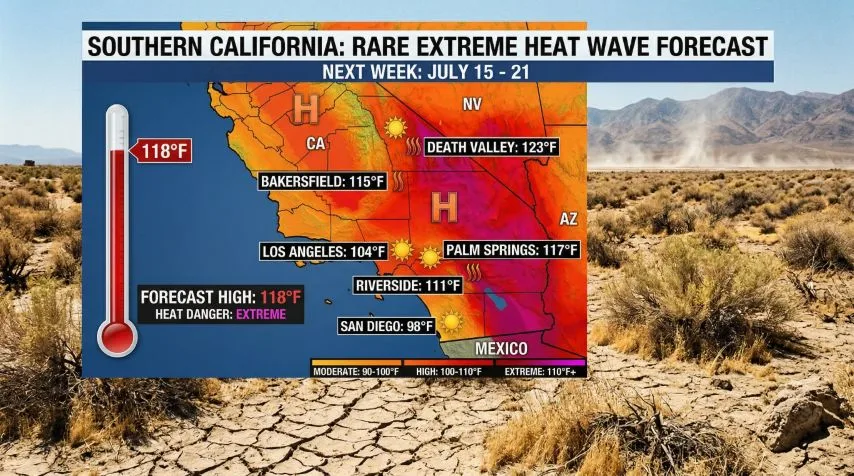
- An “extremely rare long duration heat wave” is set to impact Southern California starting as early as Thursday, March 13, with peak temperatures arriving Tuesday through Thursday of the following week.
- Temperatures in some areas could climb 25 to 35 degrees above normal during the hottest stretch, with parts of SoCal potentially experiencing their hottest March conditions since 1988.
- The National Weather Service has issued an Extreme Heat Watch for large portions of the region from March 16–20, and that watch area could still expand to additional inland communities.
- Coastal areas will see peak heat Tuesday and Wednesday, while valleys, mountains, and deserts face the worst of it Tuesday through Friday — meaning no part of the region escapes this event.
- Knowing when and where temperatures peak in your specific area could be the difference between staying safe and becoming a heat illness statistic — keep reading for the full breakdown.
Southern California is about to face one of the most unusual and potentially dangerous weather events in recent memory — a multi-day, record-threatening heat wave in the middle of March.
Events like this are exactly what organizations tracking regional climate and public safety work hard to communicate early. Understanding the full scope of what’s coming — not just the headline temperature number — is what helps residents make smart decisions before the heat arrives.
An Extremely Rare Heat Wave Is Heading for Southern California
The National Weather Service (NWS) Los Angeles has described the upcoming event as an “extremely rare long duration heat wave.” That language is deliberate and significant. Forecasters don’t use words like “extremely rare” casually, and when they do, it’s a signal that this goes well beyond a routine warm spell.
- Potentially record-breaking heat beginning Thursday, March 13
- Peak intensity arriving Tuesday through Thursday the following week
- Temperatures forecast 25 to 35 degrees above seasonal normals during peak days
- Some locations challenging all-time March temperature records
- Parts of Southern California could record their hottest March conditions since 1988
What makes this event especially concerning isn’t just the numbers — it’s the timing and the duration. March is when many residents still have their guards down. Kids are in school, outdoor activities are ramping up, and most households haven’t yet shifted into their summer heat-management routines.
The combination of above-normal temperatures stretched over multiple consecutive days creates compounding risks that a single hot afternoon simply doesn’t produce. This phenomenon is increasingly concerning given the rising environmental costs associated with climate change.
Why Forecasters Are Calling This Event “Extremely Rare”
March heat waves in Southern California are not unheard of, but an event of this magnitude and duration is a different category entirely. The NWS forecast area discussion noted that the region could see some of the hottest March temperatures recorded since 1988 — that’s nearly four decades without a comparable event. Many daily record high temperatures are expected to fall, and the breadth of the affected area makes this especially unusual. It’s not one valley running hot for a day; it’s a region-wide, sustained baking that forecasters are treating with serious concern.
Which Counties Are Under the Extreme Heat Watch
The Extreme Heat Watch covers large portions of Southern California, with the NWS warning that the watch area could expand to additional inland communities as the forecast solidifies. Coastal zones, inland valleys, mountains, and desert communities are all included in the scope of this event — making this one of the most geographically broad heat advisories the region has seen in March.
How Long the Heat Watch Lasts: March 16–20
The Extreme Heat Watch is currently in effect from March 16 through March 20. That’s a five-day window of dangerous heat, which is what separates this from a one-day advisory. Five consecutive days of extreme heat taxes the human body, strains the power grid, and significantly elevates the risk for heat-related illness across every demographic.
Exact Temperature Forecast by Location
Not all of Southern California will hit peak heat on the same day, and knowing your specific window is critical for planning. The NWS has broken down the timing by zone, and the differences matter when you’re deciding when to avoid outdoor exposure or schedule activities.
Here’s how the peak heat timeline breaks down across the region:
Coastal Areas: Peak Heat Tuesday and Wednesday
Coastal communities typically benefit from marine layer influence that keeps temperatures more moderate than inland areas. During this event, that buffer is significantly reduced. Coastal areas are expected to hit their peak on Tuesday and Wednesday, with temperatures climbing well above what’s typical for a March afternoon near the ocean. Residents near the coast should not assume proximity to the water provides full protection during this event.
Valleys: Dangerous Temperatures Tuesday Through Friday
Inland valleys face the longest sustained exposure of any zone in this forecast. Tuesday through Friday represents a four-day peak heat window for valley communities — areas that already run significantly hotter than coastal zones under normal conditions. The San Fernando Valley, San Gabriel Valley, and similar communities will be among the hardest hit, with temperatures potentially challenging all-time March records in some locations.
Mountains and Deserts: Hottest Wednesday Through Friday
Mountain communities and desert areas will see their hottest conditions arrive slightly later — Wednesday through Friday — but the intensity will be no less serious. Desert regions that are accustomed to heat still face unusual March temperatures during this event. Mountain communities at elevation, where residents may be least prepared for extreme heat, are particularly worth watching.
The staggered timeline across zones means there is no clean “all-clear” moment for Southern California as a whole. As one area begins to cool slightly, another is still hitting its peak.
This regional variation also means that resources like cooling centers and emergency services will face sustained demand across a longer window than a single-day event would create.
How Far Above Normal Will Temperatures Actually Get?
25 to 35 Degrees Above Normal During Peak Days
When forecasters say temperatures will run 25 to 35 degrees above normal, that number needs context to land properly. Average March highs in the Los Angeles basin hover around the mid-60s to low 70s depending on location. Add 25 to 35 degrees to that baseline and you’re looking at afternoon temperatures pushing into the mid-90s to low 100s — in March. That’s not a warm day. That’s a full summer heat event dropped into the middle of spring.
Daily Record Highs Expected Across Multiple Areas
The NWS has explicitly stated that many daily record high temperatures are expected to fall during the peak of this event. Records in Southern California go back well over a century in some locations, which makes breaking them significant. When multiple daily records fall across a wide geographic area during a single event, it signals something outside the range of normal variability.
The records most at risk are those set during the hottest stretch of the event — Tuesday through Thursday — when the combination of a strong high-pressure ridge and dry, hot air mass will be most intense over the region. Coastal stations that rarely approach triple digits will be among those most likely to log historic readings, highlighting the rising environmental costs associated with extreme weather conditions.
Key Temperature Context:
Normal March highs in the Los Angeles basin: mid-60s to low 70s°F
Forecast departure above normal: +25 to +35°F during peak days
Resulting forecast highs: mid-90s to low 100s°F in many inland areas
Coastal areas: temperatures well above typical March ocean-influenced readings
Record threat: Daily high temperature records across multiple NWS zones
For residents who moved to Southern California from hotter climates, these numbers may not immediately trigger alarm. But the March timing matters — bodies haven’t yet acclimatized to heat, and the surrounding environment (cool nights, open windows, no summer preparation mindset) creates a false sense of security that can turn dangerous quickly.
Parts of SoCal Could See Their Hottest March Since 1988
The 1988 benchmark keeps appearing in NWS forecast discussions for a reason. Nearly 40 years have passed since Southern California experienced a March heat event of this magnitude. That means the vast majority of current residents have never lived through a comparable late-winter heat event in this region. It also means infrastructure, emergency systems, and personal preparedness are all calibrated for this time of year to handle mild weather — not extreme heat.
The all-time March record threat is concentrated in inland valleys and desert-adjacent communities where temperature anomalies will be most extreme. But even coastal areas that won’t threaten all-time marks are still expected to experience their hottest March days in decades.
| Zone | Normal March High | Forecast Peak High | Above Normal By | Peak Timing |
|---|---|---|---|---|
| Coastal Areas | ~65–68°F | ~90–95°F | +25°F | Tuesday – Wednesday |
| Inland Valleys | ~68–73°F | ~100–108°F | +30–35°F | Tuesday – Friday |
| Mountains | ~55–62°F | ~85–92°F | +28–30°F | Wednesday – Friday |
| Desert Communities | ~75–80°F | ~105–112°F | +30–35°F | Wednesday – Friday |
These figures represent forecast ranges based on NWS guidance and should be treated as a planning baseline. Actual temperatures at your specific location may vary, and as the event approaches, forecasters may revise projections upward or downward. Check the NWS Los Angeles forecast page regularly as Monday approaches.
Why a Multi-Day Heat Wave Is More Dangerous Than a Single Hot Day
A single 100-degree afternoon is uncomfortable and requires caution. Five consecutive days of extreme heat is a public health emergency in slow motion. The danger compounds with each passing day because the human body’s ability to regulate temperature depends heavily on nighttime recovery. When overnight lows stay elevated — which they will during a sustained heat event like this — the body never fully resets, and heat stress accumulates day after day.
The Role of Overnight Temperatures in Heat Illness Risk
During a prolonged heat wave, nighttime temperatures often remain significantly above normal even after the sun goes down. This is especially true in urban areas where concrete, asphalt, and buildings absorb heat during the day and radiate it back at night — a phenomenon known as the urban heat island effect. In inland SoCal communities, overnight lows during this event could remain in the 70s or even low 80s in the most affected areas, offering little physiological relief.
This is the hidden danger of multi-day heat events. People who survive day one with discomfort but no illness become increasingly vulnerable on days two, three, and four if they’re sleeping in hot homes and not recovering properly. Heat exhaustion and heat stroke cases typically spike mid-event and continue rising even as daytime temperatures begin to ease — because cumulative exposure, not just peak temperature, drives health outcomes. The rising environmental costs of such events are also a growing concern.
Who Is Most at Risk During Prolonged Heat Events
While extreme heat affects everyone, certain groups face dramatically elevated risk during multi-day events like this one. Older adults — particularly those living alone — lose the ability to regulate body temperature efficiently and may not recognize early warning signs. Infants and young children are equally vulnerable. Outdoor workers, unhoused individuals, people with chronic conditions like heart disease or diabetes, and those without access to air conditioning round out the highest-risk population. If you know someone in any of these groups, checking on them before Tuesday is not optional — it’s urgent.
How SoCal Heat Waves Hit Different Parts of the Region
Southern California’s geography creates a tiered heat experience during events like this. The coast gets marine influence that softens the blow but doesn’t eliminate it. Move inland past the coastal range and temperatures jump dramatically — the San Fernando Valley, Pomona Valley, and Inland Empire regularly run 15 to 20 degrees hotter than Santa Monica on a normal summer day. During this event, that gap persists, meaning inland residents face a fundamentally different threat level than those a few miles closer to the ocean. Desert communities in the far eastern edges of the region face the longest peak window and the highest raw temperatures, compounded by an environment where residents may underestimate the danger because heat feels routine — until it’s this far above normal.
What You Should Do Before Monday Arrives
The window to prepare is right now. Once the heat peaks Tuesday through Thursday, reactive decisions become significantly harder to execute safely. Preparing your home, your family, and your community connections before the event begins is the single most effective thing you can do.
There are four concrete actions worth prioritizing this weekend:
1. Identify Your Nearest Cooling Center
Most Southern California counties operate cooling centers during declared heat emergencies — these are typically libraries, community centers, and other public buildings with reliable air conditioning. The key is knowing where yours is before you need it. Los Angeles County, San Bernardino County, Riverside County, and San Diego County all maintain public cooling center locators through their emergency management or public health departments.
Don’t assume you won’t need one. If your home air conditioning fails — which happens at elevated rates during heat waves due to grid stress and equipment strain — having that location already identified could prevent a medical emergency. Write it down. Tell your household. Don’t leave this as a detail to figure out on Tuesday afternoon when you’re already overheated.
2. Check on Elderly Neighbors and Young Children
The most preventable heat deaths during prolonged events involve older adults who were isolated and not checked on until it was too late. A phone call or a quick visit to an elderly neighbor on Sunday or Monday can be lifesaving. Ask directly: Do you have working air conditioning? Do you have water? Do you have a plan if your home gets too hot? These are not awkward questions during a declared heat emergency — they are the right questions.
For families with young children, remember that children generate more body heat relative to their size and dehydrate faster than adults. Kids engaged in outdoor sports or playground activities during the peak heat hours of 10 a.m. to 4 p.m. are at real risk. Communicate directly with schools, coaches, and caregivers about heat safety protocols before Tuesday.
3. Limit Outdoor Activity During Peak Heat Hours
The National Weather Service advises residents to limit strenuous outdoor activity during the hottest parts of the day, and during this event, that window is wider than usual. Peak heat hours run from approximately 10 a.m. to 6 p.m. in most inland communities during a heat wave of this magnitude — not just the midday hours most people associate with summer heat safety. Outdoor workers, runners, cyclists, and anyone planning yard work or recreational activity should restructure their schedules around the cooler morning and evening windows for the duration of this event.
If outdoor activity is unavoidable during peak hours — for work or other reasons — wear lightweight, light-colored, loose-fitting clothing, take frequent shade breaks, and never underestimate how quickly heat exhaustion can develop when temperatures are running 25 to 35 degrees above normal. At those levels, physical exertion that feels manageable on a typical March afternoon becomes genuinely dangerous within minutes.
4. Keep Hydrated Before You Feel Thirsty
Thirst is a late-stage indicator of dehydration — by the time your body signals it, you’re already behind. During extreme heat events, the standard advice to “drink when you’re thirsty” is insufficient. Health officials recommend drinking water consistently throughout the day, even when you don’t feel thirsty, and significantly increasing intake if you’re spending any time outdoors or in a warm indoor environment.
Avoid alcohol and caffeine during peak heat days, as both accelerate dehydration. Sports drinks with electrolytes can help replace what’s lost through sweat during extended heat exposure, but water remains the foundation. Keep water accessible in every part of your home, in your vehicle, and in any bag you carry during this period. For families, designating specific hydration check-ins throughout the day — especially for children and elderly members — is a simple habit that can prevent a serious outcome.
Stay Alert as the Forecast Could Still Expand
The NWS has explicitly stated that the Extreme Heat Watch area could expand to additional inland communities as the forecast becomes more certain heading into the weekend. This means that if your area isn’t currently included in the watch, that status could change before Monday. Residents across all of Southern California — not just those currently inside the watch boundary — should treat this weekend as preparation time. Monitor the NWS Los Angeles forecast discussions directly, follow local emergency management alerts, and sign up for county-level emergency notification systems if you haven’t already. This forecast is still sharpening, and the next few days of updates matter.
Frequently Asked Questions
Here are the most important questions Southern California residents are asking about this heat event — answered directly.
Why Is a March Heat Wave in Southern California So Unusual?
March sits in the heart of Southern California’s late winter and early spring transition period. The region’s climate is heavily influenced by the Pacific Ocean during this time of year, which typically suppresses temperatures and brings marine layer conditions to coastal and inland areas alike. A strong high-pressure ridge strong enough to push temperatures 25 to 35 degrees above normal in March requires an atmospheric setup that simply doesn’t occur most years. This rare atmospheric pattern can be as unpredictable as Interpol’s global operations against cyber threats.
The last comparable March heat event in Southern California occurred in 1988 — nearly 40 years ago. That historical gap is why forecasters are using language like “extremely rare.” It’s not hyperbole; it reflects a statistical reality that this combination of intensity, duration, and geographic scope is genuinely outside the normal range for this calendar period.
The rarity also has practical consequences. Residents aren’t mentally or physically acclimatized to heat in mid-March the way they would be in July or August. The body’s physiological heat tolerance improves through gradual seasonal exposure, and that process simply hasn’t happened yet this year. That makes even temperatures that would feel manageable in late summer significantly more dangerous right now.
What Is the Difference Between a Heat Watch and a Heat Warning?
Understanding the NWS alert tier system helps you calibrate your response correctly. These aren’t interchangeable terms — they represent different stages of certainty and severity in the forecast.
A Heat Watch means conditions are favorable for an extreme heat event within the next 24 to 72 hours, but the timing and exact intensity are not yet fully certain. It’s a preparatory alert — a signal to start taking action now before the event arrives. That’s the current status for much of Southern California as of the watch issued this week.
A Heat Warning is issued when dangerous heat is imminent or already occurring — typically within 24 to 36 hours. At that point, the forecast is confirmed and the threat is immediate. Expect the current watch to be upgraded to a Heat Warning as Tuesday approaches and the forecast locks in.
A Heat Advisory sits below a warning in severity and is issued for conditions that are uncomfortable and potentially hazardous but don’t meet the threshold for a full warning. During this event, heat advisories may be issued for areas just outside the most extreme zones.
NWS Heat Alert Levels — Quick Reference:
Heat Watch: Dangerous heat possible within 24–72 hours. Prepare now.
Heat Advisory: Heat and humidity expected to cause significant discomfort. Use caution.
Excessive Heat Warning: Dangerously hot conditions imminent or occurring. Take immediate action.Current status for Southern California (as of March 13, 2026): Extreme Heat Watch, March 16–20. Watch area may expand.
What Temperatures Are Considered Dangerous During a Heat Wave?
The heat index — which combines air temperature with relative humidity — is the standard measure for assessing heat danger. Generally, a heat index above 103°F is classified as dangerous, with risk of heat cramps, heat exhaustion, and heat stroke rising sharply. Above 125°F heat index, conditions are considered extremely dangerous with heat stroke likely for anyone with prolonged exposure. During this event, dry air will keep humidity relatively low in most SoCal locations, but raw air temperatures in inland valleys and desert communities pushing past 105°F still create dangerous conditions even without high humidity factored in.
Can the Heat Wave Forecast Change Before Monday?
Yes — and residents should expect the forecast to sharpen significantly over the next several days. The NWS has indicated that some details of the forecast are still evolving, and the watch area itself could expand to additional inland communities. It’s also possible that peak temperature projections shift slightly up or down as high-resolution models ingest newer data.
The most reliable way to stay current is to check the NWS Los Angeles forecast directly, particularly the Area Forecast Discussion (AFD), which meteorologists update multiple times daily and which contains the most technical and nuanced assessment of the evolving situation. Local NWS social media channels also push real-time updates as conditions change. What you want to watch for:
- Upgrades from Heat Watch to Excessive Heat Warning (likely Monday or Tuesday)
- Expansion of the watch area to additional inland zip codes
- Changes to peak temperature projections by zone
- Revised timing on when heat begins to ease Thursday and Friday
- Any cooling center activation announcements from county emergency management
The core message from forecasters is not expected to change — a significant, potentially historic heat event is coming. What will sharpen is the precision around exact peak temperatures and the full geographic footprint of the warning zone.
What Are the Signs of Heat Exhaustion vs. Heat Stroke?
Heat exhaustion is the warning stage — the body is struggling but still trying to compensate. Signs include heavy sweating, cool or pale clammy skin, fast but weak pulse, nausea, muscle cramps, fatigue, dizziness, and headache. If someone shows these signs, move them to a cool location immediately, apply cool wet cloths, and have them sip water slowly. Heat exhaustion is serious, but with prompt action it can be managed without emergency intervention in most cases.
Heat stroke is a medical emergency that requires calling 911 immediately. The body’s cooling system has failed. Signs include a body temperature above 103°F, hot and red skin (which may be dry or damp depending on the type of heat stroke), rapid and strong pulse, confusion, altered mental state, slurred speech, and in severe cases, loss of consciousness. Do not give water to someone who is confused or unconscious. Move them to a cool environment, apply ice or cold water to the neck, armpits, and groin, and wait for emergency services.