


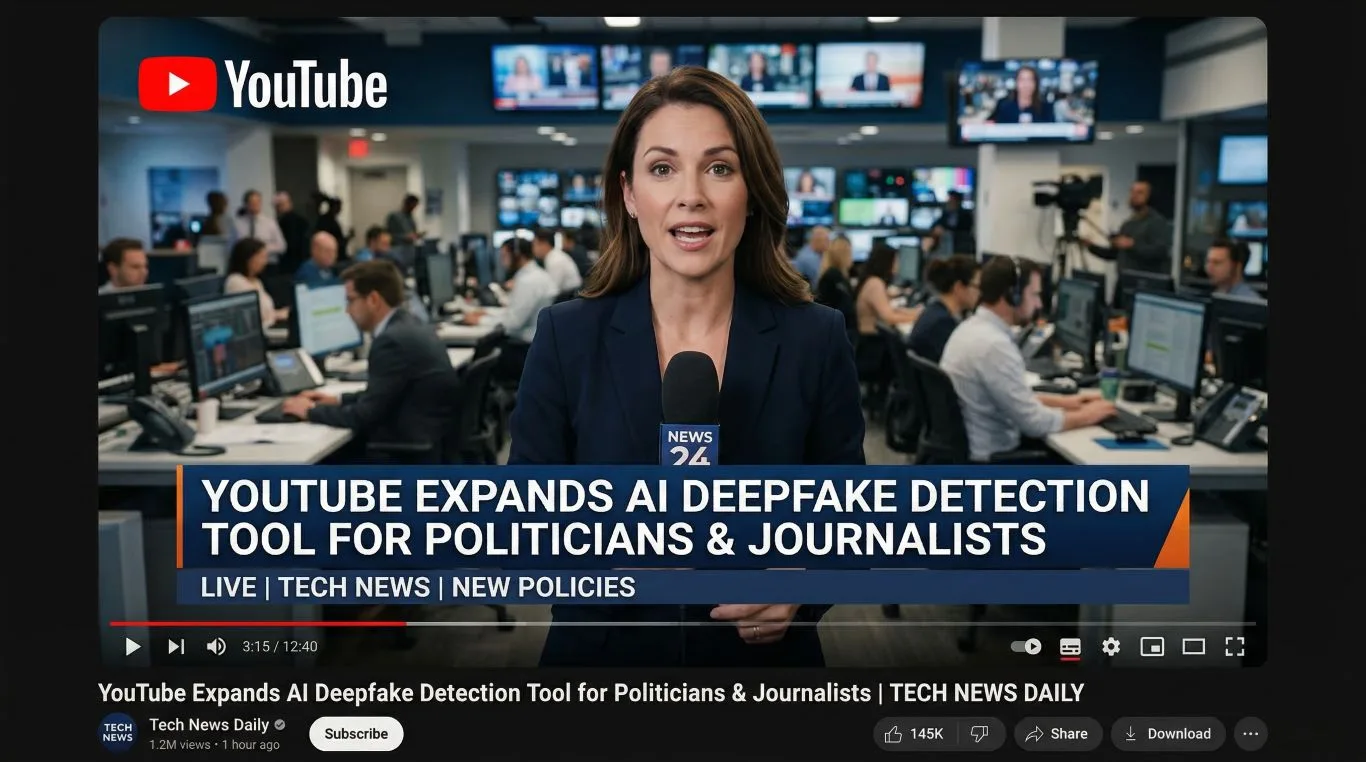
- YouTube’s AI deepfake detection tool — first launched in October 2025 — is now being expanded to politicians, government officials, and journalists to help flag and remove unauthorized AI-generated likenesses.
- The tool uses likeness detection technology to scan videos and identify deepfakes that closely resemble real, enrolled individuals — without requiring the person to manually search for violations.
- Deepfakes of public figures aren’t just embarrassing — they’ve been used in financial scams, election interference attempts, and coordinated misinformation campaigns.
- YouTube’s expansion raises important questions about where platform moderation ends and free speech begins, especially when it comes to political satire and parody content.
- Not all deepfakes will be removed — YouTube’s policies still protect certain forms of clearly labeled creative content, which means the line between satire and manipulation is something every media consumer needs to understand.
Deepfakes of public figures are no longer a fringe problem — they’re a mainstream threat to how we consume information, and YouTube is finally drawing a hard line.
YouTube Just Changed the Game for Political Deepfakes
On March 10, 2026, YouTube announced it was expanding its likeness detection technology to a pilot group that includes government officials, political candidates, and journalists. The tool, which YouTube first rolled out in October 2025, proactively scans content on the platform to identify AI-generated videos that closely resemble the appearance of enrolled individuals. This isn’t a reactive report button — it’s a system designed to catch deepfakes before they spread.
YouTube is reaching out directly to eligible politicians and journalists on the platform, offering them the choice to enroll. Once enrolled, the tool works in the background, scanning uploaded content and flagging videos that appear to use an unauthorized AI-generated likeness of that person.
Who Gets Access to the New Tool
Access isn’t open to everyone yet. The current rollout targets three specific groups:
- Government officials at various levels of civic authority
- Political candidates actively participating in electoral processes
- Journalists who are considered central figures in public discourse
YouTube itself initiates the outreach — eligible users don’t apply on their own. A company spokesperson confirmed that YouTube contacts qualifying individuals directly, and those individuals then decide whether they want to participate in the pilot program. This opt-in structure keeps the tool voluntary while still making it accessible to those most at risk. For more information on global efforts to combat misinformation, see Interpol’s recent operation.
How the Flagging and Removal Process Works
Once a deepfake is detected, the enrolled individual is notified and can review the flagged content. From there, they can submit a removal request based on unauthorized use of their likeness. YouTube then evaluates the content against its policies — which means not every flagged video automatically disappears. Parody, satire, and clearly labeled creative content still have protections under YouTube’s existing guidelines.
What Is YouTube’s Likeness Detection Technology?
YouTube’s likeness detection technology is an AI-powered system trained to recognize when a video contains a synthetic or manipulated representation of a specific real person. It goes beyond simple facial recognition — the system analyzes visual patterns, audio cues, and contextual signals to determine whether a video has been artificially generated or manipulated to portray someone in a way they didn’t authorize.
How AI Identifies Unauthorized Deepfakes
At its core, the tool compares uploaded video content against a reference profile of an enrolled individual. The AI looks for telltale signs of synthetic generation — things like unnatural skin texture rendering, inconsistent lighting on facial features, audio-visual sync issues, and artifacts that appear at the edges of the face or hairline. These are the same technical signatures that researchers in computational media forensics have used to distinguish real footage from AI-generated content.
What makes YouTube’s approach notable is that it operates at scale. The platform processes an enormous volume of uploaded content daily, and a manual review system would be completely overwhelmed. By using automated likeness detection, YouTube can flag potentially violating content much faster than any human moderation team could manage alone.
How YouTube’s Likeness Detection Tool Works — At a Glance
Stage What Happens Enrollment YouTube contacts eligible users; they opt in to the program Scanning AI analyzes uploaded videos for likeness matches Flagging System flags content that resembles enrolled individuals Review Enrolled user reviews flagged content and decides to request removal Evaluation YouTube assesses against platform policies (satire, parody protections apply) Action Content removed or retained based on policy evaluation
From Creators to Civic Leaders: The Expansion Timeline
YouTube didn’t start with politicians. When the likeness detection tool first launched in October 2025, it was primarily aimed at creators — particularly musicians and entertainers who had become frequent targets of AI-generated content using their voices and faces without consent. The expansion to government officials, political candidates, and journalists in March 2026 marks a significant shift in who the platform considers most vulnerable to deepfake harm. This move comes amid growing concerns about AI’s impact on various industries, as seen in Atlassian’s recent layoffs ahead of its AI expansion.
Why Politicians and Journalists Are High-Risk Targets
Public figures in politics and media occupy a uniquely dangerous position when it comes to deepfakes. Their faces and voices are already widely available across the internet — hours of footage, interviews, speeches, and public appearances that AI models can train on to produce convincing synthetic content. Unlike a private individual, a politician or journalist can’t simply scrub their image from the internet.
The consequences of a convincing political deepfake go far beyond personal embarrassment. A fabricated video of a government official making a false statement, announcing a fake policy, or appearing to endorse something they never supported can spread across social media in hours — often faster than any correction can catch up. For journalists, deepfakes can be used to discredit their reporting or manufacture false statements that undermine public trust in legitimate news sources.
Why Deepfakes Are Dangerous for Democracy
How AI-Generated Videos Fuel Misinformation
The speed at which a deepfake can travel is what makes it so dangerous. A synthetic video of a politician “confessing” to corruption or a journalist “admitting” their reporting was fabricated can rack up millions of views before a platform’s moderation team even identifies the content as fake. By the time a correction surfaces, the damage to public perception is often already done — and research consistently shows that false information spreads faster than corrections online.
What makes AI-generated misinformation particularly insidious is how believable modern deepfakes have become. Early deepfakes from just a few years ago had obvious glitches — blurry edges, unnatural blinking, distorted audio. Today’s AI tools can generate video that is nearly indistinguishable from authentic footage, even to trained observers. When that technology is pointed at politicians during election cycles or at journalists covering sensitive topics, the potential for real-world harm is enormous.
Real-World Scams That Used Political Deepfakes
Political deepfakes have already moved from hypothetical threat to documented reality. AI-generated audio and video of political figures has been used in financial scams where fake “endorsements” from government officials directed people toward fraudulent investment schemes. Deepfake videos of world leaders have also been deployed as part of coordinated influence operations, designed to stoke social division or spread false narratives ahead of elections. These aren’t edge cases — they represent a growing category of digital fraud that existing content moderation tools have struggled to keep pace with, as evidenced by operations like Interpol’s Operation Synergia III.
How YouTube’s Tool Actually Works
Understanding the mechanics behind YouTube’s likeness detection system helps clarify both its strengths and its current limitations. The tool isn’t a simple image-matching algorithm — it’s a multi-layered AI system trained specifically to identify synthetic media that represents a real person’s likeness without authorization.
The Enrollment Process for Eligible Users
YouTube handles the outreach side of enrollment entirely. Rather than waiting for politicians or journalists to discover and apply for the program, YouTube’s team identifies qualifying individuals on the platform and contacts them directly. This proactive approach is intentional — it removes the barrier of awareness and ensures that high-risk public figures aren’t left unprotected simply because they didn’t know the tool existed.
Once contacted, the eligible individual receives information about the program and chooses whether to opt in. Enrollment is entirely voluntary — YouTube doesn’t automatically enroll anyone, even if they clearly qualify. This matters from a data privacy standpoint, since the tool requires YouTube to maintain a reference profile of the enrolled person’s likeness to run comparisons against uploaded content.
After enrollment is confirmed, the detection system activates and begins scanning newly uploaded content as well as reviewing existing videos on the platform. When the system identifies a potential likeness match, it surfaces the flagged content to the enrolled individual for review. From that point, the enrolled user drives the process — they decide whether to request removal based on what they see. Learn more about the global efforts in tackling malicious content and enhancing online safety.
- Step 1: YouTube identifies and contacts eligible government officials, political candidates, and journalists
- Step 2: The eligible individual reviews the program details and chooses to opt in
- Step 3: YouTube builds a reference likeness profile for the enrolled user
- Step 4: The AI detection system scans both new uploads and existing content for likeness matches
- Step 5: Flagged content is surfaced to the enrolled individual for review
- Step 6: The enrolled user submits a removal request if they determine the content is unauthorized
- Step 7: YouTube evaluates the request against platform policies before taking action
What Happens After a Deepfake Is Flagged
Flagging a video doesn’t automatically trigger removal. Once an enrolled user submits a removal request, YouTube’s policy team evaluates the content against the platform’s existing community guidelines and AI content policies. The review process considers whether the video is clearly labeled as synthetic, whether it constitutes parody or satire, and whether it creates a false impression of real events involving the enrolled individual.
If the content violates YouTube’s policies — for example, if it presents a fabricated statement as genuine, without any satirical framing — the video is taken down. Channels that repeatedly upload violating deepfake content can face escalating enforcement actions, including strikes against their account or channel termination under YouTube’s existing repeat-violation framework.
Where Parody and Satire Still Have Protection
YouTube has been clear that its likeness detection tool is not designed to eliminate all AI-generated content featuring public figures. Parody, satire, and clearly labeled creative content retain protections under the platform’s policies. A comedic AI-generated sketch that is transparently labeled as synthetic and doesn’t present false information as fact would likely survive a policy review, even if it features a recognizable political figure.
The critical distinction YouTube draws is between content that deceives and content that comments. A deepfake designed to make viewers believe a politician said something they never said is a policy violation. A clearly labeled AI parody video that exaggerates a politician’s known positions for comedic effect occupies a different category. That line isn’t always clean in practice, which is exactly why YouTube retains human policy review as the final step rather than automating removals entirely.
What This Means for AI Content Moderation
YouTube’s expansion of its likeness detection tool signals something bigger than a single platform update — it represents a meaningful shift in how major technology companies are approaching their responsibility to prevent AI-generated content from undermining public trust. For years, the standard response from platforms was reactive: wait for users to report problematic content, then review it. YouTube’s proactive detection model flips that dynamic.
The implications stretch well beyond YouTube’s own ecosystem. When a platform with YouTube’s scale commits to proactive AI deepfake detection for high-risk public figures, it creates a new baseline expectation for what responsible content moderation looks like in the age of generative AI. Other platforms — both video-based and text-based — will face increasing pressure to develop comparable systems or explain why they haven’t.
YouTube’s Broader AI Policy Balancing Act
YouTube isn’t operating in a vacuum here. The platform has been navigating an increasingly complex tension between supporting the legitimate creative uses of AI-generated content — which have exploded among its creator community — and preventing that same technology from being weaponized against the very people whose voices shape public discourse. The likeness detection expansion is one piece of a broader policy framework that also includes requirements for creators to disclose when videos contain realistic AI-generated content, particularly on topics related to health, elections, and finance.
How This Compares to Other Platform Responses
YouTube isn’t the only platform grappling with deepfakes, but its proactive likeness detection approach stands apart from what most others have implemented. Meta has introduced AI content labeling requirements across Facebook and Instagram, and TikTok has similar disclosure mandates — but both of those systems rely heavily on creators self-reporting that their content is AI-generated. That’s a fundamental weakness: bad actors who intend to deceive aren’t going to voluntarily label their deepfakes. YouTube’s detection-first model doesn’t depend on the uploader’s honesty.
YouTube’s Pilot Program Still Has Limits
As powerful as the tool is, it’s still a pilot program — and that means real gaps exist. The current rollout is limited to a select group of government officials, political candidates, and journalists, which leaves out a massive portion of public figures who are equally vulnerable to deepfake harm. Celebrities, athletes, business leaders, and private individuals have no access to this system yet, even though AI-generated content targeting non-political figures has been responsible for significant financial fraud and reputational damage.
There’s also the question of geographic reach. YouTube’s pilot was announced with a focus on English-language markets and figures operating within established political and media institutions. Journalists and officials in regions with less institutional recognition, or those working in languages other than English, may find themselves outside the program’s current scope entirely. YouTube has not yet published a detailed timeline for when the tool will expand beyond the pilot group — which means for now, protection is uneven and access depends largely on whether YouTube’s team identifies you as eligible in the first place.
Frequently Asked Questions
Here are answers to the most common questions about YouTube’s AI deepfake detection tool, how it works, and who it protects. For more on AI’s impact, you can read about the rising environmental costs of datacentres.
Who is eligible for YouTube’s AI deepfake detection tool?
Currently, YouTube’s likeness detection tool is available to a pilot group of government officials, political candidates, and journalists. YouTube proactively reaches out to eligible individuals on the platform — there is no public application process. Enrollment is opt-in, meaning eligible users must agree to participate after being contacted by YouTube. In light of recent acquisitions in AI technology, the expansion of such tools is becoming increasingly significant.
The tool is not yet available to the general public, celebrities, private individuals, or public figures outside of government and journalism. YouTube has indicated this is an expanding program, but has not confirmed a specific timeline for broader access.
Can YouTube’s tool detect all types of AI-generated deepfakes?
YouTube’s likeness detection technology is specifically designed to identify AI-generated video content that resembles the appearance of an enrolled individual. It analyzes visual and audio signals to detect signs of synthetic generation, including unnatural skin rendering, facial edge artifacts, and audio-visual inconsistencies.
However, no detection system is perfect. Rapidly evolving AI generation tools continually produce more convincing synthetic content, and detection accuracy depends on the sophistication of the deepfake being analyzed. YouTube’s system is a significant step forward, but it should be understood as part of a broader content integrity strategy — not a complete solution on its own.
Does the tool remove parody or satire videos of politicians?
Not automatically. YouTube’s policies still protect clearly labeled parody and satire, even when that content features AI-generated likenesses of public figures. The key factors YouTube considers during policy review include:
- Whether the content is clearly labeled as synthetic or AI-generated
- Whether it presents false information as fact rather than as obvious commentary or humor
- Whether a reasonable viewer would be deceived into thinking the content depicts real events
- Whether the content could cause direct harm to the individual’s reputation through fabricated statements
A satirical AI video that exaggerates a politician’s known positions for comedic effect, clearly labeled as synthetic, is treated differently from a deepfake designed to make viewers believe a real statement was made. The distinction matters enormously — and it’s why YouTube has kept human policy reviewers in the loop rather than automating every removal decision.
That said, the line between satire and deception isn’t always obvious, and YouTube’s review process will inevitably involve judgment calls. Enrolled users who disagree with a review outcome have recourse through YouTube’s standard appeals process.
When did YouTube first launch its likeness detection technology?
YouTube first launched its likeness detection tool in October 2025, initially targeting creators — particularly musicians and entertainers who had become frequent victims of unauthorized AI-generated content using their voices and likenesses.
- October 2025: Initial rollout of likeness detection technology, focused on creators and entertainers
- March 10, 2026: Expansion announced to government officials, political candidates, and journalists
- Ongoing: Pilot program continues, with broader expansion timeline not yet publicly confirmed
The expansion to civic figures and journalists in early 2026 reflects YouTube’s recognition that the deepfake threat had moved well beyond entertainment into territory with direct implications for democracy and press freedom.
Prior to the October 2025 launch, YouTube had been developing and testing the underlying detection technology internally, building the system’s ability to recognize likeness patterns across a wide variety of video formats, lighting conditions, and AI generation methods.
The March 2026 expansion is the most significant step YouTube has taken to date in applying AI detection technology to protect public discourse — and it positions YouTube as one of the more proactive major platforms on this issue heading into an increasingly AI-saturated media environment.
How does YouTube’s deepfake tool differ from what other platforms offer?
The core difference is proactive detection versus reactive reporting. Most major platforms — including Meta’s Facebook and Instagram, and TikTok — currently rely on a combination of creator disclosure requirements and user reporting to surface AI-generated deepfakes. These systems only work when someone notices a problem and takes action. YouTube’s likeness detection tool actively scans uploaded content without waiting for a report to be filed.
YouTube also differentiates itself through the enrollment model. By building a reference likeness profile for each enrolled individual, the system can make highly specific comparisons rather than running generic deepfake detection across all content. This makes the tool more precise — and more useful for the individuals it’s designed to protect — compared to broad AI labeling requirements that apply to all content equally.
The limitations of competing approaches became clear during the 2024 and 2025 election cycles, when deepfake content featuring political figures spread widely on multiple platforms before moderation teams could respond. YouTube’s investment in proactive detection appears to be a direct response to those failures across the industry.