

 Key Takeaways Ex-Google Engineer Convicted for Sending AI Tech Data to China
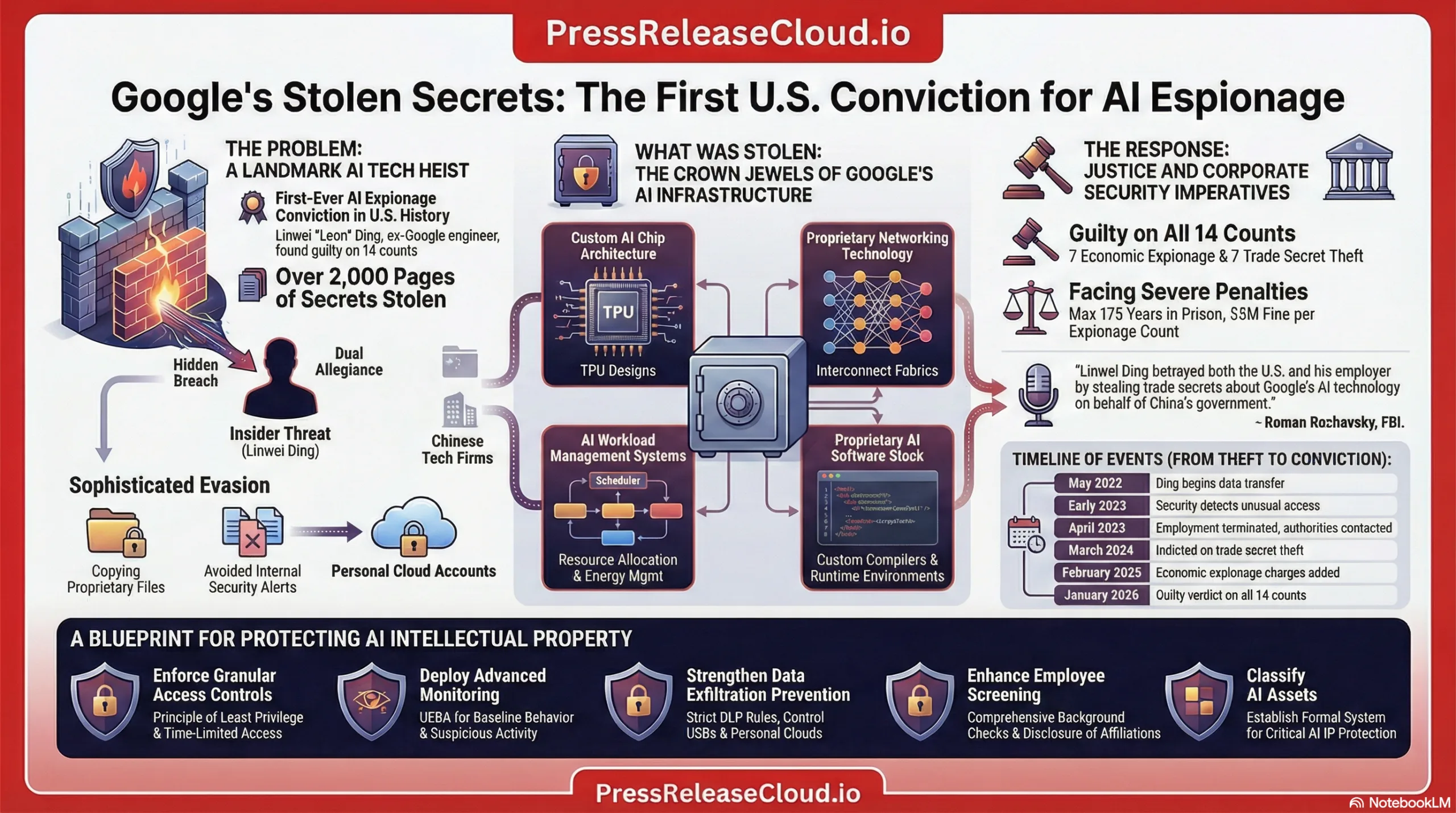

- Former Google engineer Linwei Ding was convicted on 14 counts of economic espionage and trade secret theft in the first AI-related espionage conviction in U.S. history.
- Ding stole over 2,000 pages of proprietary AI technology related to Google’s supercomputing infrastructure while secretly affiliated with Chinese tech companies.
- The case highlights critical vulnerabilities in protecting AI intellectual property, even at tech giants with sophisticated security systems.
- Companies developing AI technologies need robust insider threat detection systems to prevent similar breaches of sensitive technical information.
- This precedent-setting case may reshape how tech companies structure their security protocols and data access controls for AI research teams.
A federal jury has delivered a groundbreaking verdict in what prosecutors call the first-ever conviction for AI-related economic espionage in the United States. The case represents a critical turning point in how intellectual property theft is prosecuted in the rapidly evolving field of artificial intelligence.
Google AI Engineer’s Historic Espionage Conviction
The U.S. Department of Justice announced that Linwei Ding, 38, also known as Leon Ding, has been found guilty on all fourteen counts brought against him – seven for economic espionage and seven for theft of trade secrets. This landmark conviction comes after a detailed investigation revealed Ding had systematically stolen thousands of pages of confidential information about Google’s proprietary AI technology while employed as a software engineer at the tech giant.
First U.S. AI-Related Economic Espionage Conviction
“In today’s high-stakes race to dominate the field of artificial intelligence, Linwei Ding betrayed both the U.S. and his employer by stealing trade secrets about Google’s AI technology on behalf of China’s government,” said Roman Rozhavsky, assistant director of the FBI’s Counterintelligence and Espionage Division. This case marks a significant milestone in the enforcement of intellectual property laws within the AI sector, establishing clear consequences for those who would illegally transfer sensitive AI technology. The successful prosecution demonstrates the growing focus of U.S. law enforcement on protecting AI-related intellectual property as a matter of national security, not merely corporate interests.
Proprietary AI Technology Stolen
According to court documents, Ding exfiltrated more than 2,000 pages of Google’s AI trade secrets between May 2022 and April 2023. The stolen information wasn’t just simple code snippets or general documentation – it included comprehensive details on Google’s proprietary hardware and software systems specifically designed to power AI workloads. The theft targeted some of Google’s most valuable technical assets, including custom chip designs, specialized networking technologies, and proprietary supercomputing infrastructure that gives the company a competitive edge in developing and deploying advanced AI models.
The theft represents years of research and billions in investment by Google in developing its AI infrastructure. Given the current technological arms race between major powers in artificial intelligence, the information would have provided significant advantages to competitors looking to replicate Google’s AI capabilities without the associated research costs.
How Linwei Ding Stole Google’s AI Secrets
Engineer’s Role at Google’s AI Supercomputing Division
Ding was hired by Google in 2019 as a software engineer working specifically on the company’s supercomputing data centers – the critical infrastructure responsible for training and deploying advanced AI models. This position granted him access to highly sensitive technical information about Google’s AI architecture and operational systems. His specialized role involved working with the company’s custom-designed hardware and networking configurations that enable massive parallel processing capabilities necessary for modern deep learning applications. The trust placed in Ding as a member of this elite engineering team gave him privileged access to systems that represent the backbone of Google’s competitive advantage in the AI space.
Secret Affiliations with Chinese Tech Companies
While employed at Google and collecting a salary from the American tech giant, prosecutors successfully proved that Ding had secretly affiliated himself with two China-based technology firms. Evidence presented at trial showed he was serving as Chief Technology Officer for one of these companies while simultaneously founding another – all while still on Google’s payroll. These undisclosed relationships created a clear conflict of interest that Ding deliberately concealed from his employer. Federal investigators uncovered communications indicating these Chinese companies sought to replicate Google’s AI infrastructure capabilities, with Ding positioned as the technical expert who could deliver this competitive intelligence.
The prosecution demonstrated that Ding misled investors by claiming he could replicate Google’s AI supercomputing technology for his affiliated Chinese companies. This deception formed a critical part of the economic espionage charges, as it established a clear intent to benefit foreign entities at the expense of an American company.
Methods Used to Bypass Google’s Security Systems
The theft operation revealed sophisticated techniques to evade detection by Google’s internal security systems. Federal prosecutors detailed how Ding began systematically copying sensitive internal Google documents in May 2022, transferring them to personal cloud accounts while employing methods to disguise this activity. Court evidence showed Ding specifically engineered his access and transfer methods to avoid triggering security alerts that would normally detect unusual data movement patterns.
What Was Actually Stolen From Google
The documents Ding exfiltrated from Google contained highly specific technical information about the company’s artificial intelligence infrastructure. Unlike general AI principles that might be discussed in academic papers, these materials detailed proprietary implementations that gave Google significant competitive advantages in the field. The theft represents one of the most comprehensive AI intellectual property breaches documented to date.
Custom AI Chip Architecture Documents
Among the most valuable materials stolen were detailed specifications for Google’s custom-designed AI accelerator chips. These documents included circuit designs, optimization techniques, and proprietary architectural decisions that enable Google’s AI systems to achieve superior performance compared to off-the-shelf hardware. The stolen information covered multiple generations of Google’s Tensor Processing Units (TPUs), revealing the evolution of their design philosophy and specialized configurations for different AI workloads. Such documentation would allow competitors to potentially leapfrog years of research and development, bypassing the extensive trial-and-error process typically required to develop custom AI silicon.
Proprietary Networking Technology
Court documents revealed that Ding also stole extensive information about Google’s proprietary networking technologies that facilitate high-speed communication between AI processing nodes. These specialized networking protocols and hardware configurations are critical for distributed AI training across thousands of processors. The documentation included detailed specifications for the interconnect fabrics that allow Google’s AI systems to scale efficiently across massive computing clusters. Google’s networking architecture represents a significant competitive advantage, as the communication overhead between processing units often becomes the limiting factor in large-scale AI training operations.
AI Workload Infrastructure Systems
The theft also encompassed comprehensive documentation of Google’s AI infrastructure management systems. This included proprietary workload schedulers, resource allocation algorithms, and system monitoring tools specifically designed for large-scale AI operations. These systems are critical for maintaining high utilization and efficiency across Google’s AI computing resources. The stolen documentation detailed how Google optimizes energy usage, manages thermal constraints, and handles hardware failures in their AI data centers – information that would be immensely valuable to competitors building similar infrastructure.
Additionally, Ding exfiltrated materials related to Google’s software stack for AI development, including proprietary compilers and runtime environments that translate AI algorithms into efficient operations across their custom hardware. These tools represent years of optimization work by Google’s engineering teams to maximize the performance of their AI systems.
Timeline of the Data Theft Operation
Initial Document Transfers (May 2022)
The systematic theft began in May 2022 when Ding first started uploading Google’s confidential documents to his personal cloud storage accounts. Court records show these initial transfers focused on fundamental architecture documents describing Google’s AI infrastructure. Investigators determined that Ding carefully selected high-value documents that would provide maximum benefit to his Chinese affiliates while minimizing the risk of detection. The uploads accelerated over subsequent months, eventually encompassing thousands of pages of technical documentation.
Evidence presented during the trial revealed that Ding’s document transfers followed a pattern that aligned with specific development milestones at his affiliated Chinese companies. This correlation strongly supported prosecutors’ assertions that the theft was premeditated and strategically executed to support the Chinese firms’ technical development roadmaps.
Discovery and Investigation Process
Google’s internal security systems eventually detected unusual access patterns associated with Ding’s account in early 2023. The anomalies triggered an internal investigation that quickly identified suspicious data transfers to external storage locations. Google’s security team implemented enhanced monitoring of Ding’s activities while gathering evidence, eventually leading to his termination in April 2023.
Following Google’s initial detection, the company contacted federal authorities, who launched their own investigation. The FBI’s specialized cyber division and counterintelligence teams performed extensive forensic analysis of Ding’s electronic devices and cloud accounts. This analysis revealed not only the scope of the theft but also communications with his Chinese business partners that clearly established intent.
The investigation faced significant technical challenges, as Ding had attempted to cover his tracks by using multiple accounts, encrypted communications, and various cloud storage services. Federal investigators employed advanced digital forensics techniques to reconstruct the timeline of data exfiltration and establish connections to the Chinese companies.
- Access log analysis from Google’s internal systems
- Forensic examination of Ding’s work and personal devices
- Cloud storage account reconstruction
- Financial transaction analysis showing payments from Chinese entities
- Communication records with Chinese business partners
The meticulous investigation produced a comprehensive evidence trail that ultimately proved decisive in securing the conviction. Investigators were able to demonstrate not only what was taken but establish clear links between the theft and Ding’s intention to benefit Chinese companies at Google’s expense.
Indictment and Trial Proceedings
Ding was initially indicted in March 2024 on multiple counts related to the theft of trade secrets. As the investigation continued to uncover additional evidence, prosecutors filed a superseding indictment in February 2025 that expanded the charges to include economic espionage, reflecting the government’s assessment that the theft was intended to benefit foreign entities.
- Initial court appearance and bail hearing (March 2024)
- Discovery phase with extensive technical evidence (April-November 2024)
- Pre-trial motions regarding admissibility of classified evidence (December 2024)
- Superseding indictment filed adding espionage charges (February 2025)
- Jury selection and trial commencement (November 2025)
The trial featured testimony from Google security personnel, FBI cybercrime specialists, and expert witnesses who explained the technical significance of the stolen materials. Prosecutors presented extensive digital evidence including access logs, file transfer records, and communications between Ding and his Chinese business associates that established both the theft and the intent to benefit foreign entities.
After a three-week trial and two days of deliberation, the jury returned guilty verdicts on all fourteen counts on January 29, 2026. The unanimous decision reflected the strength of the prosecution’s case and the clear evidence of Ding’s systematic theft of Google’s proprietary AI technology.
Criminal Charges and Verdict
The culmination of this high-profile case resulted in the jury finding Ding guilty on all fourteen counts brought against him. The conviction represents a clear message from the U.S. justice system regarding the seriousness of AI-related intellectual property theft, especially when connected to foreign entities.
The Department of Justice pursued this case with unprecedented resources, recognizing the strategic importance of artificial intelligence technology to national security and economic competitiveness. The successful prosecution establishes important legal precedent in how the judicial system will handle similar cases of AI technology theft in the future.
Seven Counts of Economic Espionage
The economic espionage charges specifically addressed Ding’s intent to benefit foreign entities through his theft of trade secrets. Under U.S. law, economic espionage (18 U.S.C. § 1831) requires prosecutors to prove not only that trade secrets were stolen but that the theft was conducted with the intention to benefit a foreign government, instrumentality, or agent. Each of the seven counts corresponded to specific categories of Google’s proprietary technology that Ding transferred to benefit his Chinese business affiliations.
These charges carry particularly severe penalties, reflecting the heightened concern over technology transfer to foreign competitors. Each count of economic espionage carries a maximum sentence of 15 years in prison and fines up to $5 million, potentially resulting in a 105-year maximum sentence for these charges alone.
Seven Counts of Trade Secret Theft
The additional seven counts of trade secret theft (18 U.S.C. § 1832) focused on the unauthorized taking of confidential information, regardless of foreign benefit. These charges required prosecutors to demonstrate that Ding knowingly stole information that Google had taken reasonable measures to keep secret and that derived independent economic value from not being generally known. Each count was tied to specific documents or categories of information that Ding exfiltrated from Google’s systems.
The trade secret theft charges each carry a maximum penalty of 10 years in prison and significant fines. Combined with the economic espionage charges, Ding theoretically faces up to 175 years in prison, though actual sentencing is likely to involve concurrent terms that would result in a shorter total sentence.
Defense Arguments and Prosecution Evidence
Ding’s defense team, led by attorney Grant Fondo, attempted to shift blame to Google, arguing that the company failed to implement adequate protections for its confidential information. They contended that the accessibility of these documents demonstrated that Google didn’t truly consider them trade secrets. This defense strategy aimed to undermine a key element of the charges—that Google had taken reasonable measures to protect its confidential information.
“The prosecution presented overwhelming evidence that Mr. Ding deliberately circumvented security measures and concealed his activities, demonstrating consciousness of guilt. His defense arguments about Google’s security practices failed to address his intentional acts of deception.”
—Federal prosecutor’s closing statement
Prosecutors countered with extensive evidence showing that Ding had deliberately circumvented security measures, including accessing documents through indirect means to avoid triggering security alerts. They presented communications between Ding and his Chinese business partners that clearly demonstrated his knowledge that the information was confidential and his intent to use it to benefit his outside business interests. The jury ultimately rejected the defense arguments, finding the prosecution’s evidence compelling on all counts.
Implications for Corporate AI Security
The Ding case exposes critical vulnerabilities that exist even within technology giants with sophisticated security systems. For organizations developing or implementing AI technologies, this case serves as a powerful wake-up call about the very real threat of insider data theft and the need for enhanced protection measures.
As AI technologies become increasingly valuable and central to competitive advantage, the incentives for theft and unauthorized transfer increase proportionally. Organizations must now re-evaluate their security posture specifically around their most valuable AI assets, recognizing that traditional data protection approaches may be insufficient for this new class of intellectual property.
Vulnerabilities in Tech Company Security Protocols
One of the most alarming aspects of this case is how long Ding was able to continue exfiltrating sensitive information before detection. Despite Google’s substantial security investments, Ding managed to transfer thousands of documents over nearly a year before triggering sufficient suspicion. This timeline reveals that even sophisticated security systems can be circumvented by knowledgeable insiders with legitimate access to sensitive materials.
The case highlights particular vulnerabilities around cloud storage access and personal device usage. Ding primarily used his personal Google Cloud account to store stolen information—a method that proved difficult to distinguish from legitimate work activities. This points to a significant challenge for security teams: distinguishing between normal work patterns and malicious exfiltration when employees regularly use cloud services for legitimate purposes.
Many organizations face similar challenges with detection latency—the time between initial compromise and detection. In Ding’s case, this extended period allowed him to extract a comprehensive set of technical documentation that could potentially enable competitors to replicate Google’s proprietary AI infrastructure.
Insider Threat Detection Challenges
The Ding case exemplifies why insider threats are particularly difficult to detect and mitigate. As a legitimate employee with authorized access to sensitive information, Ding’s activities initially appeared consistent with his job responsibilities. Traditional perimeter-focused security measures prove largely ineffective against insider threats who already operate within trusted network boundaries.
Organizations developing advanced AI technologies face particular challenges in balancing security with the collaborative nature of research and development work. AI engineers and researchers often require broad access to technical documentation and systems to effectively perform their jobs. Overly restrictive access controls can impede innovation and productivity, creating a difficult trade-off between security and operational effectiveness.
Data Access Control Best Practices
In light of the Ding case, organizations should implement more granular data access controls specifically tailored to high-value AI assets. The principle of least privilege must be rigorously applied, ensuring employees have access only to the specific information needed for their current tasks. This approach reduces the potential damage from any single compromised account or insider threat.
- Implement time-limited access that automatically expires when no longer needed
- Create segmented access tiers with additional authentication for critical AI assets
- Maintain detailed access logs for sensitive documentation with automated anomaly detection
- Require justification for access to high-value technical documentation
- Implement dual-control principles for particularly sensitive AI infrastructure documentation
Organizations should also consider implementing specialized monitoring for activities related to AI infrastructure documentation. This might include tracking access patterns, monitoring download volumes, and analyzing after-hours activities that involve sensitive technical information. Creating separate security classifications specifically for AI-related assets can help ensure appropriate controls are consistently applied.
Cloud Storage Security Gaps
The Ding case highlights significant security gaps related to cloud storage and personal accounts. Organizations must implement more robust controls around data transfers to cloud environments, particularly when those environments might include personal accounts alongside corporate ones. Data loss prevention (DLP) solutions should be specifically configured to monitor transfers of technical documentation to cloud storage, with special attention to unusual transfer patterns or volumes.
Companies should establish clear policies regarding the use of personal cloud accounts for work-related activities, ideally prohibiting such usage entirely for sensitive development work. Where cloud storage is necessary, organizations should enforce the use of company-managed accounts with appropriate security controls and monitoring. Technical measures such as digital rights management can help maintain control over sensitive documents even after they leave the corporate network.
Global AI Competition and Espionage Risks
U.S.-China AI Development Race
The Ding case cannot be fully understood outside the context of the intensifying competition between the United States and China in artificial intelligence development. Both nations view AI supremacy as critical to future economic and military advantage, creating powerful incentives for technology transfer through both legal and illegal means. This case represents just one high-profile example of the broader pattern of technology competition that has characterized U.S.-China relations in recent years.
The strategic importance of AI infrastructure—particularly the specialized hardware, networking, and software systems required for training advanced models—has made these technologies particularly attractive targets for espionage. As competition intensifies, organizations developing cutting-edge AI technologies must anticipate increased targeting of their intellectual property by both state and non-state actors seeking competitive advantage.
Technology Transfer Concerns
Beyond outright theft, the Ding case highlights broader concerns about technology transfer mechanisms between competing nations. The dual roles Ding maintained—employed by Google while simultaneously working with Chinese companies—represent a particularly concerning vector for unauthorized knowledge transfer. This case will likely accelerate scrutiny of employment arrangements, particularly for specialists with access to critical AI infrastructure knowledge.
Organizations should anticipate increased regulatory attention to technology transfer risks, including more stringent disclosure requirements for employees with foreign business affiliations. The successful prosecution of Ding may encourage more aggressive enforcement actions around technology transfer controls, particularly for AI technologies with potential dual-use applications in both commercial and military contexts.
Impact on International Research Collaboration
One unfortunate consequence of high-profile espionage cases like Ding’s is the potential chilling effect on legitimate international research collaboration. The open exchange of scientific knowledge has historically accelerated innovation in many fields, including AI. However, concerns about intellectual property theft and economic espionage have already begun to restrict certain forms of international collaboration, particularly in areas with strategic significance.
Organizations engaged in AI research must carefully balance security concerns with the benefits of collaboration. This may require developing more sophisticated frameworks for information sharing that allow for productive exchange while protecting proprietary implementations and trade secrets. Clear distinctions between general research findings appropriate for open publication and proprietary implementations that constitute trade secrets will become increasingly important.
Protecting Your Organization’s AI Intellectual Property
The Ding case provides valuable lessons for organizations seeking to protect their own AI intellectual property. While no security system can completely eliminate insider threats, implementing a comprehensive security strategy can significantly reduce risks and improve detection capabilities when breaches do occur.
A layered approach combining technical controls, policy measures, and employee awareness represents the most effective strategy for protecting valuable AI assets. Organizations should view AI security as an ongoing process requiring continuous assessment and improvement rather than a one-time implementation.
Essential Security Controls for AI Research Teams
AI research environments require specialized security controls that address their unique characteristics. These teams typically need access to substantial computing resources, large datasets, and detailed technical documentation—all of which represent valuable intellectual property requiring protection. Effective security must balance these access requirements with appropriate safeguards against data exfiltration.
- Implement privileged access workstations for AI infrastructure development
- Create secure development environments with restricted external connectivity
- Deploy advanced data loss prevention solutions specifically configured for AI documentation
- Establish formal classification systems for AI-related intellectual property
- Implement code and documentation watermarking to trace the source of leaks
Physical security measures also play an important role in protecting AI intellectual property. Organizations should consider implementing clean desk policies, restricting personal electronic devices in sensitive development areas, and controlling physical access to AI development environments. These measures complement digital protections by addressing physical exfiltration vectors that might bypass network-based controls.
Regular security assessments specifically focused on AI intellectual property protection can help identify gaps in existing controls. These assessments should include both technical testing and process evaluation to ensure comprehensive coverage of potential vulnerabilities.
Employee Background Screening Protocols
Enhanced background screening represents a critical front-line defense against potential insider threats. Organizations developing valuable AI technologies should implement comprehensive screening protocols for employees who will have access to sensitive technical information, including verification of employment history, education credentials, and professional references. Ongoing periodic rescreening throughout employment can help identify changes in circumstances that might increase risk.
Data Exfiltration Prevention Strategies
Preventing unauthorized data transfers requires a combination of technical controls and policy measures. Organizations should implement comprehensive monitoring of data movement, particularly for sensitive AI-related documentation. This monitoring should cover not only network transfers but also physical media, cloud storage, and email attachments.
Advanced data loss prevention solutions can provide real-time monitoring and blocking of suspicious transfers. These systems can be configured to recognize patterns indicative of data exfiltration attempts, such as large document transfers outside of normal working hours or to unusual destinations.
Context-aware access controls can further enhance protection by considering factors beyond simple authorization. These systems evaluate the context of access requests—including time, location, device, and recent behavior patterns—to determine whether access should be granted even to authorized users.
- Implement USB device control and monitoring
- Deploy email and web filtering to prevent sensitive document transfers
- Establish baselines for normal data access patterns to detect anomalies
- Create special handling procedures for the most sensitive AI documentation
- Implement digital rights management for critical technical specifications
Monitoring Systems for Suspicious Activity
Advanced monitoring capabilities provide the last line of defense when preventive controls fail. User and entity behavior analytics (UEBA) can establish baselines of normal behavior and identify deviations that might indicate malicious activity. These systems are particularly valuable for detecting insider threats, as they can recognize subtle changes in behavior patterns that might indicate malicious intent.
Organizations should implement specialized monitoring for high-value AI assets, with accelerated alerting and response procedures for suspicious activities involving these resources. Automated anomaly detection combined with human analysis provides the most effective approach, allowing security teams to focus on genuinely suspicious activities rather than reviewing all access events.
Frequently Asked Questions
The Ding case has raised numerous questions about AI security, trade secret protection, and the implications for international technology development. The following section addresses some of the most common questions about this landmark case and its broader significance.
These questions reflect the complex technical, legal, and geopolitical dimensions of AI-related intellectual property theft. Understanding these aspects is essential for organizations seeking to protect their own AI assets in an increasingly competitive global environment.
What specific AI technology did Linwei Ding steal from Google?
Ding stole comprehensive documentation related to Google’s AI infrastructure, including custom chip designs, proprietary networking technologies, and specialized software systems for AI workload management. The stolen materials provided detailed specifications for Google’s Tensor Processing Units (TPUs) and the surrounding ecosystem that enables large-scale AI training and inference. This documentation included not only general architectural information but also specific implementation details that would allow competitors to replicate Google’s proprietary approaches without the associated R&D investment.
The theft encompassed both hardware and software components, providing a complete picture of Google’s AI infrastructure stack. This comprehensive nature of the theft made it particularly damaging, as it provided potential recipients with insights into how these various components work together to create Google’s high-performance AI systems.
What penalties does Ding face for his conviction?
Ding faces up to 15 years imprisonment for each count of economic espionage and up to 10 years for each count of trade secret theft, potentially totaling 175 years if sentenced consecutively. However, sentencing typically involves concurrent terms resulting in a shorter total sentence. He also faces potential fines up to $5 million per economic espionage count and additional fines for the trade secret theft counts. Sentencing is scheduled for April 2026, and will likely consider factors such as the economic impact of the theft and Ding’s level of cooperation with authorities.
How did Google discover the data theft?
Google’s internal security systems detected unusual access patterns in early 2023, triggering an investigation that revealed Ding’s unauthorized transfers of confidential information to personal cloud storage. The company’s security team identified anomalies in document access logs, noting that Ding was accessing documentation outside his immediate project responsibilities and transferring unusual volumes of technical specifications to external storage locations.
After identifying these suspicious patterns, Google implemented enhanced monitoring of Ding’s activities while gathering evidence. This monitoring revealed deliberate attempts to circumvent security controls, such as accessing sensitive documents through indirect methods designed to avoid triggering alerts. Google’s investigation ultimately produced sufficient evidence to terminate Ding’s employment and refer the case to federal authorities for criminal investigation.
Could this case impact U.S.-China technology relations?
The case will likely accelerate existing trends toward greater scrutiny of technology transfers between the U.S. and China, particularly in strategic areas like artificial intelligence. We can expect stricter enforcement of export controls, more thorough vetting of research collaborations, and increased scrutiny of dual employment arrangements where individuals work simultaneously for U.S. and Chinese entities. The high-profile nature of this conviction signals a more aggressive approach to prosecuting economic espionage cases involving AI technology.
Organizations engaged in international AI research collaboration should anticipate additional compliance requirements and potential restrictions on certain forms of information sharing. The case may lead to expanded definitions of controlled technologies under export regulations, particularly for advanced AI infrastructure components similar to those stolen by Ding. Companies with operations in both countries will need to implement more rigorous controls to ensure compliance with increasingly complex regulatory requirements.
What security measures could have prevented this breach?
Enhanced monitoring of data transfers to personal cloud accounts, stricter access controls based on need-to-know principles, and more rigorous background checks including disclosure of outside business interests could have potentially prevented or limited the scope of Ding’s theft. Implementing data loss prevention tools specifically configured to detect large-scale document transfers and adding digital watermarks to sensitive documents would have improved traceability and potentially deterred the theft. Regular security awareness training emphasizing the legal consequences of trade secret theft might also have influenced Ding’s risk assessment.
Are other tech companies vulnerable to similar insider threats?
Yes, all organizations developing valuable AI technology face similar insider threat risks, particularly those with international operations or employees who have access to proprietary infrastructure designs. The specialized nature of AI development creates particular challenges, as the most knowledgeable employees necessarily require access to sensitive information to perform their roles effectively. This creates an inherent tension between security and operational requirements that all organizations must navigate.
Companies with less mature security programs than Google may be even more vulnerable, lacking the sophisticated monitoring capabilities that eventually detected Ding’s activities. Smaller organizations developing innovative AI technologies may face disproportionate risks, as they often lack the resources for comprehensive security programs yet possess valuable intellectual property that makes them attractive targets.
How can organizations better protect their AI intellectual property?
Organizations should implement a multi-layered approach combining technical controls, policy measures, and security awareness. Critical protective measures include implementing the principle of least privilege for access to AI documentation, deploying advanced monitoring for data exfiltration attempts, conducting thorough background screening, and creating clear policies regarding outside employment and conflicts of interest. Regular security assessments specifically focused on AI assets can help identify gaps in existing protections.
Creating a culture of security awareness specifically around the value and vulnerability of AI intellectual property is equally important. Employees should understand both the business importance of protecting proprietary AI technologies and the potential legal consequences of mishandling this information. Regular training that includes specific examples of proper and improper handling of AI-related documentation can help reinforce appropriate behaviors.
Perhaps most importantly, organizations need to recognize that traditional security approaches may be insufficient for protecting AI intellectual property. The unique characteristics of AI development—including the need for collaboration, access to large computing resources, and the highly specialized nature of the work—require tailored security approaches that address these specific challenges.
Organizations implementing responsible AI security programs demonstrate their commitment to protecting valuable intellectual property while maintaining the innovation capabilities essential for competitive advantage in this rapidly evolving field.
For comprehensive security solutions designed specifically for artificial intelligence environments, TechGuard Security offers specialized consulting and implementation services to protect your organization’s most valuable intellectual property assets.