


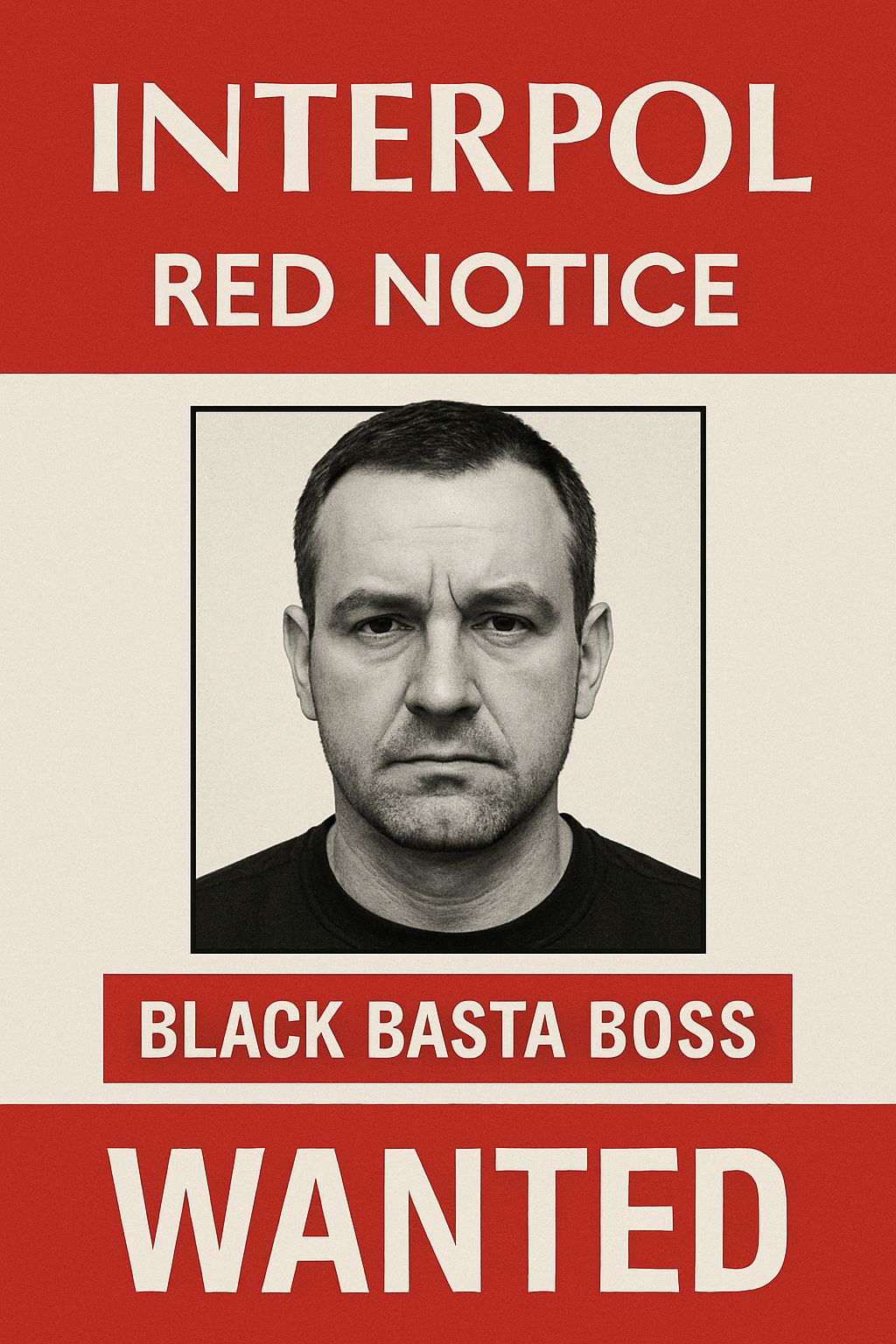
Summary of Interpol Red Notice: Black Basta Boss Wanted
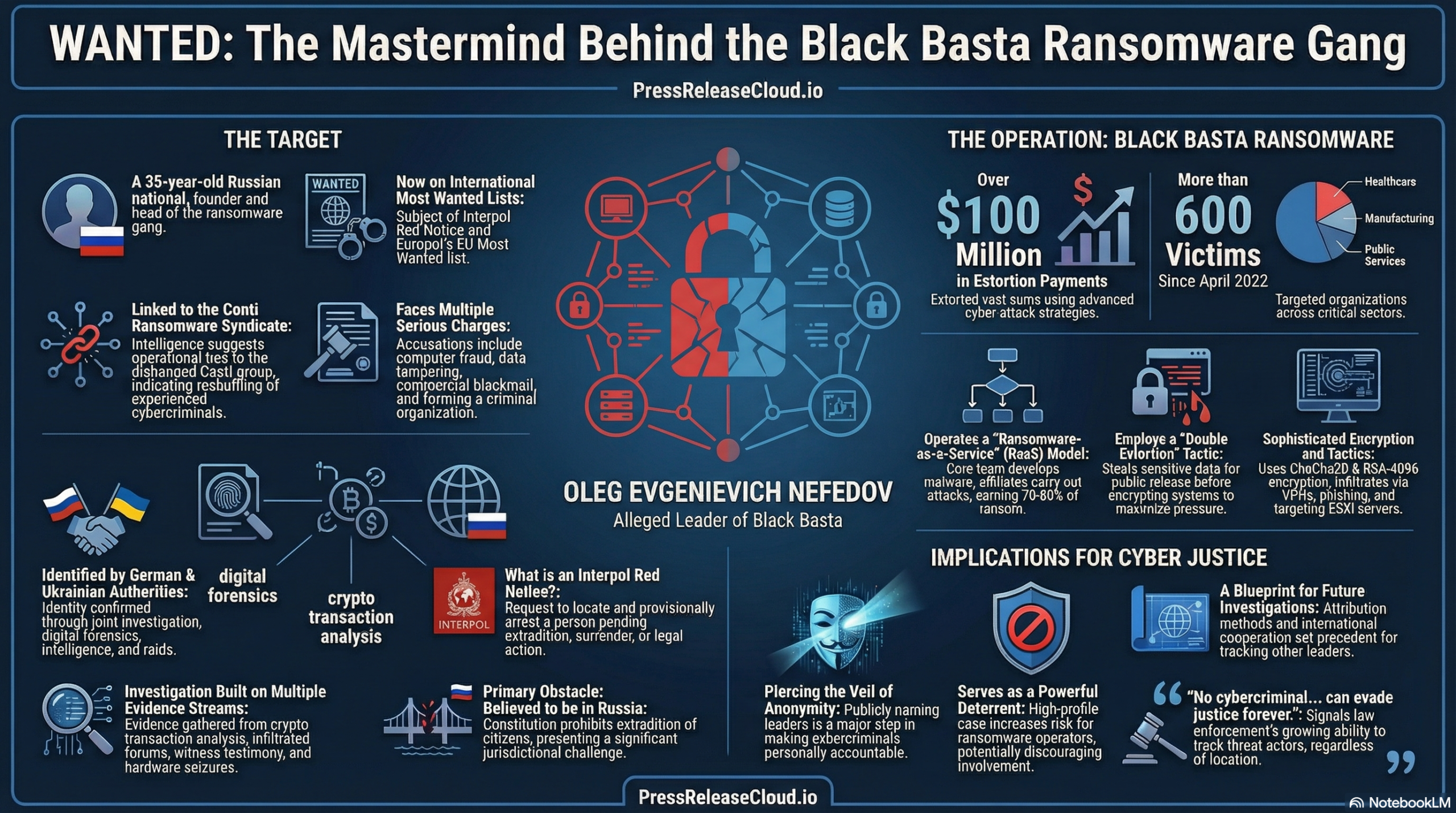
- Oleg Evgenievich Nefedov, a 35-year-old Russian national, has been identified by German and Ukrainian authorities as the head of the Black Basta ransomware gang
- Nefedov is now on Interpol’s international most wanted list, with a Red Notice issued for him, and he has also been added to Europol’s EU Most Wanted list
- The operations of the Black Basta ransomware have yielded over $100 million in extortion payments through the use of advanced double-extortion strategies
- There is evidence of strong links between Black Basta and the former Conti ransomware syndicate, suggesting a possible reshuffling of threat actors
- Apprehending Nefedov is a significant challenge for law enforcement agencies, as he is thought to be in Russia, a country that does not extradite its citizens
Oleg Evgenievich Nefedov, the alleged brains behind the Black Basta ransomware gang, has been added to Interpol’s Red Notice list by German authorities, marking a major milestone in the battle against global cybercrime. The 35-year-old Russian national has now joined the ranks of the world’s most wanted cybercriminals, with his identification and the international warrant for his arrest resulting from a joint effort by German and Ukrainian law enforcement agencies. This move is one of the most high-profile pursuits of a cybercriminal in recent memory, targeting a ransomware operation that has extorted millions from victims around the globe.
Click on Image to Enlarge
Russian Cybercriminal Ringleader Added to Interpol’s Most Wanted List
Oleg Evgenievich Nefedov, the founder and head of the Black Basta ransomware gang, has been officially identified by the Federal Criminal Police Office of Germany (BKA). He has been placed on both Europol’s “Most Wanted” and Interpol’s “Red Notice” lists. This international search is a rare instance of a major ransomware operator being publicly identified and marks a significant increase in the law enforcement’s approach to holding cybercriminals accountable. The Red Notice, which is essentially an international arrest warrant, calls for law enforcement around the world to locate and provisionally detain Nefedov until extradition or a similar legal action can be taken.
“The person in question, in his role as leader, facilitated the continued deployment of the ‘Black Basta’ ransomware and other malware. This allowed the group to penetrate foreign computer systems, steal data, and encrypt systems. They then demanded a ransom in cryptocurrencies for decryption.”
Official reports indicate that Nefedov is held accountable for all attacks carried out by Black Basta affiliates. This means he is responsible for hundreds of ransomware incidents in numerous countries. The charges against him include computer fraud, data tampering, commercial blackmail, and forming a criminal organization. If he is caught and successfully prosecuted, these crimes could lead to significant prison sentences. Law enforcement agencies are now tasked with the difficult job of finding and arresting Nefedov. It is believed that he is currently living in Russia, a country that does not usually extradite its citizens.
Meet Oleg Nefedov: The Man Behind Black Basta

Oleg Evgenievich Nefedov, a 35-year-old Russian national, has been thrust into the spotlight as the subject of a global manhunt. Until recently, he was largely unknown, operating from the shadows. However, recent investigations by law enforcement agencies have revealed that he has significant technical expertise and leadership skills. This has enabled him to lead and coordinate complex ransomware campaigns against high-value organizations worldwide. His rise to the top of Black Basta is a trend that has been observed in the world of cybercrime. Experienced operators often move from one group to another or form new groups when their previous operations are disrupted.
German and Ukrainian Authorities Confirm Identity
German and Ukrainian law enforcement agencies worked together to identify Nefedov, using digital forensics, intelligence gathering, and traditional investigative techniques. Ukrainian police conducted several raids that turned up key evidence linking Nefedov to Black Basta operations, including digital traces and communications that linked him to the ransomware infrastructure. German authorities, who had been monitoring Black Basta activities that were affecting their own organizations, provided additional technical analysis that helped confirm Nefedov’s identity and role.
- Digital forensic evidence gathered from compromised infrastructure
- Intelligence from infiltrated cybercriminal forums and markets
- Analysis of cryptocurrency transactions linked to ransom payments
- Witness testimonies and information from confidential informants
- Technical indicators connecting Black Basta to previously known operations
The investigation also benefited from information obtained during previous operations against related cybercriminal groups, particularly the disruption of the Conti ransomware syndicate, which experienced significant leaks of internal communications in 2022. These leaks provided investigators with valuable insights into the operational structure and personnel of major ransomware groups, creating a foundation for identifying key figures like Nefedov.
Connection to the Disbanded Conti Ransomware Group
Intelligence from law enforcement strongly points to Nefedov having operational ties with the now-disbanded Conti ransomware group. The Conti group, which came into existence in 2020, was behind several high-profile attacks before it stopped operations in 2022. A technical analysis of Black Basta’s code and infrastructure shows a lot of similarities with the Conti group’s methodology. This suggests that there was likely a transfer of expertise, resources, and possibly staff between the two groups. The fact that Black Basta came into existence shortly after the Conti group was disbanded further supports the theory that Black Basta is a strategic reorganization and not a completely new criminal organization.
Uncovering Nefedov’s connection to Conti has provided detectives with crucial insights into his possible allies, past operations, and technical expertise. When Conti’s internal chat logs were accidentally published on the internet in 2022, they revealed the group’s organizational makeup and interpersonal dynamics, providing a blueprint that has been critical in tracing the development of cybercriminals as they move on to new ventures. This continuous stream of intelligence has allowed the police to keep the heat on major players even as they try to repackage their illegal activities under fresh brand names. For instance, the US blocking the transfer of NATO military tech to China via a South African school highlights the global reach and implications of such activities.
The Global Search
The international operation to catch Nefedov is one of the most complex cybercrime manhunts in recent memory, with cooperation across several jurisdictions and specialized law enforcement units. Tactical teams from cybercrime divisions in Germany, Ukraine, and several other European countries have set up a joint task force committed to tracking Nefedov’s movements, watching potential associates, and collecting actionable intelligence. The operation has also reportedly involved specialized digital forensics units that are analyzing confiscated hardware and intercepted communications for more leads on Nefedov’s location.
“This case is a clear example of how international law enforcement is becoming more adept at tracking down high-profile cybercriminals. The days when ransomware operators could hide out in safe havens are dwindling as we improve our ability to identify, track, and ultimately catch these individuals, regardless of where in the world they are.”
There is intelligence that suggests Nefedov may be hiding out in Russia, which presents a significant jurisdictional challenge for those hunting him. However, investigators are looking at a number of different angles, including monitoring international travel, financial transactions, and digital activities that might reveal opportunities to catch him if he steps foot outside of Russia. Previous successful operations against ransomware operators have shown that even the most sophisticated cybercriminals eventually slip up in a way that leads to their identification and arrest.
Police are also reportedly going after Nefedov’s partners and those who provide his infrastructure, understanding that breaking down the network that supports his operations could eventually provide information that could help capture him. This tactic of going after the larger criminal ecosystem has been successful in previous operations against organized cybercrime groups, especially when it’s hard to directly catch key leaders.
The Discovery of Black Basta’s Leader
It took several years of painstaking investigation to identify Nefedov as the leader of Black Basta. The investigation combined old-fashioned detective work with the latest techniques in cybercrime investigation. The investigators used complex blockchain analysis to trace cryptocurrency payments to Black Basta. They discovered patterns in how the ransom money was divided among the members of the group. Following the money trail, they found the wallet addresses that were probably used by the leaders of the organization. These financial fingerprints were then linked to real-world identities.
By analyzing Black Basta’s malware and infrastructure, we were able to gain valuable insight into the leadership of the organization. The forensic examination of code samples revealed programming patterns and operational tactics that were distinctive and matched those previously observed in campaigns that were linked to specific developers. The network infrastructure used in Black Basta attacks sometimes contained configuration errors or reused components that created connections to previously identified operations, allowing investigators to establish continuity between different criminal campaigns.
Insiders from the cybercriminal world also contributed significantly to the investigation, providing important insights about the structure and leadership of Black Basta. These informants reportedly confirmed Nefedov’s role as the group’s creator and main decision-maker, backing up the technical evidence gathered through digital forensics and financial analysis. The combination of various independent pieces of evidence pointing to Nefedov gave investigators the confidence to publicly identify him as the brains behind the operation.
“The identification of Oleg Nefedov demonstrates our growing capability to pierce the veil of anonymity that ransomware operators have historically hidden behind. By combining financial analysis, technical forensics, and human intelligence, we can now connect digital crimes to the individuals responsible with a high degree of confidence.”
The Role Of Ukrainian Police Raids
Ukrainian law enforcement executed several coordinated raids across multiple locations that yielded critical physical evidence linking individuals to Black Basta operations. These tactical operations targeted suspected affiliates and infrastructure providers believed to be supporting the ransomware operation from Ukrainian territory. During these raids, authorities seized servers, cryptocurrency hardware wallets, and communication devices containing valuable intelligence about the organization’s structure and Nefedov’s leadership role. The Ukrainian operations demonstrate the increasingly proactive stance that the country’s cybercrime units have taken in dismantling ransomware groups operating within or connected to their jurisdiction, making Ukraine an increasingly important partner in international cybercrime enforcement.
Additional Suspects Under Investigation
While Nefedov has been identified as Black Basta’s primary leader, authorities are actively investigating several additional suspects believed to be serving in key operational roles within the organization. These individuals reportedly include technical specialists responsible for malware development, network infiltration experts who gain initial access to target systems, and financial managers who handle cryptocurrency transactions and ransom negotiations. Law enforcement sources indicate that several of these individuals have been identified and are also subjects of international notices, though their identities remain sealed to avoid compromising ongoing operations. The investigation into Black Basta’s broader network reflects the recognition that modern ransomware operations function as sophisticated criminal enterprises with specialized roles rather than as the work of isolated individuals.
The RaaS Business Model
Black Basta employs the Ransomware-as-a-Service (RaaS) business model that is the go-to for leading cybercriminal groups. Nefedov and his team of core developers are in charge of the ransomware code, payment infrastructure, and data leak sites, while affiliates are recruited to carry out the actual intrusions into the networks of victims. Affiliates typically take home between 70-80% of ransom payments, with the remaining amount going to the core team who provide the technical resources. This division of labor allows the operation to scale quickly by using the specialized skills of different criminal actors, while maintaining operational security through compartmentalization.
Group’s Breach Tactics
Black Basta’s associates utilize a wide range of advanced strategies to infiltrate target networks. Initial access is frequently obtained through phishing campaigns, exploiting VPN vulnerabilities, or buying access from initial access brokers. Once they’ve gained access to a network, Black Basta operators typically spend days or weeks performing lateral movement, privilege escalation, and data exfiltration before deploying the ransomware payload. They strategically target domain controllers and backup systems to ensure maximum impact when encryption is initiated. The group is known for its thorough reconnaissance of victim networks, identifying high-value data and critical systems to maximize leverage during ransom negotiations. Recent intelligence indicates the group has increasingly targeted vulnerable ESXi servers to more efficiently encrypt large numbers of virtual machines in a single operation.
Black Basta’s Ransom Demands and Encryption Methods
Black Basta ransomware’s technical analysis reveals a complex encryption implementation that uses ChaCha20 encryption for file contents and RSA-4096 for key protection. The ransomware adds the “.basta” extension to encrypted files and leaves ransom notes with unique victim identifiers for the payment portal. Ransom demands usually range from $1-2 million for mid-sized organizations to over $10 million for large enterprises, with payments demanded exclusively in cryptocurrency. The group runs a professional-looking dark web negotiation portal where victims can communicate with operators and verify the authenticity of decryption tools before payment. Intelligence suggests Black Basta has maintained a high rate of payment from victims compared to other ransomware groups, likely due to their reliable provision of functional decryption tools after payment and their selective targeting of organizations with both the capability and motivation to pay.
“Black Basta’s technical sophistication is reflected in their malware design, which includes anti-analysis features, aggressive termination of security processes, and deletion of volume shadow copies. The encryption implementation shows evidence of significant testing to ensure it is both rapid and difficult to circumvent without the decryption key.”
What Happens Next In The Pursuit Of Cyber Justice
With Nefedov now publicly identified and placed on international wanted lists, law enforcement agencies worldwide will intensify their efforts to monitor potential travel, financial transactions, and digital activities that might lead to his apprehension. While Russia’s non-extradition policy presents a significant challenge, history has shown that cybercriminals occasionally travel to countries with extradition agreements, creating opportunities for arrest. Simultaneously, investigators will continue targeting Black Basta’s infrastructure and affiliate network to disrupt operations and potentially develop additional intelligence that could contribute to Nefedov’s eventual capture. The identification of Black Basta’s leadership also serves as a powerful deterrent message to other ransomware operators, demonstrating that anonymity is increasingly difficult to maintain in the face of sophisticated digital forensics and international law enforcement cooperation. The precedent set by this case likely signals a new era of personal accountability for ransomware leaders who have historically operated with minimal risk of identification.
Common Queries
The Red Notice for Oleg Nefedov has sparked a great deal of interest among law enforcement officials and has raised some crucial questions about how international cybercrime is enforced. This FAQ covers the most important aspects of this case and what it means for security operations around the world.
What does an Interpol Red Notice mean?
An Interpol Red Notice is a call to action for law enforcement agencies around the globe to find and provisionally detain an individual while awaiting extradition, surrender, or other legal proceedings. It’s not an international arrest warrant, but it’s a crucial tool for sharing key details about wanted individuals. Red Notices include identifying information and legal details about the wanted person, including the crime they’re accused of and references to the applicable laws that the charge or conviction is based on.
A Red Notice is a big deal for law enforcement agencies. It’s a high-priority target and sets up the legal framework for a temporary arrest in many jurisdictions. If an officer comes across someone who has a Red Notice, they should follow their agency’s procedures for high-risk apprehensions. They should also let Interpol and the issuing country know right away. They should also secure the subject following local legal procedures.
What is the level of threat posed by the Black Basta ransomware operation?
Since its emergence in April 2022, Black Basta has proven itself to be one of the most advanced and harmful ransomware operations in operation, with over 600 organizations falling victim to its attacks. The group’s activities have led to operational interruptions in vital sectors such as healthcare, manufacturing, and public services. In addition to the direct damage caused by encryption, Black Basta’s strategy of double-extortion, which involves stealing sensitive information before deploying ransomware, has led to serious breaches of privacy and compliance violations for the organizations affected.
Any individual linked to Black Basta’s operations should be deemed a high-priority threat by law enforcement. The group’s level of sophistication suggests a professional level of skill in network infiltration, security control evasion, and operational security practices. These make investigation difficult. It is recommended that organizations in your jurisdiction are briefed on Black Basta’s tactics and are encouraged to implement the defensive measures outlined in security advisories published by national cybersecurity centers.
Is it possible to extradite Oleg Nefedov if he is found in Russia?
Extraditing Nefedov from Russia is highly challenging due to Russia’s constitution, which prohibits the extradition of its citizens. Russia has also historically been uncooperative in cybercrime cases involving Russian nationals who target foreign entities. Nonetheless, law enforcement should remain vigilant for potential travel by Nefedov to countries with extradition agreements or independent legal grounds for prosecution. Several previous cases have led to successful apprehensions when cybercriminals traveled to countries like Thailand, Czech Republic, or the Netherlands for business or leisure, creating opportunities for arrest and extradition to requesting countries. For example, the rise of national pride has influenced travel patterns, impacting extradition opportunities.
How can businesses protect themselves from Black Basta ransomware?
Law enforcement agencies recommend that businesses under their jurisdiction use a multi-layered defense strategy to protect against Black Basta and similar threats. This includes securing remote access solutions with multi-factor authentication, implementing network segmentation to limit lateral movement, maintaining offline backups, deploying endpoint detection and response (EDR) solutions, and conducting regular security awareness training. Businesses should also establish relationships with local law enforcement cybercrime units before incidents occur and develop incident response plans that include decision frameworks for addressing potential ransom demands. Early reporting of compromises to law enforcement can significantly enhance the chances of successful investigation and potential recovery of assets.
What does this Red Notice mean for global cybercrime enforcement?
The Red Notice for Nefedov is a major step forward in making ransomware operators personally responsible for their criminal activities. By publicly naming the leaders of major ransomware operations, law enforcement agencies are gradually taking away the anonymity that cybercriminals have traditionally depended on. This approach puts a lot of personal risk on ransomware operators, potentially discouraging new people from joining the ecosystem and making existing operators think twice about their involvement.
This case sets important precedents for law enforcement agencies in the areas of attribution methodology, international cooperation mechanisms, and legal frameworks for prosecuting ransomware operators. The methods used to identify Nefedov could serve as a blueprint for future investigations targeting other cybercriminal leaders. The international coordination shows the development of best practices for cross-border collaboration in digital crime cases.
This development should be seen as a chance for the international cybersecurity community to bolster intelligence sharing and coordinated action against high-priority threat actors. By capitalizing on the momentum of this case, law enforcement can continue to ramp up the pressure on ransomware ecosystems, showing that no cybercriminal, regardless of how technically skilled or where they are located, can evade justice forever. This is reminiscent of how the US blocks transfer of NATO military tech to maintain global security.