


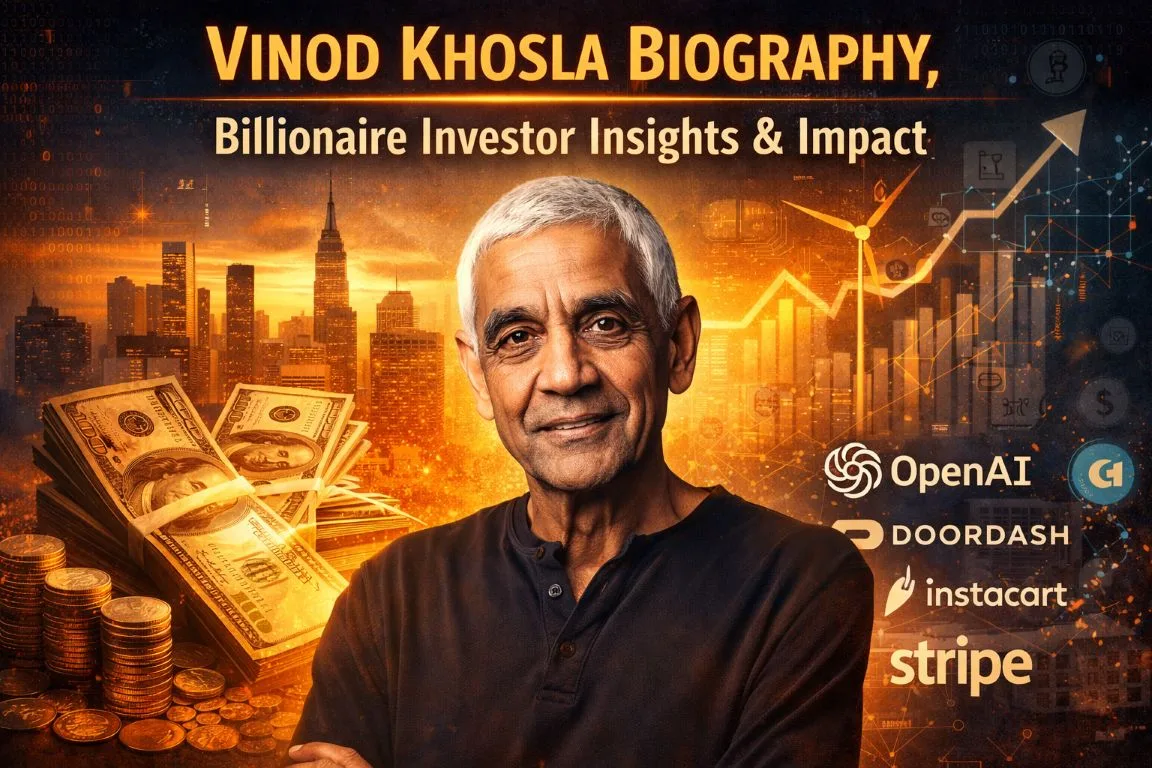
- Vinod Khosla co-founded Sun Microsystems and later launched Khosla Ventures, a firm now managing approximately $15 billion in investor capital.
- He was inspired to become an entrepreneur at age 16 after reading about Intel’s founding — a moment that redirected his entire life trajectory.
- Khosla rejects the label “venture capitalist,” preferring “venture assistant” — a philosophy that has redefined how Silicon Valley thinks about investor-founder relationships.
- In his first 24 years in the US, Khosla helped create 40 companies producing $150 billion in market value and generated six new jobs for every day he lived there.
- His bet on AI, climate tech, and health innovation may be his most ambitious chapter yet — and the strategy behind it holds lessons for anyone chasing financial independence.
One reading of an article about Intel’s founding changed the course of Silicon Valley history — and it happened to a 16-year-old boy in India who had never met an entrepreneur in his life.
Key Takeaways: Vinod Khosla’s Path From IIT Delhi to $15 Billion
Vinod Khosla’s story is not just a biography. It’s a masterclass in how conviction, curiosity, and calculated risk-taking can turn a dream into a generational legacy. Leaders Perception has documented how Khosla grew up in an Indian army household with no business background, yet became one of the most influential venture capitalists in the world. His journey from New Delhi to Menlo Park is a blueprint worth studying for anyone serious about financial independence and building lasting wealth.
From Indian Army Household to Silicon Valley Legend
Vinod Khosla was born and raised in India, the son of an Indian Army officer. His upbringing was disciplined, structured, and far removed from the world of business or entrepreneurship. There were no founders in his family, no investors at the dinner table, and no obvious path to Silicon Valley. Yet that background — grounded in resilience, structure, and ambition — turned out to be exactly the right foundation for what came next.
How Intel’s Founding Sparked a 16-Year-Old’s Dream
At 16, Khosla read an article in Electronic Engineering Times about the founding of Intel. That single piece of content lit a fire that never went out. He became obsessed with the idea of building something from nothing — and from that moment, entrepreneurship wasn’t just an option, it was the only path he could see. Most people wait for permission or a perfect moment to pursue their ambitions. Khosla didn’t.
Twice Rejected by Stanford, Then Accepted
Khosla applied to Stanford and was rejected — not once, but twice. That kind of setback stops most people cold. Instead, he used the rejections as fuel, building his academic credentials until Stanford had no choice but to say yes. It’s a pattern you’ll see repeated throughout his career: obstacles treated as data points, not verdicts.
His persistence paid off in a defining way. He eventually earned his MBA from Stanford Graduate School of Business, the institution that would become the launchpad for some of his most important relationships and opportunities.
Degrees That Built a Billionaire: IIT Delhi, Carnegie Mellon, and Stanford MBA
Khosla’s educational path was deliberately rigorous. He earned a degree in Electrical Engineering from the Indian Institute of Technology (IIT) Delhi — one of the most competitive engineering institutions in the world. He then pursued a Master’s degree in Biomedical Engineering from Carnegie Mellon University before completing his MBA at Stanford.
That combination — deep technical knowledge layered with business strategy — is rare. It gave Khosla a unique lens for evaluating technology investments that most pure financiers simply don’t have. He could stress-test the science and the business model, which is exactly what separates exceptional investors from average ones.
Co-Founding Sun Microsystems
Before venture capital, before Khosla Ventures, there was Sun Microsystems. This is where Vinod Khosla first demonstrated that he wasn’t just a dreamer — he was a builder.
How Sun Microsystems Changed Computing Forever
Sun Microsystems, co-founded by Khosla along with Scott McNealy, Andy Bechtolsheim, and Bill Joy, became a foundational company in the history of modern computing. Sun pioneered the concept of networked computing with the motto “The Network is the Computer” — a vision that was radical in the early 1980s and is simply accepted as fact today. The company built workstations and servers that powered universities, research labs, and eventually the internet itself.
What Khosla’s Role at Sun Revealed About His Investing Philosophy
As CEO of Sun in its early years, Khosla was the driving operational force behind the company’s growth strategy. What’s telling is how he approached that role — not as a manager, but as someone deeply engaged with the technical vision and the team building it. He was obsessed with the people and the problem, not just the profit. That founder-first mentality became the philosophical core of everything he did afterward at Kleiner Perkins and eventually at Khosla Ventures.
The Philosophy Behind Khosla Ventures
When Khosla launched Khosla Ventures in 2004, he wasn’t just starting another fund. He was making a statement about what venture capital should actually be. The firm was built around a simple but radical idea: that the best investors don’t just write checks — they work for founders.
Khosla Ventures is based in Menlo Park and manages approximately $15 billion in investor capital, in addition to investments funded by Khosla personally. The firm was ranked #1 in the Founders Choice list of over 200 venture capital firms — a ranking driven entirely by founder feedback, which is exactly the kind of validation Khosla cares most about.
Why He Calls Himself a “Venture Assistant,” Not a Venture Capitalist
“I want to be a venture assistant, not a venture capitalist. I want to help entrepreneurs do what they need to do.”
— Vinod Khosla
This isn’t just a catchy phrase. It’s a complete reframing of the investor-founder power dynamic. Traditional venture capital has historically placed investors at the top of the hierarchy — the ones with the money calling the shots. Khosla flipped that model entirely.
In practice, this means Khosla Ventures actively helps portfolio companies with recruiting, strategy, business development, and technical problem-solving. The firm functions more like a high-powered co-founder than a passive capital allocator. For founders, that distinction is everything.
For financial independence seekers, this philosophy holds a direct lesson: the most valuable thing you can bring to any partnership — whether it’s a business, an investment, or a career — is genuine utility. Money follows value. Khosla built a $15 billion firm by making himself indispensable to the people he backed, much like how Atlassian navigates its workforce strategy amid changing business landscapes.
The results speak loudly. By consistently prioritizing founder success over fund optics, Khosla Ventures earned the kind of reputation that no marketing budget can buy — one built entirely on outcomes and word of mouth from the entrepreneurs who experienced it firsthand.
The Real Reason Khosla Ventures Was Founded in 2004
The official story is that Khosla wanted more flexibility. The fuller story is more personal. By 2004, he had four growing children and a deep desire to spend more time with them during their teenage years. He also wanted to pursue what he described as “science experiments” — early-stage, sometimes imprudent bets on technologies that traditional VC firms wouldn’t touch. Kleiner Perkins, where he had been a partner, was a prestigious firm but not the right vehicle for the kind of high-risk, high-conviction investing he wanted to do.
Betting on “Science Experiments”: How Khosla Defines Risk
Most investors talk about risk management. Khosla talks about risk embracement. When he founded Khosla Ventures, he was explicit about wanting to fund ideas that others considered too early, too speculative, or too scientifically unproven. He called these “science experiments” — not as a dismissal, but as a badge of honor. The whole point was to back technologies before the market understood their value, much like how Meta acquires Moltbook to stay ahead in the social network platform game.
This approach requires a completely different mental model than conventional investing. Where most funds seek de-risked opportunities with clear revenue paths, Khosla actively looks for the opposite: breakthroughs that are technically audacious and commercially uncertain. His view is that the biggest returns in history have always come from bets that looked reckless at the time. The Intel article that inspired him as a teenager was proof of that — and he has spent his entire career living by that lesson.
For-Profit and Social Impact: Why Khosla Funds Both
Khosla Ventures operates two distinct tracks: traditional for-profit investments and social impact investments. This isn’t a PR strategy — it’s a genuine reflection of how Khosla thinks about capital deployment. He has been vocal about the idea that the most important problems in the world are also the most important investment opportunities, and that separating “doing good” from “doing well” is a false choice.
His social impact portfolio has focused heavily on microfinance in India and Africa, clean energy access, and health technology for underserved populations. These aren’t charity — they’re structured as real investments in companies solving real problems at scale. The thesis is that if you solve a problem that affects billions of people, the economic returns will follow.
For anyone thinking seriously about building wealth with purpose, this dual-track model is worth studying. Financial independence isn’t just about accumulating capital — it’s about deploying it in ways that compound both financially and meaningfully. Khosla has built an entire institution around that idea.
Where Khosla Puts His Money
Khosla Ventures has a distinct investment fingerprint. It doesn’t chase hot sectors after the market has already priced in the opportunity. Instead, the firm plants flags years — sometimes decades — before a space becomes mainstream. That pattern shows up clearly across the firm’s core investment themes.
Energy and Climate Tech: The Biggest Bet
Long before ESG became a buzzword and climate tech became a crowded space, Khosla was writing checks into clean energy and sustainability companies. He has backed companies working on advanced biofuels, next-generation solar, battery storage, and carbon capture. His view is straightforward: energy is the largest industry on earth, it is fundamentally broken from a sustainability standpoint, and whoever solves it will generate extraordinary wealth. He has committed hundreds of millions of his own capital to this thesis and has been one of the most consistent voices pushing for technology-driven solutions over policy-driven ones. He is also a board member of Breakthrough Energy Ventures, the climate-focused investment fund backed by Bill Gates.
AI, Health, and Food: The Next Frontier
Khosla was an early and significant backer of OpenAI, placing a high-conviction bet on artificial intelligence before the broader investment community recognized its transformative potential. That investment alone validated his reputation for seeing technological shifts years before they become consensus. He has spoken extensively about AI’s ability to democratize access to expertise — particularly in healthcare, where he believes AI doctors could deliver better outcomes than human physicians for the majority of routine medical decisions.
Beyond AI, Khosla Ventures has made substantial investments in food technology, including alternative proteins and precision fermentation — industries he believes will be forced to scale rapidly as global population and resource constraints collide. His health investments span diagnostics, drug discovery, and digital health platforms. The common thread across all three sectors is the same: technology solving a problem so large that even a small share of the market represents a massive financial opportunity.
40 Companies, $150 Billion in Market Value in His First 24 Years
In 2001, an article in Red Herring titled “The No. 1 VC on the Planet: Vinod Khosla” reported that during his first 24 years in the United States, Khosla helped create 40 companies that produced $150 billion in market value. That number puts his impact in concrete terms that are hard to argue with.
What that figure doesn’t capture is the ripple effect — the jobs created, the technologies deployed, the industries disrupted, and the entrepreneurs who learned their craft inside Khosla-backed companies and went on to build their own. Wealth creation at that scale is never contained to a single firm or a single balance sheet. It spreads through an economy in ways that take decades to fully measure.
What Makes Khosla’s Investment Instincts Different
Plenty of investors have access to capital, networks, and deal flow. What separates Khosla is his ability to form independent convictions about where technology is headed and hold those convictions under enormous social and financial pressure. That skill — conviction under uncertainty — is the rarest and most valuable asset in investing.
Why He Targets Nascent Technologies Over Proven Markets
Khosla has a clear framework for where he invests: he looks for technologies that are just crossing the threshold of scientific feasibility but have not yet attracted mainstream capital. At that stage, valuations are low, competition is minimal, and the potential upside is asymmetric. He has described this as looking for technologies where failure is possible but success would be transformative. That framing — asymmetric upside with defined downside — is the same logic that underpins every great wealth-building strategy, from early-stage investing to real estate development to building a business from scratch.
Six New Jobs Created for Every Day He Lived in the US
The same 2001 Red Herring article reported that Khosla had created six new jobs for every single day he had lived in the United States. That statistic is staggering when you let it sink in. It means his presence in the country — his decisions, his investments, his company-building — was generating employment at a rate that most corporations never achieve collectively.
This is what compounding impact looks like in practice. Each company he funded hired people, those people built products, those products created markets, and those markets generated further employment and wealth. For financial independence seekers, it’s a powerful reminder that the goal isn’t just to accumulate wealth — it’s to build systems that generate value independently and continuously.
Khosla’s Role Beyond Writing Checks
Khosla’s influence extends well beyond the portfolio companies in his fund. He serves on the board of Breakthrough Energy Ventures, sits on the board of the Indian School of Business, and holds charter membership in TiE (The Indus Entrepreneurs), a global network dedicated to fostering entrepreneurship in the South Asian community and beyond. These aren’t ceremonial roles — they reflect a genuine commitment to building the infrastructure that produces the next generation of founders and investors.
His support for microfinance initiatives in India and Africa adds another dimension to his legacy. By backing financial access programs for entrepreneurs who lack traditional banking relationships, Khosla is effectively expanding the pipeline of global innovation. The logic tracks with his broader worldview: the more people who have access to capital and mentorship, the more problems get solved, and the more wealth gets created for everyone. That’s not philanthropy dressed up as investing — it’s a coherent philosophy about how sustainable economic growth actually works.
Board Memberships: Breakthrough Energy Ventures and Indian School of Business
Khosla serves on the board of Breakthrough Energy Ventures, the Bill Gates-backed climate investment fund that pools capital from some of the world’s wealthiest individuals to fund clean energy breakthroughs. His seat on that board isn’t ceremonial — it reflects a decade-plus of personal capital deployment into energy technology and a genuine technical understanding of what’s possible. He also serves on the board of the Indian School of Business, one of Asia’s top-ranked business schools, where his involvement helps shape the next generation of South Asian entrepreneurs and business leaders.
Support for Microfinance in India and Africa
Khosla has been a consistent supporter of microfinance initiatives across India and Africa — regions where access to capital remains one of the single biggest barriers to entrepreneurship. By backing institutions that extend small loans and financial services to people locked out of traditional banking, he is effectively expanding the global talent pool of founders. His logic is simple: great ideas don’t only come from Stanford graduates with family connections. They come from everywhere, and capital should follow them there. For more on the challenges of global conflict and economic barriers, read this update.
Charter Membership in TiE: Building Entrepreneurs Globally
As a charter member of TiE (The Indus Entrepreneurs), Khosla helped build one of the world’s most powerful entrepreneurial networks from the ground up. TiE was founded in Silicon Valley in 1992 and has since expanded to chapters across the globe, connecting South Asian entrepreneurs with mentors, investors, and peers. Khosla’s involvement isn’t passive — it represents a long-term commitment to building the kind of community infrastructure that allows the next generation of founders to skip some of the painful lessons he had to learn himself.
The Lessons Every Investor Can Take From Vinod Khosla
Vinod Khosla’s biography isn’t a story about luck or privilege. It’s a story about a specific set of decisions, made consistently over decades, that compounded into one of the most remarkable careers in business history. The lessons embedded in his journey are directly applicable whether you’re managing a $15 billion fund or building your first investment portfolio from scratch.
- Back your convictions early. The biggest returns come from bets made before the market agrees with you. Khosla backed AI, clean energy, and networked computing before they were consensus plays.
- Add value beyond capital. Money is the least differentiated resource in investing. What separates great investors is what they bring beyond the check — strategy, networks, technical insight, and genuine commitment to founder success.
- Treat setbacks as data. Stanford rejected Khosla twice. He used those rejections to sharpen his credentials rather than abandon his direction. Every obstacle in his story became a redirecting force, not a stopping point.
- Think in decades, not quarters. Khosla’s energy investments took years to mature. His AI thesis was formed long before ChatGPT made artificial intelligence a dinner table conversation. The investors who win biggest are the ones with the longest time horizons.
- Solve big problems. Small markets produce small returns. Khosla has always oriented his capital toward problems affecting billions of people — energy, health, food, financial access. Scale the problem, scale the opportunity.
Perhaps the most transferable insight from Khosla’s career is this: financial independence is not a destination you arrive at by playing it safe. It is built through a repeated willingness to make asymmetric bets — where the downside is manageable and the upside is transformational. Khosla has lived that thesis every single day since he read that article about Intel at 16 years old.
Frequently Asked Questions
What is Vinod Khosla’s net worth in 2026?
Vinod Khosla’s net worth is estimated at approximately $6 billion, though various sources have cited figures as high as $13.4 billion depending on how private portfolio valuations are calculated at any given time. His wealth was initially built through his co-founding role at Sun Microsystems, and has since been substantially expanded through Khosla Ventures and his personal investment portfolio in AI, clean energy, and technology companies.
It is worth noting that a significant portion of his wealth is tied to illiquid private company stakes, meaning the publicly reported figure fluctuates based on the performance of companies like OpenAI and other Khosla Ventures portfolio companies that have not yet gone public. As those companies mature and seek liquidity events, his net worth calculation will become more precise.
What companies did Vinod Khosla co-found?
- Sun Microsystems — Co-founded in 1982 with Scott McNealy, Andy Bechtolsheim, and Bill Joy. Sun became one of the most important computing companies of the 1980s and 1990s.
- Khosla Ventures — Founded in 2004 as an independent venture capital firm focused on technology and social impact investments.
- Daisy Systems — An early electronic design automation company Khosla was involved with before Sun Microsystems.
Sun Microsystems remains his most consequential founding achievement from a pure business impact standpoint. The company’s networked computing vision shaped the architecture of the modern internet, and its open-source contributions influenced how software development evolved globally over the following four decades.
Khosla’s decision to transition from operator to investor after Sun was not a retreat — it was a strategic multiplication of his leverage. Instead of building one company at a time, he could now apply his judgment and network to dozens of companies simultaneously.
What does Khosla Ventures invest in?
Khosla Ventures invests primarily in early-stage and sometimes pre-commercial technology companies working on problems that are technically ambitious and globally significant. The firm manages approximately $15 billion in investor capital, with additional investments funded directly by Khosla himself. It operates both a for-profit investment track and a social impact investment track — a structure that reflects Khosla’s belief that the most important problems are also the most important investment opportunities.
The firm’s investment focus spans several major sectors:
- Clean Energy and Climate Technology — Advanced biofuels, solar innovation, battery storage, carbon capture, and grid modernization
- Artificial Intelligence — Infrastructure, applications, and foundational AI research, including early backing of OpenAI
- Healthcare and Diagnostics — AI-driven diagnostics, digital health platforms, and drug discovery technologies
- Food and Agriculture Technology — Alternative proteins, precision fermentation, and sustainable food systems
- Consumer and Enterprise Software — Technology platforms with transformative potential across industries
- Financial Access and Microfinance — Initiatives expanding capital access in underserved markets globally
What distinguishes Khosla Ventures’ investment thesis from most other firms is the firm’s explicit preference for technologies that are not yet proven at commercial scale. The firm actively seeks out what Khosla calls “science experiments” — bets that carry genuine failure risk but offer transformational upside if the science works and the market catches up.
Why does Vinod Khosla reject the title of venture capitalist?
Khosla prefers the title “venture assistant” over “venture capitalist” because the latter implies a power dynamic he fundamentally disagrees with. In traditional venture capital, the investor holds structural authority — they sit on boards, control term sheets, and can replace founders when companies hit turbulence. Khosla views that model as backwards. His position is that the investor’s job is to serve the founder, not the other way around.
In practice, this means Khosla Ventures functions as an active operational partner rather than a passive capital provider. The firm helps with recruiting, business development, technical strategy, and investor relations — essentially acting as a co-founder with deep resources rather than a silent financial backer.
Traditional Venture Capitalist Khosla’s “Venture Assistant” Model Writes a check, joins the board, monitors returns Actively supports day-to-day founder decisions Investor holds structural authority over founder Founder holds authority; investor provides support Focuses on portfolio risk management Focuses on maximizing individual company success Values financial metrics above all Values technical vision and founder capability first Exits when returns are achieved Stays engaged through the full company lifecycle
This philosophy is a direct product of Khosla’s own experience as a founder. He knows what it feels like to build something from nothing under pressure, and he uses that knowledge to show up differently than most investors do. The fact that Khosla Ventures was ranked #1 in the Founders Choice list of over 200 venture capital firms — a ranking based entirely on founder feedback — suggests that the approach is working exactly as intended.
What is Vinod Khosla’s educational background?
Vinod Khosla holds three degrees from three highly competitive institutions, each building on the last in a way that gave him both deep technical expertise and strategic business acumen. He began with a Bachelor of Technology in Electrical Engineering from the Indian Institute of Technology (IIT) Delhi — one of India’s most selective engineering schools, where acceptance rates rival those of the Ivy League.
From IIT Delhi, he pursued a Master’s degree in Biomedical Engineering from Carnegie Mellon University in Pittsburgh. That move was deliberate — Khosla was already interested in the intersection of technology and human impact, and biomedical engineering placed him at exactly that crossroads. It also gave him a rigorous scientific framework for evaluating technical claims that most MBAs never develop.
He completed his formal education with an MBA from Stanford Graduate School of Business — the degree that placed him inside the network that would eventually lead to Sun Microsystems, Kleiner Perkins, and everything that followed. Stanford wasn’t just an education for Khosla; it was the access point to the ecosystem he had been trying to reach since he was 16 years old reading about Intel in a magazine. The combination of IIT’s technical rigor, Carnegie Mellon’s scientific depth, and Stanford’s entrepreneurial network produced an investor whose edge is almost impossible to replicate — and whose career continues to prove it.
Vinod Khosla is a prominent figure in the world of venture capital and technology. As the founder of Khosla Ventures, he has invested in numerous successful startups and has made a significant impact on the tech industry. His focus on sustainable and innovative technologies has earned him a reputation as a forward-thinking investor. In recent years, the rising environmental costs of data centers have become a pressing issue, prompting discussions on the AI impact and the need for more sustainable solutions.