


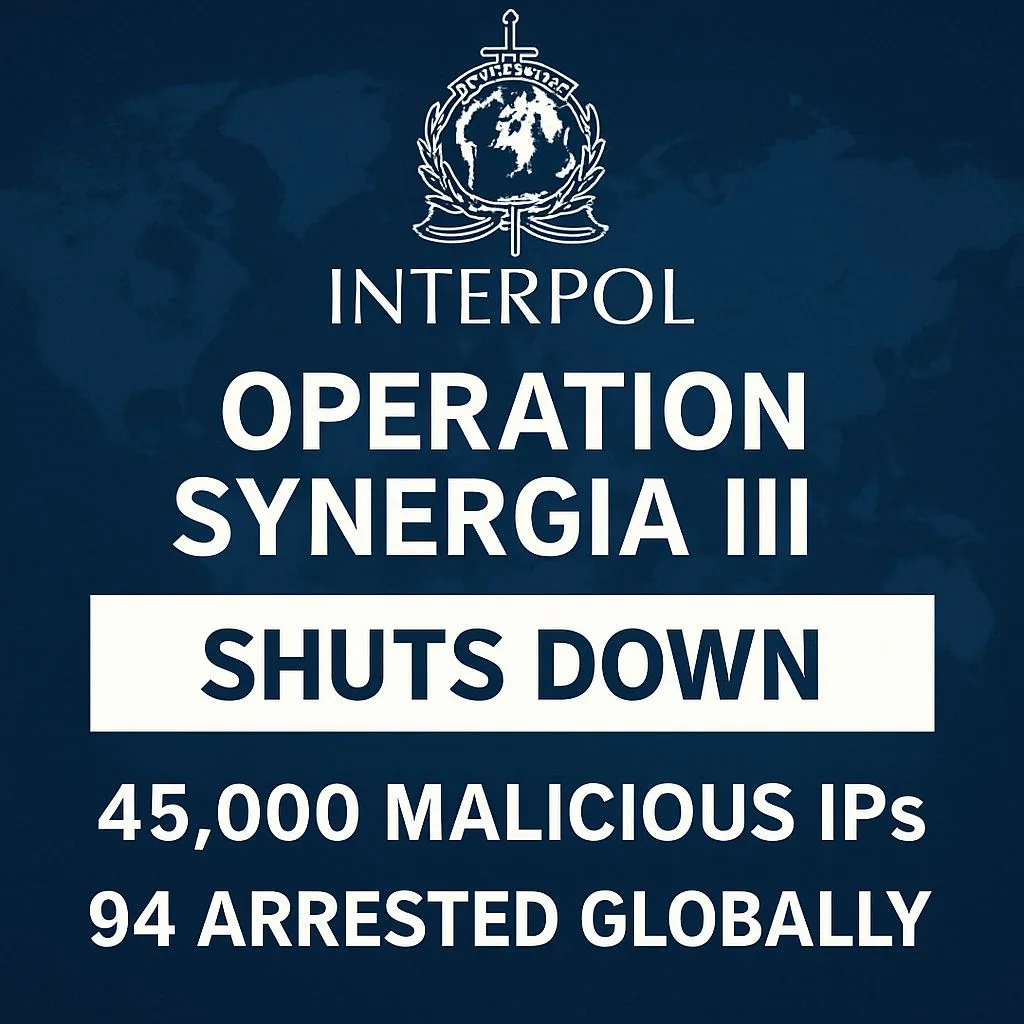
- INTERPOL’s Operation Synergia III ran from July 18, 2025, to January 31, 2026, spanning 72 countries and resulting in the takedown of over 45,000 malicious IP addresses and servers.
- 94 individuals were arrested during the operation, with 110 more suspects still under active investigation across multiple countries.
- The operation targeted phishing, malware, and ransomware infrastructure — going after the criminal networks themselves rather than individual attacks.
- Private sector partners Group-IB, Trend Micro, and S2W played a critical role in identifying and tracking malicious infrastructure used by cybercriminal groups.
- Operation Synergia III was more than double the scale of Synergia II — find out how the numbers stacked up and what that growth signals for the future of global cybercrime enforcement.
Global law enforcement just delivered one of the most significant cybercrime takedowns in history — and the numbers are staggering.
Operation Synergia III, coordinated by INTERPOL, dismantled tens of thousands of malicious servers and IP addresses used to run phishing campaigns, distribute malware, and deploy ransomware across the globe. For anyone tracking the evolution of cybercrime enforcement, this operation marks a clear turning point in how international agencies are fighting back — not just reacting to attacks, but going after the infrastructure powering them. Organizations like HackRead have been closely covering this space, providing cybersecurity communities with timely analysis of major enforcement actions like this one.
What Is Operation Synergia III?
Operation Synergia III is a large-scale, internationally coordinated cybercrime operation led by INTERPOL. Its primary objective was to identify, disrupt, and dismantle the digital infrastructure used by cybercriminal groups to carry out phishing attacks, spread malware, and deploy ransomware. Rather than focusing on individual incidents or single threat actors, the operation took a broader approach — targeting the underlying servers and IP networks that make large-scale cybercrime possible.
This strategic shift in focus is significant. By going after infrastructure rather than individual crimes, INTERPOL and its partners were able to cut off resources used across multiple criminal operations simultaneously, creating a far greater impact than targeting one group at a time.
The Timeline: July 2025 to January 2026
Operation Synergia III — Fast Facts
📅 Start Date: July 18, 2025
📅 End Date: January 31, 2026
🌎 Countries Involved: 72 countries and territories
🔒 Malicious IPs Taken Down: 45,000+
📍 Devices Seized: 200+
👮 Arrests Made: 94
🔍 Under Investigation: 110 additional suspects
🤝 Private Sector Partners: Group-IB, Trend Micro, S2W
The operation ran for approximately six and a half months, giving investigators the time needed to build actionable intelligence across dozens of jurisdictions. A longer operational window meant agencies could map out criminal networks thoroughly before making coordinated arrests and takedowns — rather than tipping off suspects prematurely.
Starting in mid-July 2025, the early phase focused heavily on intelligence gathering, with INTERPOL and its private sector partners compiling data on malicious infrastructure. As the operation progressed into late 2025 and early 2026, that intelligence was converted into coordinated law enforcement actions across participating nations.
The January 31, 2026 conclusion aligned with a series of simultaneous enforcement actions, maximizing disruption and minimizing the chance for criminal networks to relocate or rebuild their infrastructure before being taken offline.
Who Was Involved: 72 Countries and Private Sector Partners
The sheer breadth of Operation Synergia III is what sets it apart from most cybercrime enforcement efforts. Law enforcement agencies from 72 countries and territories participated, making it one of the widest-reaching international cybercrime operations ever conducted. Coordination at this scale requires not just political will but also real-time intelligence sharing between nations with vastly different legal systems and technical capabilities.
On the private sector side, INTERPOL partnered with three key cybersecurity firms: Group-IB, Trend Micro, and S2W. Each brought specialized threat intelligence capabilities that law enforcement agencies alone could not replicate. These partnerships allowed investigators to identify malicious servers faster, track cybercriminal activity across borders, and prioritize the highest-impact targets within the operation. Read more about how fake job recruiters use malware in developer coding challenges.
How INTERPOL Turned Data Into Actionable Intelligence
One of the most technically impressive aspects of Operation Synergia III was INTERPOL’s ability to transform raw threat data into coordinated, real-world enforcement actions. This process involved several interconnected steps that bridged the gap between cyber intelligence and physical arrests.
- Data aggregation: Threat data from Group-IB, Trend Micro, and S2W was pooled to identify patterns across malicious infrastructure globally.
- Infrastructure mapping: Analysts mapped relationships between IP addresses, servers, domains, and known threat actors to build complete network pictures.
- Cross-border intelligence sharing: INTERPOL facilitated secure information exchanges between member countries, ensuring each agency had jurisdiction-specific leads.
- Tactical operational support: INTERPOL provided direct assistance to member countries during the takedown phase, helping coordinate simultaneous actions to prevent criminals from going dark before arrests were made.
- Preliminary investigations to coordinated actions: Initial findings were used to trigger localized investigations, which then fed back into the global operation for wider enforcement.
This intelligence pipeline is what made the scale of Synergia III possible. Without it, 72 separate national agencies would have been working in silos — potentially disrupting the same networks repeatedly while missing the broader criminal ecosystem connecting them all.
The Scale of the Takedown
The raw numbers from Operation Synergia III tell a clear story: this was not a targeted strike against a single threat actor. It was a systematic dismantling of cybercriminal infrastructure across an entire global ecosystem. The scale of what was seized, shut down, and disrupted places this operation in a category of its own.
45,000 Malicious IPs and Servers Dismantled
Over 45,000 malicious IP addresses and servers were taken offline during the operation. These were not dormant or abandoned systems — they were actively being used to host phishing pages, distribute malware payloads, and coordinate ransomware attacks against individuals, businesses, and government entities worldwide. Taking them offline simultaneously denied cybercriminals the operational backbone they depend on to execute attacks at scale.
212 Devices and Servers Seized
Physical Assets Seized During Operation Synergia III
💻 Total Devices Seized: Over 200 (reported as 212 in preliminary figures)
📦 Types of Assets: Servers, personal computing devices, storage hardware
🌎 Scope: Seized across multiple countries and territories
🔒 Purpose: Forensic analysis to identify additional suspects and criminal networks
Physical seizures are a critical part of any major cybercrime operation. Beyond shutting down servers remotely, seizing physical hardware gives investigators access to forensic evidence — logs, communications, cryptocurrency wallets, and configuration files — that can be used to identify additional suspects, map criminal hierarchies, and build prosecution cases.
The 200+ devices seized during Synergia III will likely fuel follow-on investigations well beyond the official close of the operation on January 31, 2026. In many past INTERPOL operations, physical evidence gathered during seizures has led to secondary arrest waves months after the initial action concludes.
94 Arrested, 110 Still Under Investigation
The 94 arrests made during Operation Synergia III span multiple continents and represent a wide range of roles within the cybercriminal ecosystem — from infrastructure operators and malware developers to fraud ring coordinators and money mules. What’s equally notable is the 110 additional suspects who remain under active investigation. This figure signals that the operation’s impact extends well beyond the initial arrests.
The ongoing investigations also suggest that law enforcement agencies are being deliberate — building stronger cases rather than rushing to arrest individuals before the evidence is fully developed. For the cybersecurity community, those 110 open investigations represent a continued pressure on threat actor networks that could yield significant additional takedowns in the months ahead.
What Cybercrime Did Operation Synergia III Target?
Operation Synergia III cast a wide net across three primary categories of cybercrime — phishing, malware distribution, and ransomware. These aren’t isolated threats. They’re deeply interconnected attack types that often share the same infrastructure, making a coordinated infrastructure-level takedown far more effective than targeting each threat category separately. For instance, Microsoft’s bug fix highlights the importance of addressing vulnerabilities that could be exploited by malware.
Phishing Networks and Fraudulent Websites
Phishing remains one of the most damaging and widespread forms of cybercrime globally, and it was a central target of Synergia III. Investigators identified and dismantled thousands of fraudulent websites designed to impersonate legitimate organizations — banks, government agencies, e-commerce platforms — to steal login credentials, financial data, and personal information from unsuspecting victims. For example, fake job recruiters often use phishing techniques to lure unsuspecting individuals into revealing sensitive information.
The scale of the phishing infrastructure taken down during this operation reflects just how industrialized this type of cybercrime has become. These weren’t amateur operations running a handful of fake websites. Criminal groups were operating sophisticated, automated phishing networks capable of generating and rotating thousands of fraudulent pages to evade detection — exactly the kind of infrastructure that requires a global law enforcement response to dismantle effectively.
Malware and Ransomware Infrastructure
Malware distribution networks and ransomware command-and-control servers made up a significant portion of the 45,000 malicious IPs taken down during the operation. These servers act as the operational backbone for ransomware attacks — receiving data from infected machines, issuing encryption commands, and hosting the payment portals that criminals use to collect ransoms from victims. For more insights on how technology impacts various sectors, read about Oracle’s partnership with Red Bull Racing.
Ransomware in particular has evolved dramatically in recent years. Modern ransomware operations run like structured businesses, complete with customer service teams, negotiation departments, and tiered payment structures. Taking down the infrastructure that supports these operations disrupts the entire criminal enterprise — not just individual attacks.
- Command-and-control servers: Used to remotely manage malware-infected devices and coordinate ransomware deployments across victim networks.
- Malware distribution hubs: Servers that host and deliver malicious payloads through phishing emails, drive-by downloads, and compromised legitimate websites.
- Ransomware payment portals: Dark web and surface web pages used to facilitate ransom payments from victims to criminal operators.
- Botnet infrastructure: Networks of compromised devices used to amplify attacks, distribute spam, and conduct credential-stuffing operations at scale.
By targeting this infrastructure rather than individual incidents, Operation Synergia III effectively cut off the operational capacity of multiple criminal groups simultaneously — forcing them to rebuild from scratch while law enforcement continued building cases against identified suspects. This approach is crucial in combating threats like those posed by fake job recruiters spreading malware through various channels.
Identity Theft, Scams, and Credit Card Fraud
Beyond phishing and malware, Operation Synergia III also targeted broader fraud ecosystems involving identity theft, credit card fraud, and financial scam networks. These operations often run in parallel with phishing campaigns — harvesting stolen credentials and payment data through phishing attacks, then monetizing that data through fraudulent transactions, account takeovers, and dark web marketplaces. The interconnected nature of these crimes means that dismantling phishing infrastructure simultaneously disrupts the downstream fraud operations that depend on the stolen data it generates.
Key Cases From the Operation
While the headline numbers from Operation Synergia III are striking, the individual cases INTERPOL highlighted give a clearer picture of just how diverse and globally distributed the cybercriminal activity being disrupted really was. Each case reflects a different dimension of the cybercrime ecosystem — from massive automated fraud networks to regionally organized criminal rings. One such case involved fake job recruiters using malware in developer coding challenges.
These examples also illustrate the operational intelligence work that made Synergia III possible. Identifying a network of 33,000 malicious websites or a multi-scheme fraud ring spanning an entire country doesn’t happen through luck — it requires months of data analysis, cross-border coordination, and the kind of public-private threat intelligence sharing that defined this operation.
33,000 Malicious Websites Traced to Macau, China
One of the most significant findings of the operation was the identification of approximately 33,000 malicious websites linked to infrastructure based in Macau, China. These sites were part of a large-scale phishing and fraud network targeting victims across multiple countries and regions. The sheer volume of fraudulent domains linked to a single geographic cluster underscores how centralized cybercriminal infrastructure can be — even when attacks are distributed globally.
This case also highlights the importance of INTERPOL’s private sector partnerships. Identifying tens of thousands of malicious domains and tracing them back to a specific infrastructure cluster requires the kind of automated threat intelligence analysis that firms like Group-IB, Trend Micro, and S2W specialize in — work that would take traditional law enforcement agencies years to replicate independently.
Fraud Ring Dismantled in Togo With 10 Arrests
In Togo, authorities dismantled a fraud ring that resulted in 10 arrests. This case demonstrated that Operation Synergia III’s reach extended into West Africa — a region that has increasingly become a hub for cybercrime operations targeting victims in wealthier nations. The arrests in Togo represent exactly the kind of regional enforcement action that becomes possible when INTERPOL provides smaller national law enforcement agencies with actionable intelligence they wouldn’t otherwise have access to.
40 Suspects Arrested in Bangladesh for Multi-Scheme Fraud
Bangladesh saw one of the largest single-country arrest counts in the operation, with 40 suspects taken into custody for involvement in multi-scheme fraud operations. These schemes spanned several categories of cybercrime, reflecting the trend of criminal organizations diversifying their attack methods to maximize revenue and reduce the risk of total operational shutdown from any single enforcement action. In related news, Meta’s acquisition of Moltbook highlights the increasing focus on digital platforms amid rising cyber threats.
The Bangladesh arrests also highlight an important pattern in modern cybercrime: criminal groups are increasingly operating across multiple fraud verticals simultaneously — running phishing campaigns, identity theft operations, and financial scams in parallel. This multi-scheme approach makes them harder to fully disrupt, which is precisely why infrastructure-level operations like Synergia III are so critical to sustained enforcement success.
How Operation Synergia III Compares to Previous INTERPOL Operations
Context matters when evaluating the significance of Operation Synergia III. INTERPOL’s Synergia series has been running as an evolving effort to combat global cybercrime infrastructure, and each iteration has grown substantially in both scale and impact. Comparing Synergia III to its predecessor reveals just how rapidly INTERPOL is scaling up its cybercrime enforcement capabilities.
In 2024, INTERPOL conducted Operation Synergia II, which resulted in 41 arrests and the takedown of 22,000 malicious IP addresses along with 59 servers worldwide. Synergia III more than doubled that impact — 94 arrests versus 41, and 45,000 malicious IPs versus 22,000. That kind of growth between consecutive operations doesn’t happen by accident. It reflects deliberate investment in intelligence-sharing frameworks, expanded private sector partnerships, and a broader coalition of participating countries willing to commit law enforcement resources to coordinated international action, particularly in tackling malware threats.
Operation Synergia II in 2024: 22,000 IPs and 41 Arrests
Operation Synergia II, conducted in 2024, was itself considered a landmark cybercrime enforcement action at the time. It resulted in 41 arrests, the shutdown of 22,000 malicious IP addresses, and the takedown of 59 servers across multiple countries. The operation demonstrated that INTERPOL’s model of combining law enforcement coordination with private sector threat intelligence could produce real, measurable results against global cybercriminal infrastructure.
What made Synergia II notable was its focus on building a repeatable operational template — one that could be scaled up in future iterations. That template clearly worked. The intelligence-sharing frameworks, the private sector partnerships, and the multi-country coordination structures established during Synergia II became the foundation on which Synergia III was built, expanded, and ultimately doubled in impact.
The Growth in Scale Between Each Operation
| Metric | Operation Synergia II (2024) | Operation Synergia III (2025–2026) |
|---|---|---|
| Malicious IPs Taken Down | 22,000 | 45,000+ |
| Servers Seized | 59 | 200+ devices and servers |
| Arrests Made | 41 | 94 |
| Suspects Under Investigation | Not reported | 110 |
| Countries Participating | Not specified | 72 countries and territories |
| Private Sector Partners | Not specified | Group-IB, Trend Micro, S2W |
| Operation Duration | 2024 | July 18, 2025 – January 31, 2026 |
The growth between Synergia II and Synergia III is not just quantitative — it’s structural. The expansion from an unspecified number of countries to 72 participating nations signals a fundamental shift in how seriously global law enforcement is treating cybercrime as a shared international threat. The addition of named private sector partners like Group-IB, Trend Micro, and S2W also reflects a maturing public-private collaboration model that other international enforcement bodies are likely to adopt as a benchmark going forward.
What This Means for Global Cybersecurity
Operation Synergia III sends a clear message to cybercriminal networks worldwide: the infrastructure you depend on is no longer safe, regardless of where it’s hosted or how many jurisdictions it spans. The operation’s success in coordinating simultaneous enforcement actions across 72 countries proves that international law enforcement is closing the jurisdictional gaps that cybercriminals have historically exploited to operate with near-impunity.
For organizations and individuals concerned about cyber threats, this is genuinely significant news — but it’s not a reason to lower defenses. Taking down 45,000 malicious IPs is a major disruption, not a permanent solution. Cybercriminal groups are resilient. They rebuild infrastructure, shift to new hosting providers, and adapt their tactics in response to enforcement pressure. The 110 suspects still under investigation suggest the full impact of Synergia III is still unfolding, but the broader cybercrime ecosystem will continue to operate and evolve. Staying protected means staying informed, keeping systems patched, and treating phishing awareness as a non-negotiable part of any security posture.
Frequently Asked Questions
Operation Synergia III generated significant attention across the global cybersecurity community. Here are the most common questions answered clearly and directly.
What Was the Goal of INTERPOL Operation Synergia III?
The goal of Operation Synergia III was to identify, disrupt, and dismantle the digital infrastructure used by cybercriminal networks to conduct phishing attacks, distribute malware, and deploy ransomware on a global scale. In recent news, Microsoft’s bug also highlighted vulnerabilities that could be exploited by cybercriminals, underscoring the importance of such operations.
Rather than targeting individual cybercriminals or responding to specific incidents, the operation took a strategic infrastructure-first approach — going after the servers, IP addresses, and hosting networks that power large-scale cybercrime operations. By cutting off the operational backbone of multiple criminal groups simultaneously, the operation aimed to create maximum disruption across the entire cybercriminal ecosystem.
INTERPOL described the operation as a powerful testament to what global cooperation can achieve, noting that cybercrime in 2026 is more sophisticated and destructive than ever before. The operation’s success in translating threat intelligence into real-world enforcement actions across 72 countries reflects a significant maturation in how international law enforcement approaches large-scale cyber threats.
How Many Countries Took Part in Operation Synergia III?
Law enforcement agencies from 72 countries and territories participated in Operation Synergia III, making it one of the broadest international cybercrime enforcement operations ever conducted.
INTERPOL coordinated the participation of all member countries, facilitating cross-border intelligence sharing and providing tactical operational assistance to ensure that national agencies could act on leads simultaneously — preventing criminal networks from relocating infrastructure or alerting associates before arrests were made. For instance, efforts like combating fake job recruiters spreading malware highlight the importance of global cooperation in tackling cybercrime.
What Types of Cybercrime Did Operation Synergia III Target?
Operation Synergia III primarily targeted three categories of cybercrime: phishing networks, malware distribution infrastructure, and ransomware operations. The operation also disrupted broader fraud ecosystems including identity theft schemes, credit card fraud networks, and financial scam operations — all of which are closely interconnected with phishing and malware campaigns at the infrastructure level.
What Private Companies Helped With Operation Synergia III?
Three cybersecurity firms played a direct role in supporting Operation Synergia III: Group-IB, Trend Micro, and S2W. These companies provided specialized threat intelligence capabilities that enabled investigators to identify malicious infrastructure, track cybercriminal activity across borders, and convert raw data into the actionable intelligence needed to coordinate simultaneous enforcement actions across 72 participating countries. Their involvement reflects the growing importance of public-private partnerships in modern cybercrime enforcement.
How Does Operation Synergia III Compare to Past INTERPOL Operations?
Operation Synergia III significantly outpaced its predecessor, Operation Synergia II, which was conducted in 2024 and resulted in 41 arrests and the takedown of 22,000 malicious IP addresses and 59 servers. Synergia III more than doubled both the arrest count (94 vs. 41) and the number of malicious IPs taken down (45,000+ vs. 22,000), while also seizing over 200 physical devices and expanding participation to 72 named countries and territories.
The growth between operations reflects deliberate investment in INTERPOL’s intelligence-sharing infrastructure, expanded private sector partnerships, and a broader coalition of participating nations. Each iteration of the Synergia series has built on the operational template of the last — refining the coordination mechanisms, expanding the network of participating agencies, and increasing the scale of enforcement actions that can be executed simultaneously.
If the trajectory continues, Operation Synergia IV could be even larger in scope. For cybercriminals relying on distributed infrastructure to avoid takedowns, that pattern of escalating enforcement should be a significant concern — and for the global cybersecurity community, it represents a genuine reason for cautious optimism about the direction of international cybercrime enforcement.
Stay ahead of the latest cybercrime enforcement developments and threat intelligence updates with HackRead, your trusted source for cybersecurity news, analysis, and in-depth coverage of operations like Synergia III.