


Article-At-A-Glance: AI Traffic Camera Fines in NSW & WA
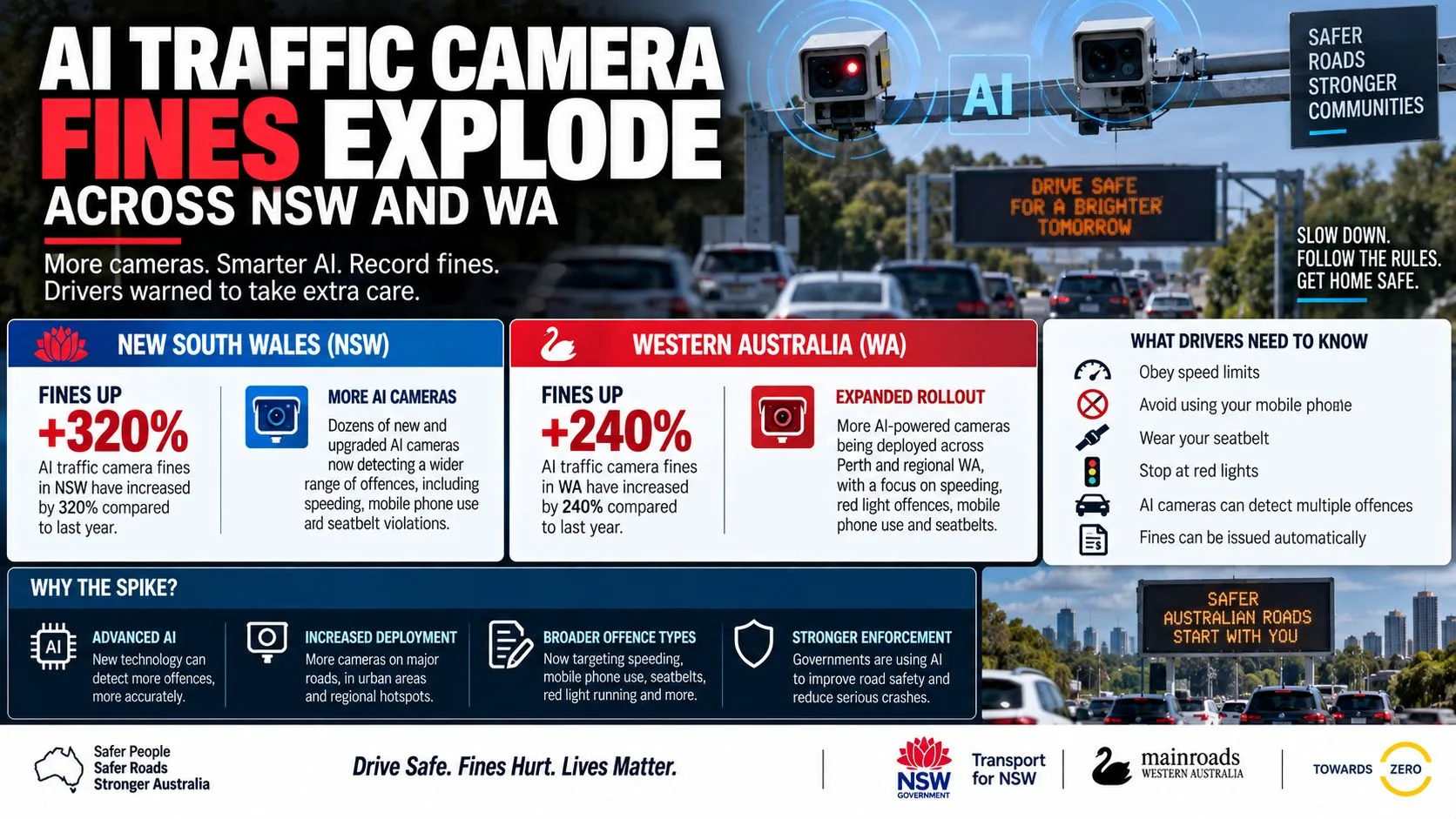
- AI traffic cameras have issued hundreds of thousands of fines across Australia, with Western Australia recording roughly 184,000 infringements since launching in October 2024.
- In New South Wales, more than 130,000 fines were issued in the 2024-2025 financial year alone — the first full year the AI camera technology was active.
- WA seatbelt fines start at A$550 and four demerit points, and repeat detections on the same trip can stack penalties into the tens of thousands of dollars.
- AI cameras use deep learning image recognition to detect phone use and seatbelt violations inside moving vehicles, but a human reviewer still checks flagged images before a fine is issued.
- Keep reading to find out exactly what these cameras can see, what your appeal options are, and whether the technology is actually making roads safer.
Australia’s roads have quietly become one of the most heavily AI-monitored driving environments in the world — and the fines are piling up fast.
Governments across New South Wales, Western Australia, and Queensland have rolled out AI-powered road safety cameras that scan every passing vehicle for illegal phone use and seatbelt violations. The technology works at scale in a way traditional enforcement never could, processing thousands of vehicles per hour without a single officer present. For drivers, that means the odds of getting caught have shifted dramatically — and many are only finding out when an infringement notice lands in their mailbox.
184,000 Fines and Counting: What’s Happening on Australian Roads
The numbers are hard to ignore. Since Western Australia launched its AI road safety cameras in October 2024, approximately 184,000 infringements have been issued. In New South Wales, the first year of AI camera operation produced more than 130,000 fines. Queensland added around 114,000 fines based on AI image recognition technology in 2024. Across three states, that’s well over 400,000 fines generated by the same underlying technology in roughly the same timeframe.
What’s driving the surge isn’t just the cameras themselves — it’s the sheer volume of vehicles they can process. Unlike a police officer stationed on a roadside, an AI camera system runs continuously, scans every lane, and flags potential violations in real time. The scale of enforcement has fundamentally changed, and fine revenue has followed.
How AI Traffic Cameras Actually Work
These aren’t your standard speed cameras with a simple trigger mechanism. AI traffic cameras use high-resolution imaging combined with deep learning models trained to recognise specific driver behaviours inside a moving vehicle.
- High-definition cameras capture detailed images of vehicle interiors as they pass
- AI image recognition software scans each image for target behaviours such as phone use or missing seatbelts
- Flagged images are queued for secondary human review before any fine is issued
- The system operates day and night using both standard and infrared imaging
- Cameras can process multiple lanes of traffic simultaneously at highway speeds
The AI models powering these systems have been trained on massive datasets of driver behaviour images, teaching them to distinguish between, say, a driver holding a coffee cup versus a mobile phone. The precision of modern deep learning means the system can detect subtle cues — the angle of a wrist, the glow of a screen — that would be invisible to a roadside observer at speed.
It’s important to understand that the AI itself does not issue fines. It flags. A trained human operator then reviews the flagged image and makes the final call on whether an infringement notice is sent. This two-stage process is what governments point to when defending the accuracy of the system.
What the Cameras Can See Inside Your Vehicle
The imaging capability of these cameras surprises most drivers. They are positioned at angles and heights specifically chosen to capture clear sightlines into the vehicle cabin, even through windscreens and side windows. The AI can detect whether a seatbelt strap is present across the driver or front passenger, whether a mobile device is being held or resting against the steering wheel, and in some configurations, whether a child restraint appears to be correctly fitted.
How AI Flags an Infringement
When a vehicle passes a camera, the system captures a burst of images and runs them through its detection model within milliseconds. If the model identifies a behaviour that meets its threshold for a likely infringement, that image set is tagged and forwarded to a human review queue. The AI assigns a confidence score to each flag, and most systems are calibrated to only pass images that meet a high confidence threshold — reducing the number of borderline cases that reach human reviewers.
The Role of Human Review After AI Detection
Every flagged image in Australia’s current AI camera programs goes through human review before a fine is issued. A trained officer examines the image evidence and makes an independent decision. This step exists as a safeguard, but critics point out that reviewers are assessing still images rather than video footage, which can make context difficult to establish — particularly in cases where a driver might appear to be holding a phone but was actually adjusting a mount or reaching for something else.
The Fine Numbers in NSW and WA
The volume of fines being generated by AI cameras is unlike anything seen in Australian traffic enforcement history. Each state launched its program at different times and with different rollout scales, but the trajectory in every case is the same — sharply upward.
What makes the numbers particularly striking is that these totals come from relatively short operational windows. NSW and WA are both still in early deployment phases, meaning camera coverage will likely expand further before it contracts.
NSW: 130,000+ Fines in the First Year
New South Wales issued more than 130,000 fines in the 2024-2025 financial year — the first full year AI camera technology was deployed in the state. The NSW program targets both mobile phone use and seatbelt non-compliance, with cameras positioned at fixed and mobile locations across the network. The scale of detections in year one exceeded many public expectations, and seatbelt fine numbers in particular drew significant media attention and public criticism.
WA: 184,000 Infringements Since October Launch
Western Australia’s rollout began in October 2024 and has already produced approximately 184,000 infringements — a figure that represents one of the fastest accumulation rates of AI-generated traffic fines in Australian history. The WA program attracted national headlines partly because of the penalty severity, and partly because of high-profile individual cases that illustrated just how fast fines could compound.
One widely reported case involved a driver who received almost A$20,000 worth of fines and faced the accumulation of nearly 200 demerit points. Cases like this highlighted a structural issue: the AI camera system detects violations at each camera location independently, meaning a driver who travels past multiple cameras while not wearing a seatbelt receives a separate fine at each point.
The financial and legal pressure this creates on individual drivers has been a central focus of public debate. While authorities argue each infringement represents a genuine separate offence, critics question whether the cumulative penalty structure reflects proportional justice or primarily serves revenue generation.
- WA cameras launched: October 2024
- Infringements issued to date: approximately 184,000
- Starting penalty: A$550 per seatbelt offence
- Demerit points per seatbelt offence: 4 points
- Highest reported individual fine total: approximately A$20,000
How These Numbers Compare to Queensland
Queensland sits at around 114,000 AI-generated fines in 2024, making it the third-highest volume state in Australia’s AI camera rollout. While the number is lower than NSW and WA, Queensland’s program is notable because it focuses heavily on mobile phone detection using AI image recognition — and the state has been running the technology longer than WA. The trajectory across all three states points to the same outcome: as camera networks expand, fine volumes will keep climbing.
What Offences Are Being Detected
AI traffic cameras in Australia are currently deployed to detect two primary categories of driving behaviour: mobile phone use and seatbelt non-compliance. Both are considered serious road safety risks backed by decades of crash data, which is the justification governments use for automated enforcement at scale. The technology was specifically developed because these behaviours are notoriously difficult to detect and prosecute through traditional roadside policing.
Mobile Phone Use While Driving
Distracted driving involving mobile phones is one of the leading contributors to serious crashes on Australian roads. AI cameras targeting phone use are trained to detect a driver holding or using a device — even when the phone is partially obscured or held low near the lap. The imaging systems capture multiple frames as a vehicle passes, giving the AI enough data points to make a reliable determination even at highway speeds. What catches many drivers off guard is that the cameras can identify phone use in low-light and nighttime conditions using infrared imaging, meaning there is no “safe” time of day to take the risk.
Seatbelt Violations
Seatbelt detection has proven to be the more contentious of the two applications, particularly in Western Australia where the fine and demerit point structure has generated the most public backlash. The AI looks for the characteristic diagonal strap of a correctly worn seatbelt across the driver and front passenger. If the strap is absent, tucked behind the seat, or worn incorrectly — such as under the arm — the system flags it as a violation. Both driver and front passenger non-compliance can be captured in the same image, meaning a single camera pass can generate two separate infringement notices from one vehicle.
How Much Are the Fines
The penalty structure attached to AI camera detections is where public anger has been most concentrated. The fines are not small, and the demerit point consequences are significant enough to threaten the licences of drivers who accumulate multiple detections in a short period. Understanding the exact penalty framework in each state is essential for any driver who wants to know what they’re risking.
WA Penalty Breakdown: Starting at A$550 and Four Demerit Points
In Western Australia, a seatbelt infringement detected by an AI camera carries a starting penalty of A$550 and four demerit points. That baseline is already among the steepest seatbelt penalties in the country, but the real financial danger comes from the way multiple detections compound. Because each camera location generates an independent infringement, a driver travelling on a route monitored by several cameras while not wearing a seatbelt receives a separate A$550 fine at each point. Four cameras. Four fines. Four sets of demerit points. The mathematics escalate quickly.
Offence Type Fine Amount (WA) Demerit Points Seatbelt (driver) A$550 4 points Seatbelt (front passenger) A$550 4 points Mobile phone use Varies by state Varies by state
How Repeat Offences Can Stack Into Thousands of Dollars
The case of the WA driver who accumulated nearly A$20,000 in fines and close to 200 demerit points is not an anomaly in the mathematical sense — it’s a predictable outcome of the per-camera infringement model applied to a driver who passed multiple camera sites while non-compliant. Each camera detection is treated as a standalone offence under the current framework, with no cap on cumulative penalties for the same underlying behaviour on a single trip. This has been one of the most heavily criticised aspects of the program, with legal advocates and community groups arguing the structure is disproportionate and potentially designed to maximise revenue rather than modify behaviour.
Challenging an AI Traffic Fine
Receiving an AI camera fine does not mean the matter is automatically closed. Drivers do have formal options to contest infringement notices, and in some cases those challenges succeed. However, the process requires a clear understanding of what grounds are actually available, because simply believing the camera was wrong is not, by itself, a sufficient basis for a successful appeal.
The two-stage detection process — AI flag followed by human review — means that by the time a fine reaches a driver’s mailbox, at least one trained officer has already assessed the image evidence and determined it meets the threshold for an infringement. Overturning that decision requires presenting new information or identifying a procedural error, not just expressing disagreement with the outcome.
Grounds for a Legitimate Appeal
There are specific circumstances where contesting an AI traffic camera fine has a realistic chance of success. The most commonly accepted grounds include:
- Mistaken identity: The vehicle in the image is not yours, or the number plate has been misread or cloned
- Medical exemption: A documented medical condition prevents correct seatbelt use, supported by a signed certificate from a registered medical practitioner
- Image quality issues: The evidence image is too unclear to conclusively establish the alleged offence
- Procedural errors: The infringement notice contains incorrect details about the time, date, location, or vehicle
- Emergency circumstances: A genuine emergency can, in rare cases, provide a lawful excuse for the detected behaviour
What won’t work as an appeal ground is arguing that you were only briefly on your phone, that you were stationary in traffic, or that the seatbelt was technically on but uncomfortable. The AI camera system and its human reviewers assess the image as captured, and the legal standard for most of these offences does not include duration or intent as mitigating factors at the infringement notice stage.
The Real Cost of Taking It to Court
Appealing an AI traffic fine through the court system is a legitimate right, but it comes with real financial and time costs that drivers need to weigh carefully before proceeding. Taking an infringement to a magistrates court means paying court filing fees, potentially engaging a lawyer, and attending hearings — all of which can exceed the value of the original fine, particularly for lower-penalty offences. The stress and time investment involved is significant, and for many drivers, the calculus simply doesn’t favour a court challenge unless the fine amount is substantial or the demerit point consequences threaten their licence.
There is also an important risk to understand: if a court finds against you, it has the power to impose a penalty greater than the original fine. Some drivers have entered court proceedings expecting a reduced penalty and left with a higher one. Going to court is not a low-risk option, and getting proper legal advice before filing is strongly recommended rather than representing yourself based on a general sense that the fine was unfair.
Are AI Traffic Cameras Actually Making Roads Safer
This is the central question underneath the entire public debate, and the honest answer is that it’s complicated. Governments consistently cite road safety justifications for AI camera programs, and the underlying premise is sound — mobile phone use and seatbelt non-compliance are genuinely dangerous behaviours with well-documented links to serious crashes and fatalities. The deterrence argument holds that widespread, unavoidable enforcement changes driver behaviour over time, reducing risk across the entire network. Whether the current fine volumes reflect a system successfully catching high rates of non-compliance, or a system set up to generate revenue rather than change behaviour, is a question that researchers, legal experts, and the public are actively debating. What is clear is that the scale of detections — hundreds of thousands of fines across three states in roughly one year — suggests either that non-compliance rates were far higher than previously understood, or that the detection sensitivity of the AI systems is catching behaviours that traditional enforcement would never have prioritised. Probably both.
Frequently Asked Questions
AI traffic camera fines have generated enormous public confusion about how the technology works, what drivers’ rights are, and what happens if they don’t pay. The questions below address the most common points of uncertainty directly and practically.
Understanding your situation clearly — whether you’ve just received a fine or you’re trying to understand the system before you encounter it — is the most useful thing you can do. The enforcement environment has changed permanently, and the drivers who adapt their habits to that reality are the ones who avoid costly surprises.
For those navigating fines, appeals, or just trying to understand the road rules in more detail, staying informed about traffic enforcement developments in your state is essential. Traffic enforcement awareness resources are available through government road safety agencies as well as independent organisations focused on driver education.
Can an AI Traffic Camera Fine Be Wrong?
Yes, AI traffic camera fines can be wrong, though the two-stage detection process — AI flag plus human review — is designed to minimise errors before a fine is issued. The most common sources of error include misidentification of the vehicle through number plate misreading, image quality issues in difficult lighting conditions, and cases where an object other than a phone was interpreted as a device by the AI model. Human reviewers can also make errors, particularly when assessing ambiguous still images without supporting video context.
If you believe your fine is incorrect, you have the right to request the evidence image that formed the basis of the infringement notice. Reviewing that image is the first and most important step before deciding whether to challenge the fine. In many cases, the image makes the detection clear and unambiguous. In others, it raises legitimate questions worth pursuing through the formal review or court process.
How Do I Know If I Have Been Caught by an AI Traffic Camera?
In most cases, you won’t know at the time of detection. AI traffic cameras do not flash, make a sound, or provide any immediate indication that a vehicle has been flagged. The first notification most drivers receive is a physical infringement notice sent to the registered address of the vehicle owner, typically arriving days to weeks after the detection event.
Some states provide online fine checking tools through their transport or fines management portals, where you can search using your licence or registration details. However, there is no real-time notification system in place — the postal infringement notice remains the primary method of communication in NSW and WA.
If you believe you may have been detected but haven’t received anything, check that your vehicle registration address is current and up to date. Fines sent to an outdated address are still legally valid, and failing to update your details doesn’t pause the payment deadline or appeal window. Missed notices that proceed to enforcement can result in additional fees and licence suspension.
Can I Appeal an AI Camera Fine in NSW or WA?
Yes, both NSW and WA have formal processes for contesting AI camera infringement notices. In NSW, you can request an internal review through Revenue NSW, which allows a senior officer to reassess the fine without you needing to go to court. In WA, the process runs through the Fines Enforcement Registry. In both states, if the internal review is unsuccessful, you have the right to elect to have the matter heard before a magistrate. The key is acting within the stated timeframes on your infringement notice — missing the response deadline significantly limits your options and can result in the fine moving directly to enforcement action.
Do AI Traffic Cameras Operate 24 Hours a Day?
Yes. AI traffic cameras are designed for continuous operation around the clock, and this is one of the key advantages governments cite over traditional roadside enforcement. The cameras use both standard visible-light imaging during daylight and infrared imaging technology at night, maintaining detection capability across all lighting conditions.
There is no time of day, weather condition, or traffic volume that reliably reduces the cameras’ ability to detect and flag target behaviours. Drivers who assume late-night or early-morning travel carries lower detection risk are operating on a false premise.
Condition Camera Capability Daylight Full high-resolution colour imaging Night / Low Light Infrared imaging active, detection maintained Rain / Overcast Operational with possible minor image quality variation Heavy Traffic Multi-lane simultaneous detection capability Highway Speeds Burst imaging captures multiple frames per vehicle pass
What Happens If I Ignore an AI Traffic Camera Fine?
Ignoring an AI traffic camera fine is one of the costliest mistakes a driver can make. In both NSW and WA, unpaid infringement notices that pass their due date are automatically referred to the relevant fines enforcement agency, which triggers additional fees on top of the original penalty amount. The fine escalates financially the longer it remains unpaid.
Beyond the financial escalation, enforcement agencies have significant powers to recover unpaid fines without court proceedings. These powers include placing a hold on your vehicle registration renewal, suspending your driver’s licence, garnishing wages, and in some cases, seizing and selling assets. These are not theoretical outcomes — they are routinely applied to persistent non-payment situations.
If you genuinely cannot afford to pay a fine, both NSW and WA offer formal options including payment plans, work and development orders, and in some cases, fine reduction applications based on financial hardship. Engaging with the fines agency proactively is always a better outcome than ignoring the notice and waiting for enforcement action to begin.