
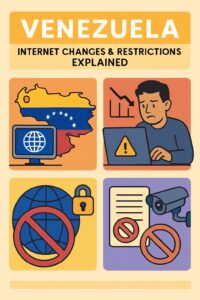
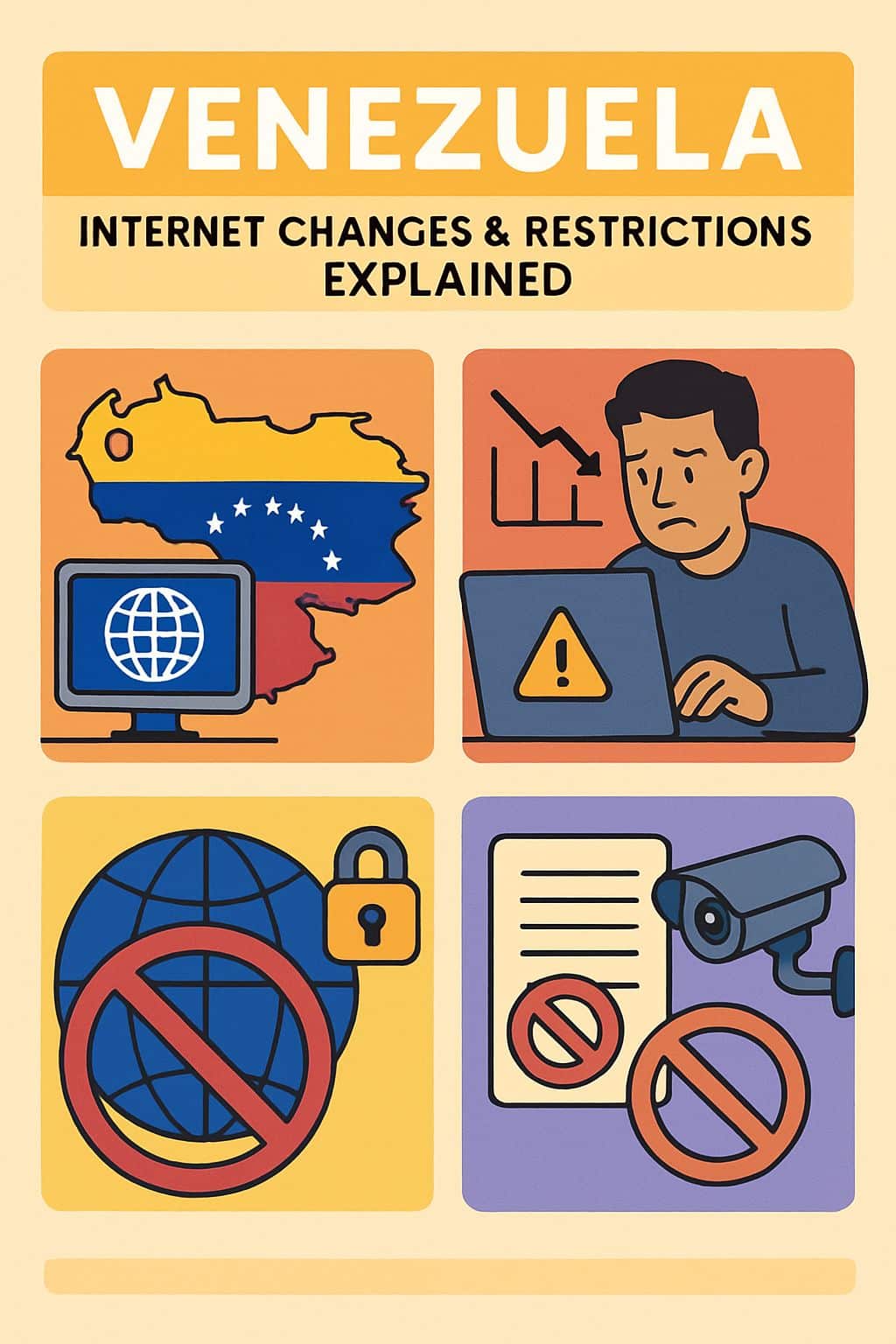
Key Takeaways Venezuela Internet Changes & Restrictions Explained
- Venezuela is experiencing significant internet disruptions following U.S. military operations, with NetBlocks confirming outages in parts of Caracas
- Venezuelans are turning to alternative means of connectivity with Tor usage surging dramatically as citizens seek uncensored information
- Starlink has offered free internet access to Venezuela until February 3, 2026, providing a lifeline during the ongoing crisis
- Government control of internet infrastructure in Venezuela has historically been used as a tool for information manipulation and censorship
- Citizens are adopting various circumvention techniques including VPNs, satellite services, and proxy servers to maintain communication during blackouts
 Internet access in Venezuela has deteriorated dramatically in recent days, coinciding with significant political upheaval and U.S. military operations in the country. As power outages sweep through parts of the capital and beyond, thousands of Venezuelans find themselves digitally isolated at a critical moment. This digital disruption isn’t merely a technical inconvenience—it represents a profound crisis where information access has become both vital and dangerous.
For those monitoring global internet freedom, this pattern of internet restriction during political instability follows a concerning global trend. Independent monitoring groups have verified these disruptions are not isolated incidents but part of a broader pattern affecting critical communication channels when citizens need them most. The timing and nature of these outages reflect the strategic importance of information control during periods of political uncertainty.
The current situation builds upon years of deteriorating internet infrastructure and increasing government control over digital spaces in Venezuela. Long before the current crisis, internet users in the country faced some of the slowest connection speeds in Latin America, frequent outages, and deliberate blocking of news sites and social media platforms. What we’re witnessing now is the acceleration of these restrictions during a moment of national instability.
Venezuela’s Digital Shutdown: What’s Really Happening
The internet disruptions in Venezuela aren’t simply technical failures—they represent a strategic approach to information control during crisis. Rather than complete nationwide blackouts, the restrictions manifest as rolling outages, targeted blocking of specific platforms, and significant slowdowns that render many services unusable. This approach allows for plausible deniability while effectively limiting citizens’ ability to communicate, organize, or access uncensored information during critical moments.
What makes Venezuela’s current situation unique is the compounding effect of long-term infrastructure decline combined with acute political crisis. The country’s internet had already been suffering from years of underinvestment, with download speeds averaging well below regional standards. This existing fragility made the system particularly vulnerable to both intentional restrictions and collateral damage from physical infrastructure impacts during periods of unrest. For further insight, the US warns Venezuela’s new leader amid ongoing political turmoil.
Power Outages and Internet Blackouts Following US Military Operation
The timing of Venezuela’s most recent internet disruptions aligns directly with U.S. military operations in the country. According to multiple reports, large portions of Caracas experienced complete power failures immediately following military strikes, with secondary effects rippling through the national communication infrastructure. These blackouts weren’t isolated incidents but part of a coordinated series of events that severely impacted the country’s ability to maintain stable internet connectivity. For more details on these events, you can read about what is happening to the internet in Venezuela.
Power infrastructure and internet service are inextricably linked in Venezuela, with even brief electricity disruptions causing cascading failures across the telecommunications network. The country’s internet service providers lack sufficient backup power systems to maintain operations during extended outages, creating a situation where even limited power disruptions can cause disproportionate internet accessibility problems.
Historical patterns suggest these disruptions may not be entirely coincidental. During previous periods of political tension, Venezuela has experienced similar patterns of service degradation that conveniently limit citizens’ ability to organize or share information. The current situation appears to follow this established playbook, though with the added complication of physical infrastructure damage from military operations.
NetBlocks Confirms Internet Service Disruption in Caracas
Independent internet monitoring organization NetBlocks has provided concrete evidence of Venezuela’s connectivity crisis. Their metrics confirm significant disruptions to internet service in parts of Caracas, directly correlating with reported power outages during the U.S. military operation. This third-party verification is crucial as it establishes an objective record of service disruptions beyond government or opposition claims.
NetBlocks specifically noted that the patterns observed weren’t consistent with routine technical failures but instead aligned with the timing of military activity. Their monitoring tools detected sudden drops in connectivity across multiple providers simultaneously—a pattern typically associated with centralized disruption rather than isolated technical issues. This data supports the assessment that the interruptions were either deliberately implemented or resulted directly from targeted infrastructure impacts.
The geographic distribution of outages mapped by NetBlocks shows concentrations in politically significant areas, suggesting potential targeting rather than random failures. This pattern of selective disruption has been observed in other countries during periods of unrest, where authorities maintain connectivity in certain areas while limiting it in potential hotspots for opposition activity.
Connection Patterns Showing Crisis Behavior
Venezuela’s internet traffic patterns have dramatically shifted in ways that clearly indicate crisis behavior among users. The most telling signal is the explosive growth in Tor network usage—a system designed to anonymize web browsing and bypass censorship. This surge represents tens of thousands of Venezuelans actively seeking alternative routes to information as conventional channels become increasingly restricted or monitored. The political climate in Venezuela further exacerbates these shifts in internet usage.
When analyzing user behavior during the disruptions, clear patterns emerge of adaptive strategies. During brief windows of connectivity, there are spikes in downloads of communication apps, VPN services, and offline maps—tools that help maintain function during extended outages. These behavioral adaptations demonstrate both the population’s technical resilience and the severity of the restrictions they’re attempting to circumvent.
- Dramatic increase in encrypted messaging app usage
- Surge in VPN installations when connectivity returns
- Shift to low-bandwidth communication methods
- Increased reliance on offline capabilities and local networks
- Coordinated sharing of connectivity during limited windows of access
Previous Cyberattack on PDVSA Oil Company
The current internet disruptions follow a concerning precedent set by previous cyberattacks against Venezuela’s critical infrastructure. Most notably, the state-owned oil company PDVSA suffered significant digital attacks that disrupted operations and communications. These previous incidents demonstrate the vulnerability of Venezuela’s networks to both external attacks and internal manipulation, setting the stage for the current crisis.
Security experts analyzing these earlier attacks noted sophisticated targeting of control systems and communications infrastructure, suggesting state-level capabilities were involved. Whether the current disruptions follow similar technical patterns remains unclear, but the strategic parallels are evident—targeting communications infrastructure during periods of heightened tension to create operational advantages for specific stakeholders. For instance, the US warning to Venezuela’s new leader highlights the geopolitical tensions that can accompany such disruptions.
How Venezuelans Are Getting Online During the Crisis
In the face of increasing restrictions, Venezuelans are demonstrating remarkable resilience through a variety of ingenious workarounds. As conventional internet access becomes unreliable, citizens have rapidly adapted by employing alternative connectivity methods, creating an underground network of information sharing that bypasses official channels. This digital resistance represents not just technical problem-solving but an act of information sovereignty during crisis.
Community networks have emerged where those with intermittent access download news and information to share with neighbors during blackouts. These grassroots solutions include improvised mesh networks in some neighborhoods, allowing limited local communications even when national infrastructure fails. The determination to stay connected reflects the critical importance of information access during political uncertainty.
Dramatic Surge in Tor Usage
One of the most striking indicators of Venezuela’s internet crisis is the explosive growth in Tor network usage. Data shows Tor connections from Venezuela have increased by several thousand percent in recent days, representing one of the most dramatic surges ever recorded globally. This isn’t merely a technical anomaly but a clear signal of a population actively seeking ways to circumvent censorship and surveillance.
The Tor network, designed to provide anonymous browsing by routing traffic through multiple encrypted layers, has become an essential lifeline for many Venezuelans. Despite being resource-intensive on already limited connections, users are prioritizing this solution because it provides access to uncensored information while protecting their identity. This widespread adoption indicates both the severity of the restrictions and the technical adaptability of Venezuelan internet users.
For many users, Tor serves as their only reliable window to independent news sources and communication platforms that have been blocked on conventional channels. The network’s architecture makes it particularly resistant to the types of filtering implemented by Venezuelan authorities, though users still face challenges with connection speed and stability when using these circumvention tools.
Starlink’s Free Internet Initiative Until 2026
In a significant development, Starlink has announced free internet access for Venezuela until February 3, 2026. This satellite-based solution bypasses terrestrial infrastructure entirely, potentially providing a critical alternative channel during the ongoing crisis. The timing of this offer clearly corresponds with the current political situation, offering connectivity that operates independently of local control mechanisms.
Starlink’s satellite internet technology can deliver broadband speeds to areas with damaged or offline ground infrastructure. The system requires specialized receiver equipment but operates completely outside the control of local internet service providers. This independence from ground infrastructure makes it particularly valuable during periods of intentional service disruption or infrastructure damage. For more insights, read how internet disruptions in Venezuela highlight the importance of such technology.
While promising, the actual impact of Starlink’s offer depends heavily on the availability of necessary receiver equipment within Venezuela. The terminals required for connection aren’t widely distributed in the country, and importing new equipment presents significant logistical challenges during the current crisis. Nevertheless, for those able to access the technology, Starlink represents perhaps the most reliable connectivity option currently available.
Equipment Requirements for Satellite Access
Accessing Starlink’s satellite internet requires specialized equipment that presents both opportunities and challenges for Venezuelans. Each user needs a Starlink terminal consisting of a satellite dish (often called a “dishy”), a router, and power supply. These components aren’t readily available within Venezuela, and the retail cost of approximately $599 per terminal plus shipping represents a significant investment in a country facing severe economic challenges.
For those who can acquire the equipment, satellite connectivity offers significant advantages during the crisis. The system operates independently of local infrastructure, making it immune to intentional shutdowns or local damage. Once operational, a single terminal can provide connectivity for multiple users, potentially serving as a neighborhood access point in areas where conventional internet has failed. This development comes as Venezuela’s new leader extends an olive branch to the US, signaling potential changes in the country’s approach to international relations.
Installation presents additional challenges, as terminals require clear line-of-sight to the sky and stable power sources. In urban areas with frequent outages, backup power solutions become necessary to maintain reliable service. Despite these hurdles, the completely independent nature of satellite internet makes it an increasingly valuable option as conventional infrastructure becomes less reliable.
Areas Most Affected by Connectivity Issues
The impact of Venezuela’s internet disruptions isn’t uniform across the country, with certain regions experiencing significantly greater connectivity challenges. Urban centers, particularly Caracas, have seen dramatic fluctuations in service availability, with neighborhoods experiencing complete blackouts followed by brief windows of limited connectivity. These patterns appear to correlate with areas of political significance or potential unrest.
Rural areas, which already suffered from limited connectivity before the crisis, now face near-complete digital isolation. In many remote communities, even basic telecommunications have become unreliable, creating information deserts where citizens have little access to news about ongoing events. This digital divide exacerbates existing inequalities and creates dangerous information gaps during a period of national uncertainty.
Border regions present a unique situation, as some citizens near international boundaries can occasionally connect to networks from neighboring countries. This geographical advantage has created information flow patterns where border communities sometimes have better access to uncensored information than those in central regions, despite generally poorer infrastructure.
Government Control Tactics and Digital Censorship
Venezuela’s current internet restrictions build upon a long-established framework of digital control that predates the current crisis. The government has developed sophisticated mechanisms for limiting information flow, combining technical measures like targeted blocking with legal frameworks that criminalize certain types of online expression. Understanding this historical context is crucial for recognizing the current disruptions as part of a strategic approach to information control rather than merely technical failures.
Historical Pattern of Information Control
The Venezuelan government has systematically expanded its control over digital spaces for more than a decade, creating a comprehensive architecture for information restriction long before the current crisis. Beginning with selective website blocking in the early 2010s, authorities gradually implemented more sophisticated filtering technologies capable of targeting specific content across multiple platforms. This evolution demonstrates a deliberate strategy of expanding control capabilities while maintaining plausible deniability about the intentional nature of restrictions.
Legal frameworks have evolved in parallel with technical capabilities, creating broad categories of prohibited speech that can be selectively enforced against government critics. The 2017 “Law Against Hate” established vague prohibitions against content that “promotes fascism, hatred or intolerance,” providing legal cover for targeting opposition voices. These regulations created a chilling effect even when technical blocks weren’t in place, as users self-censored to avoid potential legal consequences. For more context, read about Venezuela’s new leader and the ongoing political climate.
During previous political flashpoints, including contested elections and protests, Venezuelan authorities established clear patterns of escalating restrictions that closely mirror current tactics. These historical episodes typically featured selective service degradation rather than complete shutdowns, temporary blocking of specific platforms during key events, and targeted disruption of communication tools used by opposition organizers. The current crisis represents an intensification of these established patterns rather than an entirely new approach, as seen in recent events where Venezuela’s new leader has faced warnings from international powers.
Social Media Restrictions
Social media platforms have been particularly targeted during Venezuela’s internet restrictions, reflecting their critical role in information sharing during crises. Twitter, Instagram, and WhatsApp have experienced intermittent blocking and severe throttling that renders them effectively unusable, even during periods when basic web browsing remains functional. These platform-specific restrictions demonstrate sophisticated filtering capabilities designed to limit mass communication while maintaining basic internet functionality.
The technical implementation of these blocks has evolved over time, moving from crude DNS-level blocking to more advanced methods including deep packet inspection that can identify and restrict specific types of traffic. This progression has made circumvention increasingly difficult for average users without specialized tools. The government has simultaneously promoted alternative “national” platforms that operate under direct oversight, attempting to shift users toward channels that can be more easily monitored.
Timing patterns reveal strategic implementation of these restrictions, with intensification during specific events like opposition rallies, international statements, or breaking news events. Rather than constant blocking, these tactical disruptions create uncertainty about connectivity and complicate real-time information sharing during critical moments. This approach maximizes the impact on coordination while minimizing international attention that complete shutdowns would generate.
State-Owned ISPs and Their Vulnerabilities
Venezuela’s internet infrastructure is heavily dominated by state-controlled providers, creating inherent vulnerabilities to centralized manipulation. CANTV, the state telecommunications company, serves as the primary internet backbone for the country, giving authorities direct control over core infrastructure. This centralized architecture means that government directives can be rapidly implemented across much of the nation’s network without requiring cooperation from independent entities.
Economic Consequences of Digital Isolation
The internet restrictions in Venezuela have triggered devastating economic consequences beyond the immediate crisis. Digital isolation has crippled e-commerce, remote work opportunities, and financial transactions—all critical economic lifelines during periods of instability. Small businesses that relied on social media for marketing and payment apps for transactions have seen revenues plummet as connectivity issues persist, pushing many toward insolvency during an already challenging economic environment. For more insights, the US warns Venezuela’s new leader amid the ongoing crisis.
For the broader economy, these restrictions compound existing challenges from hyperinflation and sanctions. Banking systems rely on consistent connectivity to process transactions, and as networks become unreliable, even basic economic activities become impossible. Remittances from Venezuelans abroad—which constitute a significant portion of many families’ income—have become increasingly difficult to access as digital payment platforms experience outages. This digital disconnection effectively accelerates economic collapse by shutting down channels that had previously helped citizens weather the crisis.
Safety Concerns for Online Activities
Venezuelans face significant safety concerns when attempting to access uncensored information or communication platforms. The government has increasingly criminalized the use of VPNs and circumvention tools, with individuals caught using these technologies potentially facing harassment, detention, or prosecution under broad “national security” provisions. This creates a dangerous environment where simply seeking information carries real physical risk, forcing users to balance their need for connectivity against potential consequences for themselves and their families. For more context, read about Venezuela’s new leader and the ongoing political challenges.
Information Gap Between Connected and Disconnected Regions
A troubling information divide has emerged between Venezuelans with some form of internet access and those completely cut off from digital communications. Urban centers with intermittent connectivity—particularly wealthier neighborhoods with resources for backup power and alternative access methods—maintain at least some awareness of unfolding events. Meanwhile, rural communities and poorer urban areas experience near-complete information blackouts, receiving only government-approved messaging through state media channels.
This connectivity gap creates dangerous disparities in crisis response capabilities. Communities without reliable information access cannot make informed decisions about safety, resource allocation, or political participation. As the situation evolves, this digital divide threatens to deepen existing societal fractures, with well-connected groups maintaining advantages in both safety and economic opportunity compared to those facing digital isolation. For instance, Venezuela’s new leader highlights how political changes can impact access to information and resources.
What Happens Next for Venezuela’s Internet
The trajectory of Venezuela’s internet situation hinges on both political developments and technological responses. If the current political instability continues, we can expect increasingly sophisticated restrictions as authorities attempt to control information flow. Simultaneously, we’ll likely see the proliferation of circumvention technologies as both international organizations and Venezuelan technical communities develop and distribute tools specifically designed to overcome these restrictions. This technological cat-and-mouse game will shape the information landscape in coming weeks.
Long-term infrastructure damage presents perhaps the most concerning scenario. Even if political stability eventually returns, the physical telecommunications infrastructure has suffered from years of underinvestment and recent physical impacts. Rebuilding these systems will require significant resources and technical expertise that may not be immediately available. This suggests that even under the most optimistic political outcomes, Venezuela’s connectivity challenges may persist for months or years as fundamental infrastructure issues are addressed.
Frequently Asked Questions
The complex and rapidly evolving nature of Venezuela’s internet crisis has generated considerable confusion. Below, we address the most common questions about the current situation, providing clarity on what’s actually happening and how individuals both inside and outside Venezuela can respond effectively. These answers reflect the latest available information but may evolve as the situation develops.
Understanding these fundamentals can help Venezuelans navigate the current restrictions while giving the international community context for supporting internet freedom in the region. As always, specific circumstances vary by location and may change rapidly as both restrictions and circumvention techniques evolve.
Is internet completely unavailable in Venezuela right now?
No, internet access in Venezuela isn’t completely unavailable, but instead varies dramatically by location, time, and service provider. Most areas experience rolling connectivity issues rather than complete blackouts—functioning intermittently for unpredictable periods before failing again. The pattern typically involves brief windows of limited functionality followed by extended outages, particularly after significant political developments or during evening hours. This inconsistent availability creates significant challenges for planning any activities requiring stable connections.
The nature of restrictions also varies across different services. Basic web browsing may function during periods when messaging apps and social media platforms remain blocked. Government and banking websites often receive priority bandwidth allocation, remaining accessible when other services fail. This selective availability suggests sophisticated traffic management rather than simple infrastructure failure, though both factors contribute to the current situation.
How can Venezuelans safely communicate with people outside the country?
Venezuelans seeking secure external communications have several options, each with different security and accessibility tradeoffs. Signal and Telegram with their encrypted messaging capabilities provide strong security when available, though both face intermittent blocking. For more consistent access, Tor Browser combined with secure messaging platforms offers the strongest protection against both surveillance and censorship, though at the cost of requiring more technical knowledge and consuming more bandwidth on already limited connections.
For those with satellite phone access, these devices provide communication completely independent of local infrastructure, though at significant cost and with limited availability. When no dedicated secure options are available, users often employ a combination of coded language on still-functioning platforms and frequent switching between communication channels to maintain some level of privacy. Family members outside Venezuela can support these efforts by researching current working methods and sharing configuration details through multiple channels to increase the likelihood that some will reach their contacts inside the country.
What is Starlink and how does it work in Venezuela?
Starlink is a satellite internet service developed by SpaceX that provides high-speed broadband internet through a constellation of thousands of small satellites in low Earth orbit. Unlike traditional internet that relies on ground-based infrastructure controlled by local providers, Starlink beams signals directly to special receiver dishes that users install at their locations. This makes it particularly valuable during the current crisis because it operates completely independently of Venezuela’s terrestrial networks and cannot be easily blocked by conventional means. For more context on the situation in Venezuela, you can read about Venezuela’s new leader and their efforts to improve international relations.
To access Starlink in Venezuela, users need specialized equipment including the satellite dish (“dishy”), router, and power supply. While Starlink has announced free service for Venezuela until 2026, acquiring the necessary hardware remains challenging due to import restrictions, cost (approximately $599 plus shipping for the basic kit), and limited local availability. Once operational, a single terminal can provide connectivity for multiple users within its Wi-Fi range, potentially serving as a community access point in areas with no other connectivity options.
The effectiveness of Starlink varies based on physical conditions. Users need a clear view of the sky without obstruction from buildings or dense foliage, making it more practical in some settings than others. Despite these limitations, Starlink represents one of the most promising connectivity solutions for Venezuelans during the current crisis, particularly for community organizations, journalists, and emergency services that require reliable communications independent of local restrictions.
Are there legal risks for Venezuelans using VPNs or circumvention tools?
Yes, Venezuelans face real legal risks when using circumvention technologies, though enforcement remains inconsistent. The government has increasingly framed VPN usage and censorship circumvention as potential national security violations under broadly written cybersecurity laws. Individuals perceived as opinion leaders or connected to opposition activities face the highest risk of targeted enforcement, with potential consequences including device confiscation, detention, or formal charges carrying significant penalties. Ordinary citizens typically face lower risks but should still exercise caution, particularly when accessing or sharing politically sensitive content.
Will internet restrictions in Venezuela likely increase or decrease in coming months?
Internet restrictions in Venezuela will most likely follow political developments closely, with temporary intensification during periods of heightened tension or significant events. If political instability continues, expect increasingly sophisticated technical measures targeting circumvention tools that citizens currently rely on, including more aggressive VPN blocking and potential criminalization of satellite internet equipment. However, complete long-term shutdowns remain unlikely due to the regime’s own reliance on digital infrastructure for basic governance and the international criticism such measures would generate.
A critical factor will be the physical telecommunications infrastructure’s condition after recent events. Even if political will for restrictions diminishes, the practical reality of damaged equipment, power shortages, and years of underinvestment will continue to limit connectivity. Any sustainable improvement would require significant infrastructure investment that seems unlikely in the current economic environment.
The international response, particularly regarding Starlink and other satellite services, will significantly impact how effectively Venezuelans can bypass local restrictions. If these alternative access methods become more widely available despite government opposition, they could fundamentally alter the information landscape regardless of official policy.
For those monitoring this situation, the most reliable indicators of future trends will be patterns of technical blocking against specific services, legal actions against individuals using circumvention tools, and physical measures against alternative connectivity infrastructure like satellite receivers. These early signals often precede broader restriction campaigns.
For anyone seeking reliable information access in Venezuela, developing multiple connectivity options and building digital resilience skills will remain essential strategies regardless of how formal restrictions evolve in coming months.
Looking for more information about protecting your internet freedom during political instability? Our team specializes in helping people around the world maintain secure access to information when they need it most.