


Key Takeaways
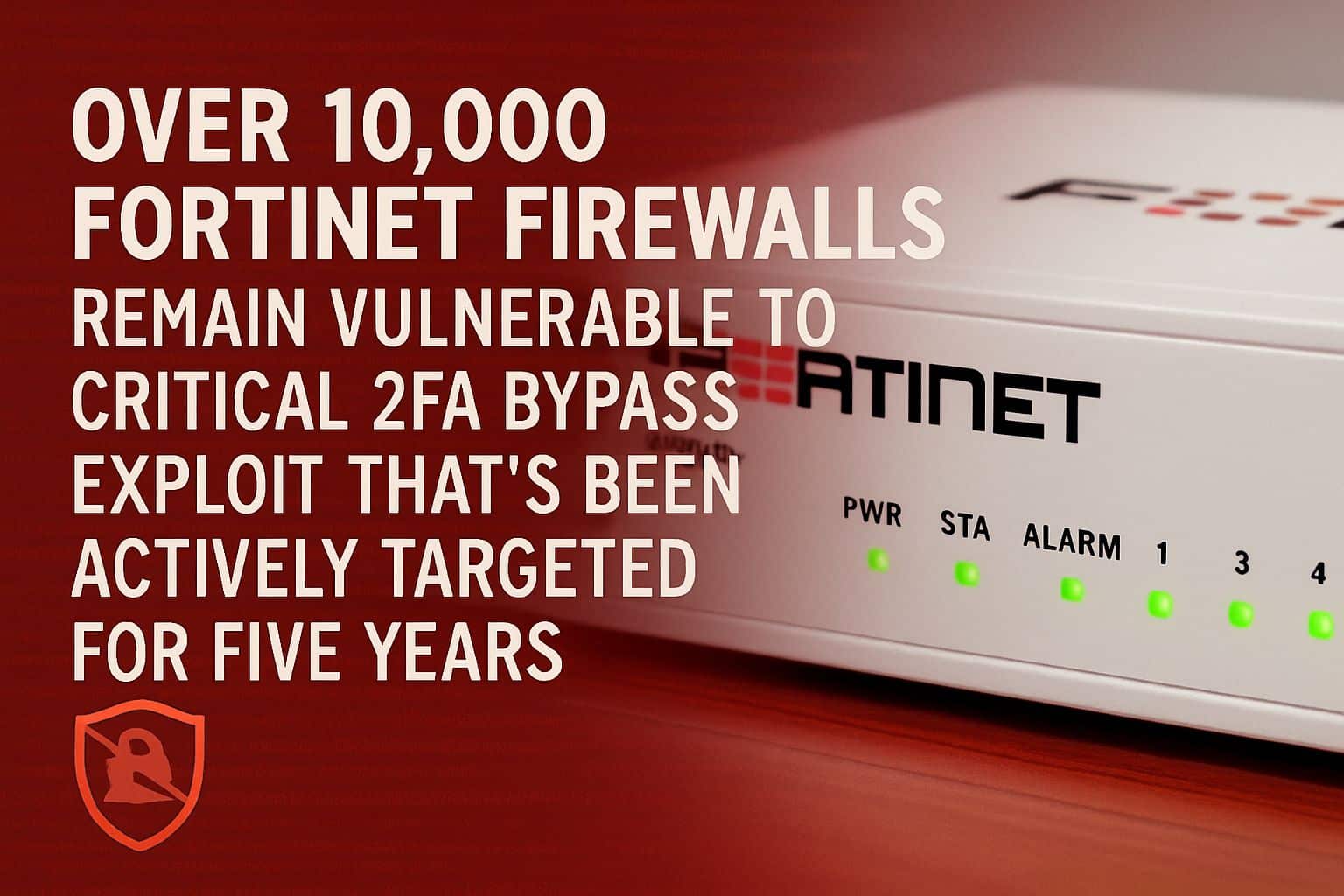
- Over 10,000 Fortinet firewalls remain vulnerable to a critical two-factor authentication (2FA) bypass exploit that’s been actively targeted for five years.
- The vulnerability (CVE-2020-12812) allows attackers to bypass 2FA by exploiting case-sensitivity in usernames, potentially granting complete administrative access to network security systems.
- State-sponsored hacking groups are actively exploiting this vulnerability, with the United States hosting more than 1,300 exposed vulnerable devices.
- Organizations can protect themselves by updating to patched FortiOS versions (6.0.10, 6.2.4, or 6.4.1 or later) or applying temporary mitigations if immediate patching isn’t possible.
- Network Security Partners, a leading cybersecurity consulting firm, recommends conducting urgent security audits for organizations using Fortinet products to identify potential compromises.
Fortinet Firewall 2FA Vulnerability Puts Thousands at Risk
A critical security vulnerability in Fortinet’s firewall products continues to threaten network security across thousands of organizations worldwide. Despite patches being available since 2020, over 10,000 Fortinet firewall devices remain exposed to an authentication bypass vulnerability that effectively neutralizes two-factor authentication protections. This persistent vulnerability allows attackers to gain unauthorized access to critical network infrastructure, potentially compromising entire corporate networks. Network Security Partners has observed increasing exploitation attempts targeting these unpatched systems in recent months.
The vulnerability, tracked as CVE-2020-12812, has been actively exploited by threat actors, including state-sponsored hacking groups, for five years. Despite multiple warnings from Fortinet, security researchers, and government agencies like the FBI and CISA, thousands of organizations have failed to apply the necessary patches. This oversight creates a significant security gap that sophisticated attackers continue to leverage for initial network access, data exfiltration, and persistent threats.
What makes this vulnerability particularly concerning is its relative simplicity to exploit combined with the critical nature of the affected devices. Firewalls represent the first line of defense for corporate networks, and compromising them grants attackers a strategic foothold with potential access to all internal systems. Organizations using Fortinet products must take immediate action to verify their vulnerability status and implement the available fixes before falling victim to these ongoing attacks.
What the Fortinet 2FA Bypass Vulnerability Actually Does
At its core, this vulnerability undermines the entire purpose of two-factor authentication on Fortinet devices. 2FA normally requires users to provide two forms of verification—typically a password plus a second factor like a security token—before gaining system access. However, CVE-2020-12812 allows attackers to completely circumvent this security measure through a surprisingly simple exploit involving username case manipulation.
The Technical Details of CVE-2020-12812
The vulnerability specifically impacts Fortinet FortiOS when configured to use LDAP (Lightweight Directory Access Protocol) for user authentication. The critical flaw exists in how FortiOS handles username case sensitivity during the authentication process. When a user attempts to log in with 2FA enabled, the system should verify both factors before granting access. However, due to this vulnerability, simply altering the case of characters in a valid username (for example, changing “Admin” to “admin” or “ADMIN”) can cause the system to bypass the second authentication factor entirely.
This vulnerability received a CVSS score of 9.8 out of 10, reflecting its critical severity. The high score is justified by the ease of exploitation, minimal privileges required to execute the attack, and the complete authentication bypass that results. The technical root cause involves a logical error in FortiOS’s implementation of the LDAP authentication protocol, where the system fails to maintain consistent case sensitivity checks across the entire authentication process.
“The FortiOS SSL VPN web portal may allow a user to log in successfully without being prompted for the second factor of authentication (FortiToken) if they change the case of their username when credentials are submitted.” – Fortinet Security Advisory
How Attackers Exploit the Case-Sensitivity Flaw
Attackers leveraging this vulnerability typically follow a systematic approach. First, they identify potential targets running vulnerable Fortinet firewall versions through common scanning techniques. Once a target is identified, they attempt to discover valid usernames through brute force attacks or social engineering. With a valid username in hand, the attacker then manipulates the case of the username during login while providing the correct password.
The authentication system incorrectly processes this request, recognizing the password as valid but failing to enforce the second authentication factor requirement. This oversight grants the attacker a fully authenticated session despite never providing the required second factor. For administrative accounts, this means complete control over the firewall and, by extension, potentially the entire network it protects. Such vulnerabilities can be as impactful as a major security breach, emphasizing the importance of robust security measures.
What’s particularly dangerous is that these authentication bypass attempts may not trigger obvious security alerts in many default logging configurations. Unless specifically configured to flag authentication anomalies, many systems will simply record these as successful logins, making detection challenging without detailed forensic analysis.
Which Fortinet Products and Versions Are Affected
The vulnerability specifically impacts Fortinet FortiOS-powered devices configured with LDAP authentication, including:
- FortiOS versions prior to 6.0.10
- FortiOS versions prior to 6.2.4
- FortiOS versions prior to 6.4.1
- Any FortiGate firewall running these vulnerable versions
- SSL VPN configurations that utilize LDAP for authentication
The vulnerability primarily affects the FortiOS operating system that powers Fortinet’s flagship FortiGate firewall appliances. These devices are widely deployed across enterprises, government agencies, and critical infrastructure providers worldwide. Particularly at risk are configurations where administrative access or VPN access is protected using LDAP authentication with 2FA enabled—precisely the high-security configurations that security-conscious organizations typically implement.
The Massive Scale of Exposed Systems
The scope of this vulnerability’s impact cannot be overstated. Recent security research has revealed an alarming number of Fortinet systems remain vulnerable despite patches being available for years. This widespread exposure creates a target-rich environment for sophisticated threat actors looking to establish network footholds.
Over 10,000 Vulnerable Firewalls Still Online
Security researchers tracking CVE-2020-12812 exploitation have identified more than 10,000 Fortinet firewall devices exposed on the public internet that remain unpatched against this critical vulnerability. These systems represent a significant attack surface that continues to be actively targeted by multiple threat actors. The sheer number of vulnerable systems suggests many organizations remain unaware of the risk or haven’t prioritized this critical security update. In a related development, a teenager was arrested for an alleged ISIL-inspired terror plot, highlighting the ongoing threats posed by cyber vulnerabilities.
What makes this finding particularly troubling is that these exposed devices are specifically firewalls—the very systems designed to protect networks from unauthorized access. When compromised, these devices don’t just become victims themselves; they become conduits that allow attackers to bypass security controls and gain privileged access to internal networks. In essence, a compromised firewall transforms from being a security asset to a significant liability.
Geographic Distribution of Compromised Systems
The geographic distribution of vulnerable Fortinet devices shows concentrations in regions with high numbers of enterprise organizations and critical infrastructure. The United States alone hosts over 1,300 vulnerable IP addresses associated with Fortinet devices susceptible to this 2FA bypass. Other significant concentrations appear throughout Europe, Asia, and Australia, making this a truly global security concern.
This distribution closely aligns with Fortinet’s strong market penetration in enterprise environments, government agencies, healthcare organizations, and financial institutions. Unfortunately, these are precisely the high-value targets that sophisticated threat actors prioritize. The concentration of vulnerable devices in certain sectors and regions creates attack patterns that security teams should monitor closely for potential exploitation attempts.
Why So Many Systems Remain Unpatched After 5 Years
The persistence of this vulnerability five years after patches became available highlights fundamental challenges in cybersecurity operations. Many organizations operate with a “set and forget” mentality regarding network infrastructure, particularly firewalls. These devices are often considered stable components that should rarely be modified once properly configured, leading to significant patch delays.
Additionally, firewall updates typically require scheduled maintenance windows and potential downtime—resources that busy IT teams may struggle to allocate. Some organizations also face legitimate concerns about potential service disruptions from updates, especially when dealing with mission-critical systems that protect key business operations. Others may simply lack visibility into their security posture, unaware they’re running vulnerable firmware versions or that their particular configuration exposes them to this exploit.
Legacy systems present another common obstacle, as some older Fortinet hardware may not support the newer, patched versions of FortiOS. Organizations running such systems face difficult decisions between expensive hardware upgrades or accepting the ongoing risk, much like the challenges faced by South Africa and Zimbabwe in establishing a joint border facility to enhance security and efficiency.
Real Threats From This Vulnerability
The risks associated with this vulnerability extend far beyond theoretical security concerns. Multiple threat actors are actively exploiting this flaw in ongoing campaigns, with documented cases of network compromises directly attributed to CVE-2020-12812 exploitation.
State-Sponsored Hackers Actively Targeting Fortinet Devices
Intelligence agencies and security researchers have confirmed that state-sponsored hacking groups are specifically targeting Fortinet devices using this 2FA bypass vulnerability. These sophisticated threat actors recognize the strategic value of compromising network security devices, which provide an ideal entry point for long-term persistent access to target networks. Some of these campaigns began as early as 2021, just months after the vulnerability was disclosed, and have continued with increasing sophistication.
These state-backed actors typically deploy more resources, demonstrate higher technical capabilities, and operate with greater patience than typical cybercriminals. Their attacks against Fortinet devices often represent just the initial phase of larger intelligence gathering or espionage campaigns. Once they establish a foothold through the compromised firewall, they methodically expand their access throughout the target network, potentially remaining undetected for months or even years.
FBI and CISA Warnings About Ongoing Exploitation
The FBI and the Cybersecurity and Infrastructure Security Agency (CISA) have issued multiple joint advisories regarding the exploitation of Fortinet vulnerabilities, including specific warnings about CVE-2020-12812. These government alerts highlight that threat actors are chaining multiple Fortinet vulnerabilities together to maximize their chances of successful network penetration. The agencies have observed attackers specifically targeting organizations across critical infrastructure sectors, government entities, and technology service providers.
These official warnings emphasize that successful exploitation typically leads to data exfiltration, ransomware deployment, or the installation of persistent backdoors that enable long-term espionage. CISA has included this vulnerability in its Known Exploited Vulnerabilities catalog, which triggers mandatory remediation timelines for federal agencies and serves as a prioritization guide for all organizations. The repeated government warnings underscore the persistent threat this vulnerability poses even years after its initial discovery.
How Attackers Gain Full Administrative Access
Once attackers successfully bypass 2FA using the case-sensitivity exploit, they typically gain the same level of access as the targeted user account—which often includes administrative privileges. With admin access to the firewall, attackers can modify security policies, create backdoor accounts, intercept network traffic, disable security controls, and pivot to internal systems. This privileged position at the network edge gives attackers unprecedented visibility and control over the organization’s entire digital infrastructure.
How to Check if Your Fortinet Firewall is Vulnerable
Given the widespread exploitation of this vulnerability, immediate assessment of your Fortinet infrastructure is critical. Determining your exposure requires checking several key configuration elements that specifically relate to this 2FA bypass vulnerability.
The assessment process involves verifying your current FortiOS version, examining authentication settings, and searching for potential indicators of compromise in your system logs. These checks should be prioritized based on the criticality of each Fortinet device, focusing first on internet-facing systems that present the highest risk profile.
1. Verify Your FortiOS Version
The first and most crucial step is determining if your Fortinet devices are running vulnerable versions of FortiOS. Log into the FortiGate admin interface and navigate to the dashboard or system information page where the current firmware version is displayed. Alternatively, use the CLI command “get system status” to view detailed version information. If your system is running FortiOS versions earlier than 6.0.10, 6.2.4, or 6.4.1, it remains vulnerable to the 2FA bypass exploit and requires immediate attention.
2. Check the Authentication Settings
Even if you’re running a vulnerable FortiOS version, your system is only exploitable if it uses specific authentication configurations. Check if your firewall is configured to use LDAP for user authentication, particularly for administrative or VPN users. Additionally, verify if two-factor authentication is enabled for these accounts, as the vulnerability specifically targets 2FA implementations.
- Navigate to User & Authentication > User Definition to review authentication methods
- Check User & Authentication > Authentication Settings for LDAP configurations
- Verify if 2FA is enabled under User & Authentication > FortiToken
- Examine VPN configurations for LDAP and 2FA implementation
- Review admin account settings for authentication methods in use
The vulnerability specifically impacts systems where case-sensitive username matching is enabled in LDAP configurations. This setting is often the default, making many systems vulnerable unless explicitly reconfigured. Organizations using Active Directory integration via LDAP should pay particular attention, as these configurations are especially susceptible to the case-sensitivity exploit.
Remember that the vulnerability only affects systems where 2FA is implemented alongside LDAP authentication. However, don’t assume you’re safe if you don’t use 2FA—while you wouldn’t be vulnerable to this specific exploit, lacking 2FA altogether introduces different security risks that should be addressed. For more information on cybersecurity, you might be interested in this article about a recent cyber threat.
3. Review System Logs for Suspicious Access
Examining system logs can reveal if attackers have already exploited this vulnerability in your environment. Focus on authentication logs, paying special attention to successful logins where usernames appear with unusual capitalization patterns or where 2FA challenges are suspiciously absent. Look for login attempts where the username differs from the user’s typical login name only in letter case, as this pattern strongly indicates exploitation attempts.
Additionally, search for other suspicious activities that might indicate post-exploitation behavior, such as policy changes, unusual administrative actions, or the creation of new user accounts. These activities often follow successful authentication bypass attempts and can help identify compromised systems. If your logs show evidence of exploitation, consider the system compromised and follow your incident response procedures while expediting remediation efforts.
Fix Your Vulnerable Fortinet Firewall Now
If your assessment confirms that your Fortinet devices are vulnerable to the 2FA bypass exploit, immediate remediation is essential. The longer vulnerable systems remain exposed, the greater the risk of compromise. Fortunately, several effective mitigation strategies exist, ranging from complete patches to temporary workarounds that can reduce risk while planning for permanent solutions.
1. Update to a Patched Version Immediately
The most comprehensive solution is updating your FortiOS firmware to a version that contains the security patch for CVE-2020-12812. Fortinet has addressed this vulnerability in FortiOS versions 6.0.10, 6.2.4, 6.4.1, and all subsequent releases. Plan a maintenance window to perform the update, ensuring you have appropriate backups and rollback procedures in place. Follow Fortinet’s recommended upgrade path to avoid compatibility issues, particularly if updating from significantly older versions. Remember that firmware updates may require device reboots, so schedule the maintenance during periods of minimal network activity to reduce operational impact.
For organizations with multiple Fortinet devices, prioritize updates based on exposure and criticality. Internet-facing systems and those protecting sensitive assets should be updated first, followed by internal infrastructure components. If you’re managing a large deployment, consider using Fortinet’s central management tools like FortiManager to streamline the update process across multiple devices.
2. Temporary Mitigation: Disable Case Sensitivity
If immediate patching isn’t feasible, Fortinet has provided a temporary workaround to mitigate the vulnerability. The exploit relies on username case sensitivity in LDAP configurations, so disabling this feature will prevent successful exploitation. To implement this mitigation, modify your LDAP server configuration in the FortiOS admin interface to set “username-case-sensitivity” to “disable” or use the CLI command: “config user ldap set username-case-sensitivity disable end” for each LDAP server configuration. For more on recent security threats, read about a teenager arrested for an alleged ISIL-inspired terror plot.
While this workaround effectively blocks the specific exploitation technique, it should only be considered a short-term solution. Complete patching remains necessary to address the underlying vulnerability and protect against potential variant exploits. Document any temporary mitigations implemented and establish a timeline for completing the full firmware update to ensure the workaround doesn’t become a forgotten permanent solution.
3. Reset All User Credentials
If you suspect your system may have already been compromised, reset all user credentials, particularly for administrative and VPN accounts. This precaution helps eliminate any backdoor accounts or compromised credentials the attackers might have established. Implement stronger password policies and ensure all accounts, especially privileged ones, use unique, complex passwords. When resetting credentials, verify the identity of users through out-of-band methods to prevent social engineering attempts during the recovery process. Additionally, review all authentication configurations to identify and remove any unauthorized changes that might have been introduced during a compromise. For example, learn from the case of a teenager arrested for an alleged terror plot to understand the importance of vigilance in security measures.
4. Enable Additional Security Monitoring
Enhance your security monitoring capabilities to detect potential exploitation attempts and unauthorized access. Configure your Fortinet devices to send detailed authentication logs to a security information and event management (SIEM) system where you can create alerts for suspicious login patterns. Pay particular attention to authentication events where usernames show case variations or where 2FA challenges are unexpectedly absent. Implement geolocation-based alerts for admin logins from unusual locations and time-based alerts for access outside normal business hours. Consider deploying additional network monitoring solutions that can detect lateral movement or unusual data exfiltration patterns that might indicate a compromise has already occurred.
The Bigger Picture: Enterprise Firewall Security
The persistent exploitation of this five-year-old vulnerability highlights critical lessons for overall enterprise security posture. Network perimeter devices like firewalls represent prime targets precisely because they control access to entire digital ecosystems. Organizations must recognize that these critical security controls require the same rigorous update and management processes applied to other infrastructure components.
This vulnerability also demonstrates how seemingly minor implementation details—like case sensitivity handling in authentication processes—can create significant security gaps when not properly addressed. Robust security architectures must consider these nuanced aspects of protocol implementations rather than focusing solely on high-level security concepts.
Why Firewall Vulnerabilities Are Prime Targets
Firewalls occupy a strategically valuable position at network boundaries, making them especially attractive targets for sophisticated attackers. Successfully compromising a firewall grants attackers a privileged vantage point from which to observe, intercept, and manipulate network traffic. This position also typically provides direct access to internal networks that would otherwise be protected from external threats. For nation-state actors and advanced persistent threats, firewalls represent ideal insertion points for long-term espionage campaigns, allowing them to establish persistent access that survives routine network changes. The concentration of security functions in these devices means a single vulnerability can potentially undermine multiple security controls simultaneously, maximizing the impact of a successful exploit.
The Crucial Role of 2FA in Network Security
The 2FA bypass vulnerability underscores why multi-factor authentication has become a fundamental security control for protecting sensitive systems and privileged access. When properly implemented, 2FA significantly raises the bar for attackers by requiring something the user knows (password) plus something they possess (token or mobile device). This defense-in-depth approach means that even if credentials are compromised through phishing or password attacks, unauthorized access remains blocked without the second factor. However, this Fortinet vulnerability demonstrates that 2FA implementations must be rigorously tested and verified to ensure they actually deliver the expected security benefits in practice.
Organizations should view this vulnerability as a reminder to evaluate all authentication systems—not just Fortinet products—for similar implementation flaws that could undermine multi-factor protections. Regular security assessments should specifically test authentication bypass scenarios to verify that 2FA mechanisms work as intended across all access paths and edge cases.
Don’t Let Your Network Become the Next Victim
With over 10,000 vulnerable systems still exposed and active exploitation continuing five years after patches became available, the message is clear: proactive security management is essential. Organizations using Fortinet products must take immediate steps to assess their exposure, apply available patches, and implement additional monitoring to detect potential compromise. The persistence of this vulnerability in production environments demonstrates that security requires ongoing attention, not just during initial deployment or in response to high-profile incidents.
Remember that attackers, particularly state-sponsored groups, are specifically targeting these known vulnerabilities as part of sophisticated campaigns. Every day a vulnerable system remains unpatched represents another opportunity for these threat actors to gain a foothold in your network. By prioritizing this remediation effort now, you can eliminate a proven attack vector before it impacts your organization.
“This vulnerability represents a particularly concerning security gap because it undermines a protection mechanism specifically implemented to enhance security. Organizations that deployed 2FA believed they were taking appropriate steps to secure their environments, only to have that protection potentially neutralized by an implementation flaw.” – Network Security Partners Advisory Team
The continued exploitation of this vulnerability serves as a powerful reminder that cybersecurity requires constant vigilance. Even as new threats emerge, attackers continue to leverage old, known vulnerabilities that organizations have failed to address. Establishing effective vulnerability management processes that prioritize security updates for critical infrastructure components is essential for maintaining a robust security posture in today’s threat landscape.
Frequently Asked Questions
Below are answers to common questions about the Fortinet 2FA bypass vulnerability to help organizations better understand the risk and appropriate responses.
How long has this Fortinet 2FA bypass vulnerability existed?
The vulnerability (CVE-2020-12812) was first disclosed in May 2020 when Fortinet released security patches to address the issue. However, the vulnerable code likely existed in FortiOS for some time before discovery. Fortinet released fixes in FortiOS versions 6.0.10, 6.2.4, and 6.4.1 in July 2020, making this a five-year-old vulnerability that continues to be actively exploited.
Intelligence agencies began warning about active exploitation of this vulnerability alongside other Fortinet issues in April 2021, indicating that attackers quickly weaponized the exploit once it became public knowledge. The fact that exploitation continues years later demonstrates the long-term risk posed by unpatched vulnerabilities in security infrastructure.
Can attackers exploit this vulnerability remotely?
Yes, the vulnerability can be exploited remotely without requiring any physical access to the affected devices. Attackers only need network connectivity to the FortiOS web interface or SSL VPN portal of the vulnerable Fortinet device. This typically means the device must be exposed to the internet or the attacker must already have access to the internal network where the device is deployed.
The remote exploitation capability makes this vulnerability particularly dangerous for internet-facing Fortinet devices, which are directly accessible to potential attackers worldwide. This explains why security researchers have identified over 10,000 vulnerable systems exposed on the public internet that remain at immediate risk of exploitation.
Organizations should be especially concerned if they have FortiOS devices configured to provide remote access through SSL VPN, as these configurations are frequently targeted due to their accessibility and the valuable access they provide when compromised.
What data or systems can attackers access after bypassing 2FA?
After successfully exploiting the 2FA bypass vulnerability, attackers gain the same level of access as the targeted user account. If they compromise an administrative account, they effectively gain complete control over the Fortinet device, including the ability to modify security policies, create backdoor accounts, intercept network traffic, and potentially access internal networks protected by the firewall. For VPN user accounts, attackers can establish remote connections into the protected network, gaining access to internal resources and positioning themselves for lateral movement to other systems.
Will Fortinet automatically update my firewall to fix this issue?
No, Fortinet devices do not automatically update firmware by default. Organizations must manually download and install the appropriate patched version to address this vulnerability. Fortinet provides firmware updates through their customer support portal, which requires an active support contract to access. Organizations should implement a regular firmware review and update process for all network security devices to ensure vulnerabilities are promptly addressed.
How do I know if my Fortinet firewall has already been compromised?
Detecting compromise requires careful analysis of authentication logs and system behavior. Look for suspicious login events, especially successful authentications where usernames show unusual capitalization patterns or where expected 2FA challenges don’t appear in logs. Also check for unexpected changes to firewall policies, newly created admin accounts, unusual outbound connections, or unexpected VPN sessions.
If you suspect compromise, Fortinet recommends contacting their technical support team for assistance with forensic analysis. They can help identify indicators of compromise specific to their products and recommend appropriate remediation steps. Additionally, consider engaging external cybersecurity incident response specialists who have experience with Fortinet compromises to conduct a thorough investigation.
Remember that sophisticated attackers often take steps to cover their tracks by modifying or deleting logs, so the absence of obvious signs doesn’t guarantee your system hasn’t been compromised. This is why proactive patching remains the most effective protection against this well-known vulnerability.
Network Security Partners provides comprehensive security audits for organizations using Fortinet products to identify vulnerabilities and ensure proper configuration of security controls. Contact their team today to protect your critical infrastructure from these ongoing threats, as demonstrated by the recent law enforcement operation against a major drug trafficking ring.