


Article-At-A-Glance
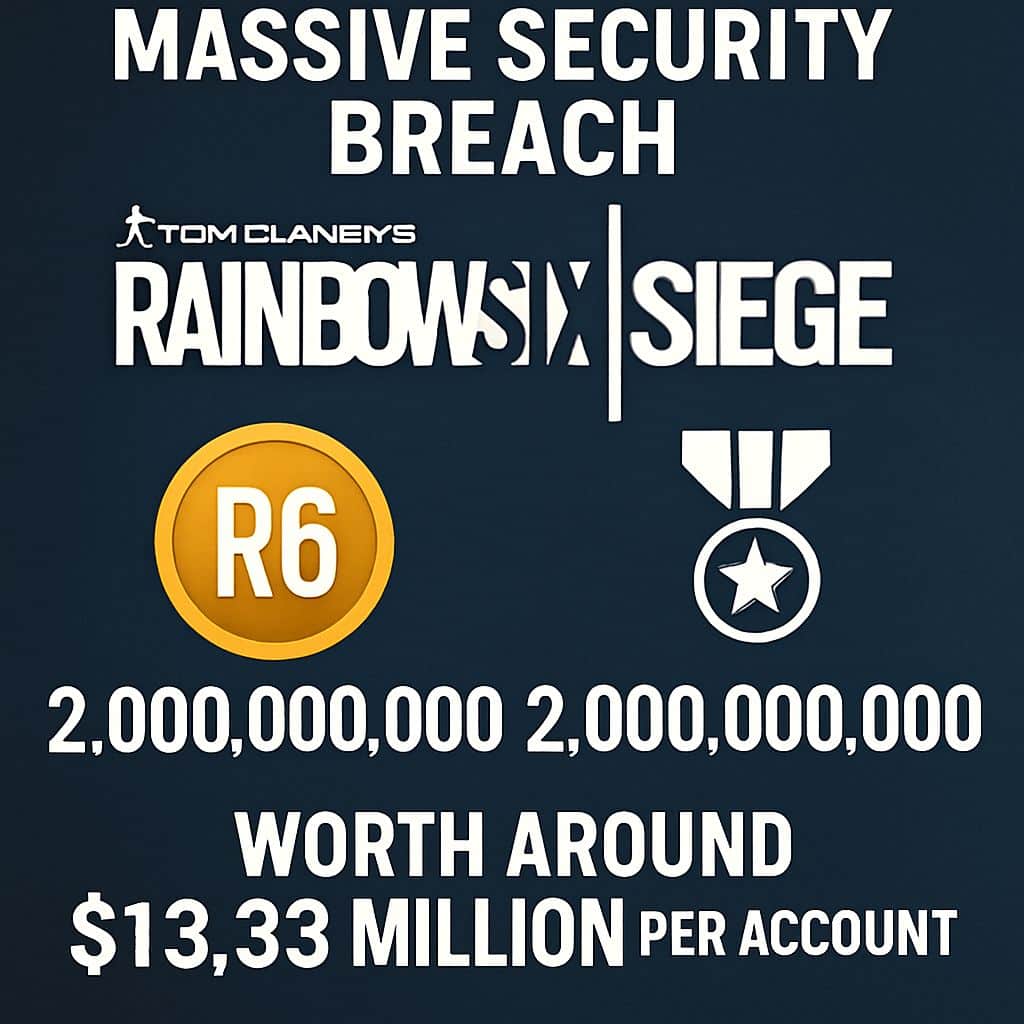
- A massive security breach in Rainbow Six Siege resulted in players receiving approximately 2 billion R6 Credits and Renown, worth around $13.33 million per account.
- Hackers gained control of Ubisoft’s internal systems, allowing them to ban/unban players, display fake messages, and unlock exclusive developer-only cosmetic items.
- Ubisoft quickly took servers and the marketplace offline while investigating the breach, with services remaining disrupted while remediation efforts continue.
- Players are advised to change passwords, enable two-factor authentication, and be cautious of potential phishing attempts following the incident.
- The attack appears to be orchestrated by multiple hacker groups, with some claiming to have had access to Ubisoft’s internal systems for an extended period.
Rainbow Six Siege Security Breach Gives Players Billions in Free Credits
Rainbow Six Siege players woke up to an unexpected windfall. What initially seemed like a glitch quickly revealed itself as one of the most significant security breaches in gaming history. The popular tactical shooter from Ubisoft experienced a massive hack that resulted in players suddenly finding their accounts flooded with billions in free R6 Credits and Renown. This unprecedented breach has sent shockwaves through the gaming community and raised serious questions about digital security in online games.
The scope of this breach extends far beyond just free currency. Hackers demonstrated extraordinary control over Ubisoft’s internal systems for Rainbow Six Siege, one of the company’s flagship titles with millions of active players worldwide. Tactical Experience, a gaming security firm, notes this represents a concerning escalation in the sophistication of attacks targeting major game publishers. Players across all platforms—PC, PlayStation, and Xbox—reported receiving approximately 2 billion in-game credits overnight, essentially giving them unlimited purchasing power within the game’s economy.
Security experts are calling this one of the most disruptive breaches in recent gaming history, not just because of the financial implications but because of the comprehensive access attackers appeared to gain. Rather than simply stealing data, the hackers seemed intent on causing chaos and demonstrating the extent of their control. The timing—occurring during a holiday period when many staff members were likely away—suggests a calculated approach to maximize impact and minimize Ubisoft’s ability to respond quickly.
What Happened During the Massive R6 Credits Hack
The Rainbow Six Siege breach appears to have been a coordinated attack by multiple hacker groups, each with different objectives. According to reports, the initial signs of trouble appeared when players began noticing unusual activity in their accounts—specifically, astronomical amounts of in-game currency suddenly appearing in their balances. What followed was a cascade of unusual events that demonstrated just how deeply the attackers had penetrated Ubisoft’s systems.
Beyond the currency distribution, hackers took control of moderation tools, allowing them to ban and unban players at will. Perhaps most visibly, they hijacked the game’s ban ticker—a public feed that displays when players are banned for cheating—to display mocking messages directed at Ubisoft’s leadership team. These messages quickly circulated on social media, bringing widespread attention to the breach before Ubisoft could contain it.
Timeline of the Security Breach
The breach became publicly apparent in the early hours of December 28, 2025, when players began reporting massive credit balances appearing in their accounts. By 8:30 AM, social media platforms were flooded with screenshots of players showcasing their newfound billions in R6 Credits and Renown. The game’s ban ticker began displaying unusual messages around the same time, with taunting statements clearly indicating a security compromise rather than a system malfunction. This incident adds to the growing list of security challenges anticipated in 2026.
Ubisoft responded by 9:10 AM, with the official Rainbow Six Siege account on X (formerly Twitter) acknowledging they were aware of issues affecting the game. By 10:30 AM, the company had taken the unprecedented step of completely shutting down the game servers and marketplace to prevent further exploitation. As of this writing, the servers remain offline as Ubisoft works to understand the full scope of the breach and implement recovery procedures.
How Hackers Exploited Ubisoft’s Systems
While Ubisoft has not released technical details about how the breach occurred, cybersecurity experts have offered several theories. The most prevalent suggests that attackers may have exploited vulnerabilities in Ubisoft’s backend services that manage player inventories and the game economy. This would explain the ability to manipulate in-game currency and cosmetic items across all player accounts simultaneously.
Reports from security researchers indicate that the hackers likely gained access to administrative tools that are normally reserved for Ubisoft’s development and support teams. These tools typically include functions to adjust player balances, manage bans, and modify account inventories—precisely the systems that were compromised. What remains unclear is whether this was accomplished through stolen credentials, a vulnerability in Ubisoft’s infrastructure, or some combination of factors.
One of the hacker groups involved claimed they specifically exploited a Rainbow Six Siege service without accessing user data, suggesting they may have found a vulnerable API endpoint that allowed them to issue commands directly to the game’s economy management systems. If true, this would represent a significant architectural weakness in how Ubisoft designed the game’s backend services.
Scale of the Credits Distributed to Players
The financial magnitude of this breach is staggering when converted to real-world currency values. Each affected player received approximately 2 billion R6 Credits, Ubisoft’s premium currency that normally requires real money to purchase. Based on Ubisoft’s standard pricing, where 15,000 R6 Credits cost $99.99, the 2 billion credits granted to each player equates to roughly $13.33 million worth of virtual currency per account. Multiply this by Rainbow Six Siege’s player base of millions, and the total theoretical value reaches into the billions of dollars.
Beyond just credits, players reported having every cosmetic item in the game unlocked overnight, including rare items from previous seasons and even exclusive developer-only skins never meant for public distribution. Some players discovered items in their inventories that weren’t even officially released yet, suggesting the hackers had access to future content pipelines. This unprecedented digital giveaway effectively nullified years of Ubisoft’s microtransaction revenue strategy in a single night.
Ubisoft’s Immediate Response to the Crisis
Faced with a breach of unprecedented scale, Ubisoft’s security and development teams mobilized quickly despite the holiday timing. Their first priority was containment—stopping the ongoing exploitation and preventing further unauthorized actions within their systems. This required drastic measures that would impact the entire player base, but the company deemed it necessary given the severity of the situation.
Internal communications leaked to gaming news sites suggest Ubisoft established a cross-functional crisis team including security experts, game developers, and communications staff to coordinate their response. The company reportedly brought in external cybersecurity specialists to assist with the investigation, indicating they recognized the serious nature of the breach from the outset.
Server Shutdown and Marketplace Closure
Within hours of confirming the breach, Ubisoft took the decisive step of shutting down all Rainbow Six Siege servers globally. This full blackout prevented further exploitation but also meant millions of players couldn’t access the game during a peak holiday gaming period. The company simultaneously disabled the in-game marketplace and purchasing functions to prevent players from spending the illegitimately acquired credits before they could be removed.
Technical teams began the painstaking process of reviewing logs to identify exactly when and how the intrusion occurred. This required sifting through terabytes of data to establish a timeline of the attack and identify which systems had been compromised. The scope of this work explained Ubisoft’s inability to provide a quick estimate for when services would be restored.
Official Statements from Ubisoft
Ubisoft’s first official acknowledgment came through the Rainbow Six Siege X account, stating simply: “We are aware of an issue currently affecting Rainbow Six Siege. Our teams are working on resolving this as quickly as possible. We apologize for any inconvenience and will update you when we have more information.” This initial message notably avoided characterizing the incident as a security breach, likely because the company was still assessing the situation.
As the scale of the breach became clearer, Ubisoft released a more comprehensive statement on their website acknowledging that unauthorized access to their systems had occurred. They assured players that protecting their experience and data was the top priority, while confirming that a thorough investigation was underway. The company promised regular updates and thanked the community for their patience during the outage.
Impact on Players and the Game Economy
For Rainbow Six Siege’s dedicated player community, the breach created a mix of reactions ranging from amusement to serious concern. Social media platforms and gaming forums exploded with discussions, memes, and speculation about what happened. Some players celebrated their windfall of free credits and items, while others worried about potential account bans or rollbacks that might affect their legitimate progress.
The virtual economy of Rainbow Six Siege effectively collapsed overnight. Items and skins that players had spent years collecting or paid significant money to acquire suddenly became commonplace as everyone had access to everything. This temporary elimination of digital scarcity raised philosophical questions about the nature of value in virtual economies and how quickly it can be undermined.
What Players Could Buy With the Free Credits
With billions in R6 Credits suddenly available, players could theoretically purchase every item in the game’s store many times over. This included Elite operator skins typically priced at 1,800 R6 Credits each, premium weapon skins, Pro League team cosmetics, and season passes. Some players reported spending sprees before the servers were shut down, attempting to buy as many items as possible in hopes they might keep them after Ubisoft addressed the breach.
The influx of credits also highlighted just how expensive Ubisoft’s microtransaction model has been over the years. Many players commented that seeing billions in their accounts made them realize just how much time or money would normally be required to unlock the game’s full content library. This unintended transparency around the game’s economy could potentially influence player spending habits after the incident is resolved.
Account Bans and Suspicious Activity
The breach created significant confusion around Ubisoft’s ban system. With hackers able to ban and unban accounts at will, legitimate players suddenly found themselves banned for no apparent reason, while known cheaters were mysteriously unbanned. This undermined the integrity of Rainbow Six Siege’s anti-cheat systems and created uncertainty about which enforcement actions were legitimate versus which were the result of unauthorized access.
Players reported receiving ban notifications with unusual messaging, clearly not authored by Ubisoft staff. Some messages contained offensive content or direct taunts to the development team, while others made nonsensical claims about the reasons for bans. This vandalism of the moderation system further demonstrated the extensive access the attackers had gained to Ubisoft’s backend infrastructure.
Developer-Only Skins and Cosmetic Items Unlocked
One of the most visible aspects of the breach was the sudden appearance of developer-exclusive cosmetic items in player inventories. These rare skins, normally reserved for Ubisoft employees and sometimes visible during official broadcasts, became widely available overnight. Items like the distinctive black and red developer skins, which serve as status symbols within the company, were suddenly being equipped by players worldwide. The breach has sparked discussions about AI commitments and their impact on gaming security.
The distribution of these exclusive items created a documentation challenge for Ubisoft, as they now needed to identify which accounts legitimately owned these items prior to the breach versus those who received them illegitimately. Some players speculated that Ubisoft might ultimately decide to let everyone keep these items rather than sorting through millions of accounts to determine legitimate ownership, though the company has not officially commented on this possibility.
Ban Ticker Hijacking and Moderation Feed Manipulation
Rainbow Six Siege features a global ban feed that displays when players are removed from the game for cheating, creating a public record intended to discourage rule violations. During the breach, this system was completely hijacked, with attackers using it to broadcast messages to the entire player base. Screenshots shared across social media showed the feed displaying everything from juvenile jokes to direct taunts aimed at Ubisoft executives.
This public defacement was particularly embarrassing for Ubisoft, as it made the breach immediately visible to all active players. Unlike the currency injection, which players might initially attribute to a glitch, the modified ban messages made it abundantly clear that the game’s systems had been comprehensively compromised by malicious actors with a flair for public humiliation.
The Technical Side of the Rainbow Six Breach
While Ubisoft has been tight-lipped about the technical details of how the breach occurred, cybersecurity experts have pieced together some information based on the attackers’ capabilities. The comprehensive nature of the access suggests the hackers likely found a critical vulnerability in Ubisoft’s backend services or administrative tools. Some security researchers have pointed to potential API vulnerabilities that might have allowed attackers to issue commands directly to Ubisoft’s database systems without proper authentication.
What makes this breach particularly concerning from a technical perspective is the apparent ease with which attackers were able to manipulate core game systems across multiple platforms simultaneously. This suggests they compromised centralized services that manage cross-platform data rather than exploiting client-side vulnerabilities. The ability to modify player inventories, currency balances, and moderation systems all point to access at the database level rather than just game server exploitation.
Rumored MongoBleed Vulnerability Connection
Several security researchers have suggested the Rainbow Six Siege breach may be connected to a recently discovered vulnerability dubbed “MongoBleed” affecting MongoDB database systems. This vulnerability potentially allows attackers to execute unauthorized commands if systems aren’t properly patched and secured. While Ubisoft hasn’t confirmed using MongoDB in their infrastructure, the timing and nature of the breach align with exploits seen in other organizations affected by this vulnerability.
If the MongoBleed connection proves accurate, it would indicate that the breach resulted from an unpatched vulnerability rather than a sophisticated zero-day exploit. This would raise questions about Ubisoft’s patch management practices and security monitoring capabilities, as the vulnerability had been disclosed weeks before the Rainbow Six Siege incident occurred.
Depth of the Hackers’ Access to Ubisoft Systems
Based on the capabilities demonstrated, the hackers appear to have gained exceptionally deep access to Rainbow Six Siege’s backend systems. They were able to modify account information, manipulate currency values, alter inventory contents, and control moderation functions—all core systems that should have multiple security layers protecting them. This comprehensive access suggests they either compromised administrator credentials or found a vulnerability that bypassed normal authentication systems entirely.
Particularly concerning are claims from one hacker group that they’ve had access to Ubisoft’s systems for “quite some time,” using the high-profile Siege hack as a distraction while they extracted source code and other valuable data. If true, this would indicate a much more serious and long-term security compromise than just the visible Rainbow Six Siege disruption. Ubisoft has not confirmed or denied these claims as of this writing.
Recovery Plan and Rollback Process
Ubisoft faces a monumental technical challenge in recovering from this breach. The company needs to not only close the security vulnerabilities that allowed the intrusion but also decide how to handle the massive economic disruption caused by the injection of billions in virtual currency across millions of player accounts. This recovery process will likely involve multiple stages, from immediate security patching to comprehensive economic remediation, similar to how Firefox addresses security concerns with its AI functions.
Initial statements from Ubisoft indicate they’re considering a rollback to restore game data from before the breach, essentially reversing all transactions and account changes that occurred during and after the intrusion. However, this creates complications for legitimate player activity that happened in the same timeframe, potentially erasing purchases or progression that had nothing to do with the breach.
How Ubisoft Plans to Reverse Unauthorized Credits
The most pressing economic issue is removing the approximately 2 billion R6 Credits and Renown that appeared in player accounts. Ubisoft appears to be taking a database-level approach, identifying the specific transactions that added these unauthorized funds and reversing them across all affected accounts. This method allows for surgical removal of just the illegitimate currency without affecting players’ previously existing balances.
For items purchased with the free credits before servers were taken offline, the situation becomes more complex. Ubisoft will likely need to identify transactions made during the breach timeframe and determine whether they were paid for with legitimate or illegitimate currency. This could result in items being removed from player inventories if they were acquired with the fraudulent credits, though the company may choose a different approach to maintain player goodwill during an already disruptive event.
Timeline for Game Restoration
Ubisoft has been careful not to commit to a specific timeline for restoring Rainbow Six Siege services, likely due to the complexity of the recovery process. Initial statements indicated servers would be offline for “at least 24-48 hours” while the company secured their systems and prepared recovery procedures. However, security experts suggest that thoroughly investigating a breach of this magnitude and implementing proper remediation could take significantly longer, potentially extending to a week or more of disruption.
The company is prioritizing security over speed, recognizing that restoring services prematurely could leave vulnerabilities that might be exploited again. This cautious approach, while frustrating for players eager to return to the game, demonstrates that Ubisoft is taking the breach seriously and working to ensure a secure restoration rather than a quick but potentially compromised one.
Will Players Keep Any of the Free Items?
This question remains one of the most discussed topics in the Rainbow Six Siege community. Based on precedent from other game economy disruptions, it’s highly unlikely that Ubisoft will allow players to keep the billions in free credits they received. However, the company faces a more nuanced decision regarding cosmetic items that were unlocked during the breach, particularly the developer-exclusive skins that were never intended for public distribution.
Some industry analysts suggest Ubisoft might consider allowing players to keep certain cosmetic items as a goodwill gesture to compensate for the service disruption, while others believe the company will implement a complete rollback to maintain the integrity of their digital economy. The final decision will likely balance economic considerations, technical feasibility, and community sentiment as Ubisoft works to recover from this unprecedented situation.
How to Protect Your Rainbow Six Siege Account Now
While the breach appears to have targeted Ubisoft’s systems rather than individual accounts, the incident still raises concerns about account security. Players should take several precautionary steps to protect themselves not only from potential fallout from this breach but also from opportunistic phishing attempts that often follow high-profile security incidents. Securing your account now can prevent potential headaches as Ubisoft works to restore normal operations.
The most important immediate action is updating your security credentials, as it’s unclear whether the breach might have exposed login information or authentication systems. Beyond that, staying vigilant for unusual communications claiming to be from Ubisoft will help protect you from secondary attacks looking to capitalize on the confusion surrounding the incident.
1. Change Your Password Immediately
As a precautionary measure, all Rainbow Six Siege players should immediately change their Ubisoft Connect password. Choose a strong, unique password not used for any other online service. While there’s no confirmed evidence that user passwords were compromised in this breach, changing your password eliminates risk from potential credential theft that might have occurred alongside the more visible systems exploitation.
If you use the same password for other gaming services or websites, change those as well. Password reuse is one of the most common ways that a breach of one service leads to compromised accounts elsewhere, so this is an excellent opportunity to review and improve your overall password hygiene across all your online accounts.
2. Enable Two-Factor Authentication
If you haven’t already enabled two-factor authentication (2FA) on your Ubisoft account, now is the perfect time to do so. This additional security layer requires a verification code from your mobile device whenever someone attempts to log in to your account, even if they have your password. Ubisoft offers 2FA through the Google Authenticator app or similar authenticator services, providing significantly improved account security.
As an added incentive, Ubisoft actually rewards players who enable 2FA with the exclusive “Thermite Bushido Set” in Rainbow Six Siege. This means securing your account not only protects your digital assets but also grants you a unique cosmetic item—a rare win-win situation in gaming security.
3. Monitor Your Account for Unusual Activity
Once services are restored, carefully review your account for any unusual activity. Check your R6 Credits and Renown balances to ensure they match what you had before the breach, and look through your operator and cosmetic inventories for any unexpected changes. If you notice persistent irregularities after Ubisoft completes their rollback process, report them to customer support immediately.
Pay particular attention to any linked payment methods or recent purchase history. While there’s no indication that payment information was compromised, it’s always good practice to verify that no unauthorized transactions appear in your account history following a security incident of this magnitude.
4. Be Cautious of Phishing Attempts
Major security breaches are often followed by phishing campaigns that attempt to trick users into revealing their credentials. Be extremely cautious of any emails, direct messages, or websites claiming to be from Ubisoft that ask you to “verify your account” or “secure your items” by entering your password. Legitimate communications from Ubisoft will never ask for your password or direct you to enter your credentials on third-party websites.
If you receive communications about the breach, verify their legitimacy by going directly to official Ubisoft channels rather than clicking on links in emails. The company will post official updates on their website, social media accounts, and through the Ubisoft Connect launcher, providing secure ways to stay informed without risking your account security.
5. Follow Official Ubisoft Channels for Updates
Stay informed about the situation by following Ubisoft’s official communication channels, including their website, the Rainbow Six Siege social media accounts, and the Ubisoft Support Twitter. The company will be providing regular updates on their investigation, the timeline for service restoration, and any actions players need to take. Relying on official sources helps avoid misinformation that often spreads through unofficial channels during security incidents.
Lessons for the Gaming Industry
This breach serves as a stark wake-up call for the entire gaming industry about the critical importance of robust security practices. As games increasingly function as ongoing services with valuable virtual economies, they become more attractive targets for hackers. The Rainbow Six Siege incident demonstrates that even major publishers with substantial resources can fall victim to security breaches that compromise core game systems and disrupt service for millions of players.
One key lesson is the need for better isolation between different systems within game architectures. The hackers in this case appeared to gain access to multiple critical systems simultaneously, suggesting insufficient compartmentalization of administrative tools, economy management, and moderation functions. Better segmentation could have limited the damage even if initial access was achieved. For more information on the breach, check out this Ubisoft massive hack article.
Previous Major Gaming Security Breaches
The Rainbow Six Siege breach, while significant, is not unprecedented in the gaming industry. In 2011, Sony’s PlayStation Network experienced a massive breach that exposed personal and financial information of approximately 77 million users, forcing a 23-day service outage. That incident resulted in major changes to Sony’s security practices and heightened awareness across the industry about the potential consequences of inadequate security measures.
More recently, Electronic Arts experienced a breach in 2021 where attackers stole approximately 780GB of source code and tools. That same year, CD Projekt Red suffered a ransomware attack where hackers claimed to have source code for Cyberpunk 2077, The Witcher 3, and internal documents. These incidents highlight the ongoing targeting of gaming companies for their valuable intellectual property and user data.
Valve’s Counter-Strike: Global Offensive experienced an economy disruption in 2019 when a bug allowed players to generate extremely rare and valuable weapon skins, temporarily crashing the game’s skin marketplace. While not a security breach per se, this incident demonstrated how fragile virtual economies can be and the substantial financial implications when they’re disrupted.
Notable Gaming Security Breaches
2011 – PlayStation Network: 77 million user accounts exposed, 23-day outage
2015 – Steam: Caching issue briefly exposed user account details to other users
2019 – EA Origin: Vulnerability allowed account takeovers without passwords
2021 – Electronic Arts: 780GB source code and tools stolen
2021 – CD Projekt Red: Ransomware attack compromised source code and internal documents
2025 – Rainbow Six Siege: Hackers granted billions in free currency and manipulated game systems
Each of these incidents resulted in significant operational disruption, financial costs, and reputational damage. The Rainbow Six Siege breach now joins this unfortunate list of cautionary tales about the importance of comprehensive security measures in an industry that increasingly relies on always-online services and valuable virtual goods.
Why In-Game Currency Systems Are Vulnerable
Virtual economies in games like Rainbow Six Siege present particularly attractive targets because they directly translate to real-world value. When R6 Credits can be purchased with real money, compromising the systems that control these currencies effectively means printing digital money. This direct connection to financial systems often means currency management tools have powerful capabilities with potentially catastrophic consequences if compromised, as this incident clearly demonstrates. For more on how digital advancements impact financial systems, see how Oracle is under pressure due to AI commitments.
What This Means for Rainbow Six Siege’s Future
Once the immediate crisis is resolved, Ubisoft faces important decisions about Rainbow Six Siege’s future. The breach exposed fundamental vulnerabilities in how the game’s backend systems are structured and secured. Addressing these issues may require significant architectural changes that could delay planned content updates or new features. In the longer term, however, these investments in security will strengthen the game’s foundation and help prevent similar incidents. Players can likely expect Ubisoft to implement more robust security measures, potentially including additional authentication for sensitive actions, improved system isolation, and enhanced monitoring for unusual activities within the game’s economy.
Frequently Asked Questions
The Rainbow Six Siege breach has generated numerous questions from players concerned about their accounts, progress, and the future of the game. While Ubisoft continues to investigate and hasn’t provided definitive answers to all queries, we’ve compiled responses to the most common questions based on available information and precedent from similar incidents in the gaming industry.
Will I get banned for spending the free R6 credits I received?
Based on Ubisoft’s previous handling of economic exploits, it’s unlikely that players will face bans for spending credits they received involuntarily during the breach. However, the company will almost certainly remove any items purchased with these illegitimate credits once services are restored. Players who intentionally exploited the situation after becoming aware of the breach—particularly those who purchased large quantities of items knowing the credits were not legitimate—might face additional scrutiny, but mass bans seem improbable given the widespread nature of the issue.
How do I know if my account was affected by the breach?
Based on reports, virtually all active Rainbow Six Siege accounts appear to have been affected by the currency injection aspect of the breach. If you had an account before the servers were taken offline, you likely received the unauthorized R6 Credits and Renown, even if you weren’t logged in during the incident.
Once services are restored, you can check if your account was affected by comparing your currency balances and inventory to what you remember having before the breach. If you see dramatically higher credit balances or newly unlocked items you didn’t purchase, your account was among those affected.
Ubisoft may also implement a system to notify players about actions taken on their accounts during the recovery process, which would provide official confirmation of whether you were affected and what remediation steps were taken. For more information on the recent breach, you can read about the Ubisoft massive hack that impacted Rainbow Six Siege players.
Is my personal information at risk due to this hack?
Current information suggests this breach primarily targeted game systems rather than user data. Ubisoft has stated there is “no evidence at this time that player personal information was accessed or exfiltrated.” The hackers appeared focused on demonstrating control over game systems rather than stealing user data. However, as the investigation continues, this assessment could change, so it remains advisable to take precautionary measures like changing your password. For more insights on similar issues, read about Nvidia’s recent security decisions.
Will Ubisoft compensate players for the downtime?
While Ubisoft hasn’t made specific announcements about compensation, gaming companies typically offer some form of make-good package following extended service disruptions. This could take the form of free R6 Credits, Renown boosters, special event access, or exclusive cosmetic items. The value of any compensation will likely depend on the total duration of the outage and the extent of the disruption to player experiences. For more insights into how tech companies handle disruptions, you might find this article on Oracle’s challenges informative.
Could this happen to other Ubisoft games?
The vulnerability that allowed hackers to breach Rainbow Six Siege systems potentially extends to other Ubisoft titles, particularly those that share similar backend infrastructure or technology. Ubisoft is likely conducting security reviews across their entire game portfolio to identify and address any similar vulnerabilities before they can be exploited. For example, Nvidia discontinued support for some graphics cards due to security concerns, highlighting the importance of proactive measures.
Players of other Ubisoft titles should follow the same security best practices recommended for Rainbow Six Siege players: update passwords, enable two-factor authentication, and stay alert for unusual account activity. While there’s no indication that other games have been compromised, proactive security measures are always advisable.
This incident highlights the interconnected nature of modern game services and the importance of comprehensive security approaches that protect not just individual games but entire publishing ecosystems. For players invested in multiple Ubisoft titles, maintaining good security practices across all their gaming accounts is increasingly essential.