


Key Takeaways:
- The status of Missouri’s new congressional map is in dispute due to a referendum campaign seeking to repeal the plan.
- The Missouri secretary of state and attorney general claim the map took effect, while referendum backers argue it is frozen until the secretary of state certifies the referendum.
- The dispute has led to a federal court fight, with the state’s solicitor general seeking sanctions against the referendum campaign’s attorneys.
- The outcome has significant implications for Missouri’s 2026 midterm elections.
- The controversy surrounds the interpretation of Missouri’s constitution and prior court decisions regarding the effect of submitting referendum signatures on the implementation of a new law.
Introduction to the Dispute
The controversy over Missouri’s congressional redistricting has taken a new turn, with a dispute emerging over whether the submission of referendum signatures has frozen a map passed by lawmakers in September. The Missouri secretary of state and attorney general have declared that the map took effect, while the backers of the referendum campaign are strongly disputing this claim. The conflict has sparked an unusual fight in federal court, with the state’s solicitor general seeking sanctions against the attorneys representing the referendum campaign.
Background on Redistricting
The redistricting process in Missouri has been contentious, with lawmakers passing a new map in a special session earlier this year. The map was designed to transform Democratic Congressman Emanuel Cleaver’s Kansas City-based district into a GOP-leaning seat, as part of a national push by Trump to prevent Republicans from losing their slim majority in the U.S. House next year. However, the plan has been met with opposition from redistricting foes, who have unleashed a number of lawsuits challenging the proposal. The lawsuits include claims that the plan violates compactness and contiguity standards and that the governor did not have the authority to call the special session.
The Referendum Campaign
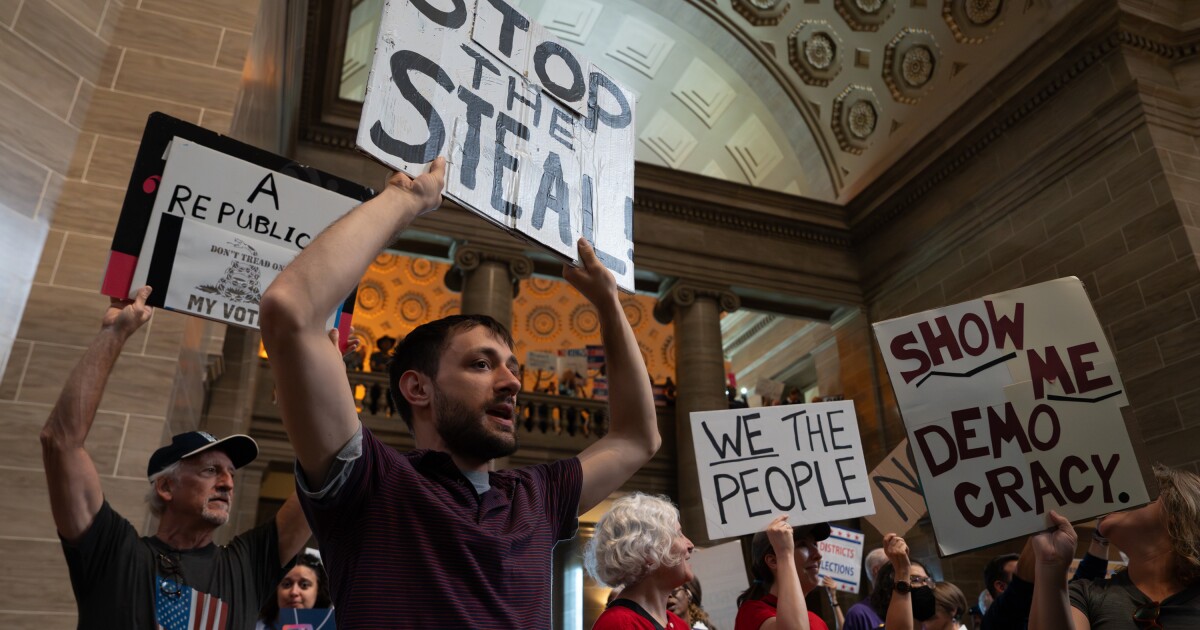
The referendum campaign, backed by the group People Not Politicians, has added another layer of complexity to the dispute. The campaign submitted signatures last week, which, according to the group’s representatives, has stopped the new congressional map from being active. They point to Missouri Constitution language and prior court decisions, as well as the precedent set by then-Secretary of State Jay Ashcroft, who prevented a right-to-work law from going into effect after unions submitted signatures to put it up for a statewide vote. The group’s executive director, Richard von Glahn, argues that the law is suspended until the secretary of state issues a certificate of sufficiency or insufficiency.
The Federal Court Fight
The dispute over the status of the new map has led to a federal court fight, with Attorney General Catherine Hanaway’s lawsuit at the heart of the controversy. Hanaway’s suit, which was dismissed by U.S. District Judge Zachary Bluestone, challenged the constitutionality of the referendum. However, the dismissal has not resolved the issue, with the state’s solicitor general, Louis Capozzi, seeking sanctions against the referendum campaign’s attorneys. Capozzi argues that the attorneys have made concessions in court that contradict their public statements, and that this conduct is "dishonorable and unethical."
The Solicitor General’s Request for Sanctions
Capozzi’s request for sanctions has been met with resistance from the referendum campaign’s attorneys, who argue that they have not made any concessions that contradict their public statements. The attorneys, Chuck Hatfield and Jessica Amunson, have refused to retract their statements, contending that Capozzi is mischaracterizing their comments during the hearing. The dispute has escalated, with von Glahn describing the solicitor general’s actions as an "aggressive escalation" against the rights of Missourians to engage freely in the political process.
Implications for the 2026 Midterm Elections
The outcome of the dispute has significant implications for Missouri’s 2026 midterm elections. If the new map is frozen due to the submission of signatures, it is unlikely that the new lines will go into effect next year. The deadline to verify signatures is roughly a week before the 2026 primary elections, and there is U.S. Supreme Court precedent against changing district lines close to when people vote. The dispute highlights the complexities and challenges of the redistricting process, with the fate of Missouri’s congressional map hanging in the balance.